If you are paid every two weeks, a monthly budget often feels wrong. Rent is due on the 1st whether payday falls on the 2nd or the 12th, and some months bring two paychecks while others bring three. A biweekly budget fixes that mismatch by planning each paycheck on its own, instead of pretending your income arrives once a month.
Biweekly pay is not the same as twice a month
Biweekly pay arrives every 14 days, on the same weekday. Semi-monthly pay arrives twice a month, usually on the 1st and 15th. The difference matters: biweekly pay gives 26 paychecks in a year, while semi-monthly pay gives 24.
Because 52 weeks divided by 2 is 26, most months bring two paychecks and two months bring three. In some years, depending on your payday calendar, you may see 27 paychecks. The extra checks are not a bonus from your employer. They are your normal pay, arriving on a schedule that does not line up with calendar months.
Step 1: Use take-home pay, not gross pay
Start with the amount that actually reaches your bank account after tax, retirement contributions, and other deductions. If your paycheck varies with overtime or hours, use the lowest recent paycheck as your planning number. A plan built on a low check still works in a good month; a plan built on a high check fails in a short month.
Next, list every bill with its amount and due date, plus regular living costs such as groceries, gas, and household supplies. Check last month’s bank statement for anything missing, including yearly bills such as car registration.
Step 2: Assign every bill to a paycheck
The core rule is simple: each bill is paid from the last paycheck that arrives before its due date. Bills due between the 3rd and the 16th come from the first check of the month. Bills due from the 17th through the 2nd of next month come from the second check.
Here is how that rule looks on $1,850 checks, with rent of $1,200 split in half across the two checks:
| Paycheck A | Amount | Paycheck B | Amount |
|---|---|---|---|
| Rent (first half) | $600 | Rent (second half) | $600 |
| Car payment | $340 | Car insurance | $150 |
| Electric bill | $110 | Internet | $70 |
| Phone | $60 | Groceries (2 weeks) | $280 |
| Groceries (2 weeks) | $280 | Gas (2 weeks) | $130 |
| Gas (2 weeks) | $130 | Savings | $100 |
| Savings | $100 | Card minimum | $75 |
| Personal and buffer | $230 | Household | $125 |
| Personal and buffer | $320 | ||
| Total | $1,850 | Total | $1,850 |
Notice that savings appears in both checks. Saving $100 per check builds $2,600 over a year. If that is too much at first, start with $25 or $50 per check.
Each check also ends with a personal and buffer line. That money covers small costs that do not fit a category, and it stops the plan from failing on the first unexpected $40 expense. If the buffer is left over, move it to savings or to a debt payment.
How the 26-check math works
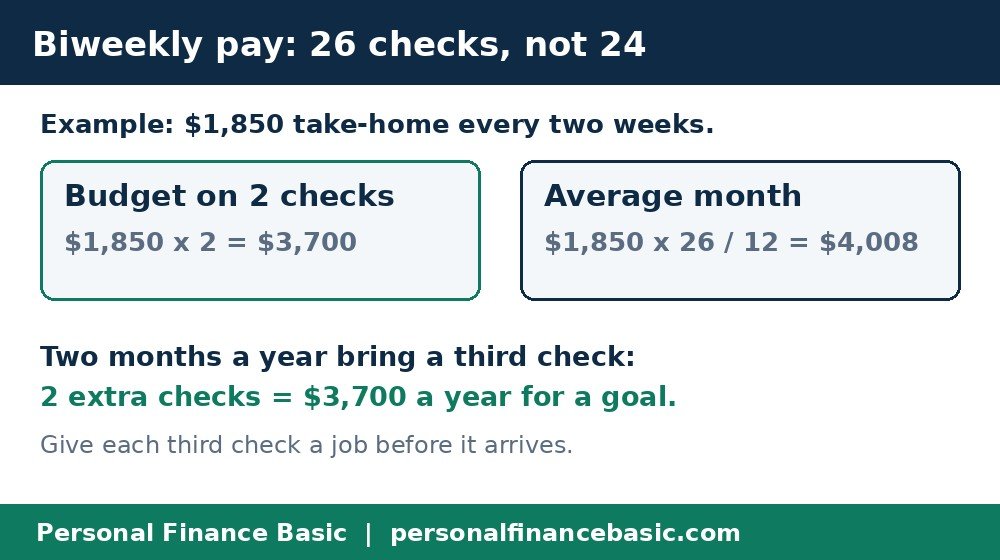
Budget on two checks a month. The two extra checks each year are then free for a goal, instead of covering regular bills.
A monthly budget built on 26 paychecks divided by 12 assumes $4,008 a month on a $1,850 paycheck. That average is correct over a year, but in a two-paycheck month you only receive $3,700, so budgeting on the average leaves you $308 short in ten months of the year. Over a year, the full 26 checks bring $48,100, so the two extra checks add $3,700. That is the money that disappears when a monthly budget spends the average every month.
Step 3: Give every third check a job in advance
Two months a year, a third paycheck lands in the same month. Decide now what it is for, before it arrives. Common choices include a starter emergency fund, a lump payment on a credit card, or a sinking fund for a yearly bill.
One third check of $1,850 could be split as $1,000 to an emergency fund, $600 to a credit card balance, and $250 to personal spending. Two such checks a year move $2,000 into emergency savings and $1,200 off a card balance. Mark the three-paycheck months on a calendar at the start of the year, using your employer’s schedule.
Step 4: Set aside money for yearly bills
Yearly bills feel like emergencies only because no money was set aside for them. Divide each yearly bill by 26 and save that slice from every check: a $1,200 insurance bill needs about $46 per check. Keep this money in a separate savings account, called a sinking fund, so it is not spent as checking money.
Mistakes that break a biweekly budget
The most common mistake is budgeting on the yearly average of $4,008 instead of the two-check figure of $3,700. A second mistake is paying all the bills from the first check and living on what is left from the second, which leaves the second half of the month thin and pushes spending onto a credit card. Splitting bills across both checks, and splitting rent in half, keeps both halves workable.
A third mistake is treating the third check as free money. Without a job assigned in advance, it usually goes to spending that leaves no trace by the next payday. Finally, do not skip the buffer. A plan with no room for a $40 cost fails at the first $40 cost. A $100 to $200 buffer in checking, treated as off limits for routine spending, absorbs small surprises without touching savings or a card.
Putting it together this week
On your next payday, write down your take-home pay, assign each bill to the paycheck that arrives before it is due, and set an automatic savings transfer for the day after payday, even if it starts at $25. Review after two pay periods and move a bill if one check is always tight.
At a glance
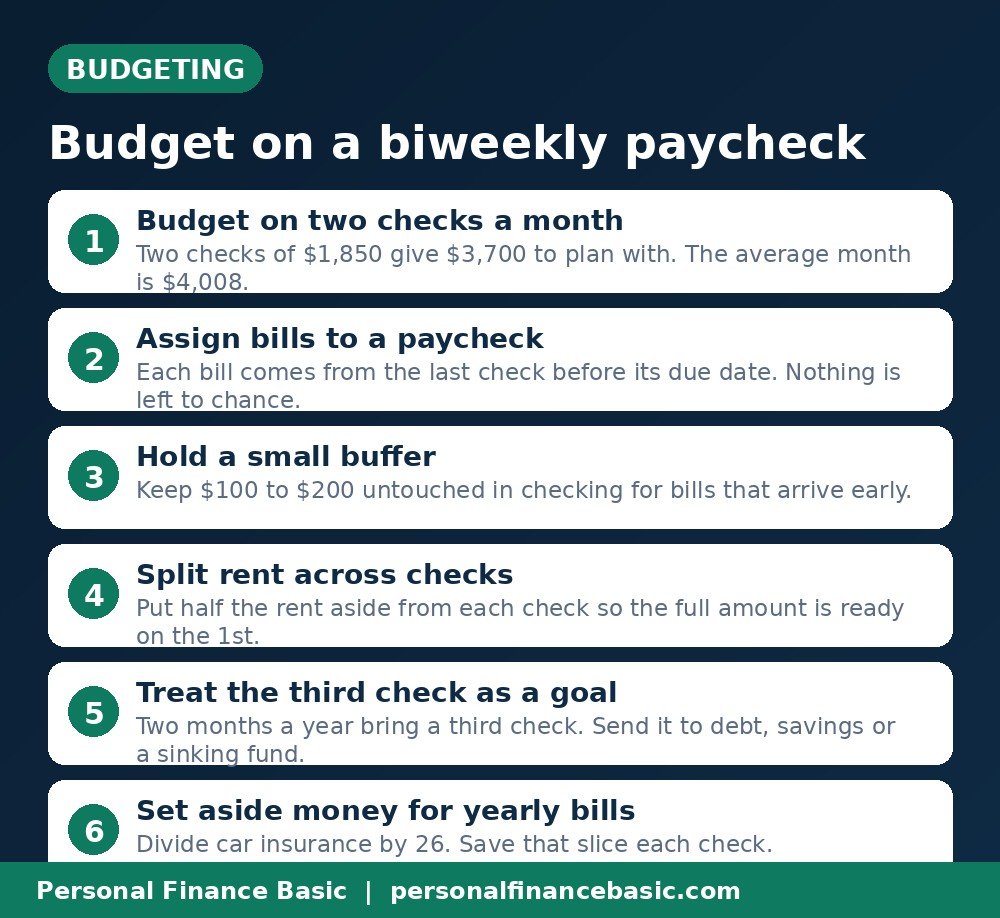
The main points from this guide, in one picture.
Frequently asked questions
How many paychecks do you get if you are paid biweekly?
Usually 26 paychecks a year, because 52 weeks divided by 2 is 26. Most months have two paychecks and two months have three. Some schedules produce 27 paychecks, depending on the weekday of your first payday.
Should I budget on two paychecks or on the monthly average?
Budget on two paychecks. On $1,850 checks, that gives $3,700 a month to plan with. The monthly average of $4,008 overstates income in every two-paycheck month, which is most months.
What should I do with a third paycheck?
Give it a job before it arrives. Send it to an emergency fund, a debt payment, or a sinking fund for a yearly bill. A split between a goal and a small amount of personal spending works well if the split is decided in advance.
How do I handle rent if payday falls after the 1st?
Split rent in half and set aside one half from each check. By the 1st, the full amount is ready even if the most recent paycheck arrived late in the previous month.
Is biweekly pay the same as getting paid twice a month?
No. Twice a month, or semi-monthly pay, arrives on fixed dates such as the 1st and 15th and gives 24 paychecks a year. Biweekly pay arrives every 14 days and gives 26 paychecks a year, with two three-paycheck months in most years.
This guide is general education, not financial or tax advice. Pay schedules, tax withholding, and benefits vary by employer and state, so check your own pay stub and employer schedule when you set up your plan.
Related reading: How to make a budget for beginners (step by step) and The 50/30/20 budget rule, explained with examples