Paying only the minimum on a credit card feels like handling the bill. The payment goes out on time, no late fee appears, and the account stays in good standing. The problem is what the minimum does not do: it is not designed to clear the debt in a reasonable time. On a typical card, most of the early minimum goes to interest, and the payment shrinks as the balance falls, which stretches the payoff out for years.
That does not make the minimum useless. It is the floor that keeps you current. The mistake is treating the floor as the plan. Once you see how the numbers work, one change, a fixed payment you choose yourself, usually cuts years off the payoff.
What the minimum payment actually is
The minimum is the smallest amount the issuer will accept for that billing cycle to keep the account current. The most common formula in the United States is 1% of the balance plus that month’s interest and fees, with a dollar floor, often $25 to $35, that applies when the percentage comes out lower. Some cards instead charge a flat percentage of the balance, often 2% to 4%. Your card agreement states the exact formula, and your statement shows the amount due.
Two features of the formula matter. First, the interest for the month is part of the payment, so only the remainder reduces the balance. Second, because the formula is tied to the balance, the minimum falls as the balance falls. A payment that starts at $150 can end up at $40 near the end of the payoff. That shrinking payment is the main reason minimum-only payoffs take so long.
The math on a $5,000 balance
Take a $5,000 balance at 24% APR, with no new spending and no fees, under the 1%-plus-interest formula with a $35 floor. The first month adds about $100 in interest. The first minimum is about $150, so only about $50 of it reduces the balance. Month after month, the same pattern repeats: interest takes a large share, the balance falls slowly, and the minimum falls with it.
Paying only the minimum in this example takes about 201 months, or close to 17 years, and costs about $8,442 in interest. That is more than the original balance, paid again in interest alone, for a total of about $13,442. These figures are a worked example at one APR and one formula, not a promise for any card.
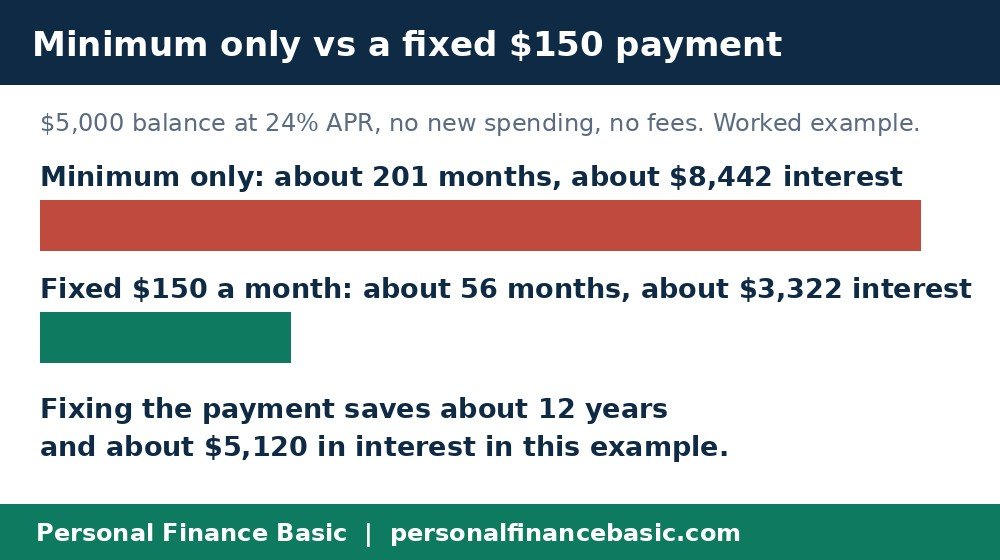
A fixed payment clears the same balance far sooner than a shrinking minimum. Figures are a worked example at one APR, not a promise for any card.
Why the balance barely moves at first
Credit card interest is charged on the balance, so a large balance generates a large interest charge each month. At 24% APR, the monthly rate is 2%, so every $1,000 of balance adds about $20 in interest per month. On $5,000, that is about $100. Until the payment rises well above the monthly interest, the balance can only creep down.
This is also why new spending is so damaging during a payoff. A $200 purchase does not just add $200 to the debt. At 24% APR it adds about $4 a month in interest, and on minimum payments it can take years to clear on its own. While you are paying a balance down, daily spending belongs on cash or a debit card.
Read the warning box on your statement
United States card statements carry a minimum payment warning, required by federal rules. It shows two numbers for your actual balance: how long it takes to pay off if you make only minimum payments, and the monthly payment that would clear the balance in 36 months. If you have never read that box, read it on your next statement.
The 36-month figure is a useful default if you can afford it. If not, a smaller fixed payment still helps a lot.
The one change that matters: fix your payment
Take the first minimum and freeze it as your payment for the whole payoff. On the $5,000 example, the first minimum is about $150. Paid as a fixed $150 every month, the same balance clears in about 56 months, under five years, with about $3,322 in interest. Compared with minimum-only payments, that saves about 12 years and about $5,120 in interest.
Start with your current minimum, round it up to the next $25 or $50, and raise it when a bill drops or your pay rises. Pay the minimum on every card first, every month, on time. Then send all extra money to one card, usually the one with the highest APR, since that saves the most interest.
When paying only the minimum is the right call
There are months when the minimum is the best you can do, and that is fine. If money is tight, paying the minimum on time beats missing a payment, because it avoids a late fee and a damaged payment record. A short stretch of minimum payments during a job loss or a medical bill is a holding pattern, not a failure. The risk is only when the holding pattern becomes the plan by default, month after month, for years.
If even the minimum is out of reach, call the issuer before the due date and ask about a hardship program. Many issuers can lower the APR or the payment for a set period, often 6 to 12 months. A nonprofit credit counselor can also review your budget and explain a debt management plan. Look for an agency that belongs to the National Foundation for Credit Counseling and explains its fees in writing before you sign anything.
At a glance
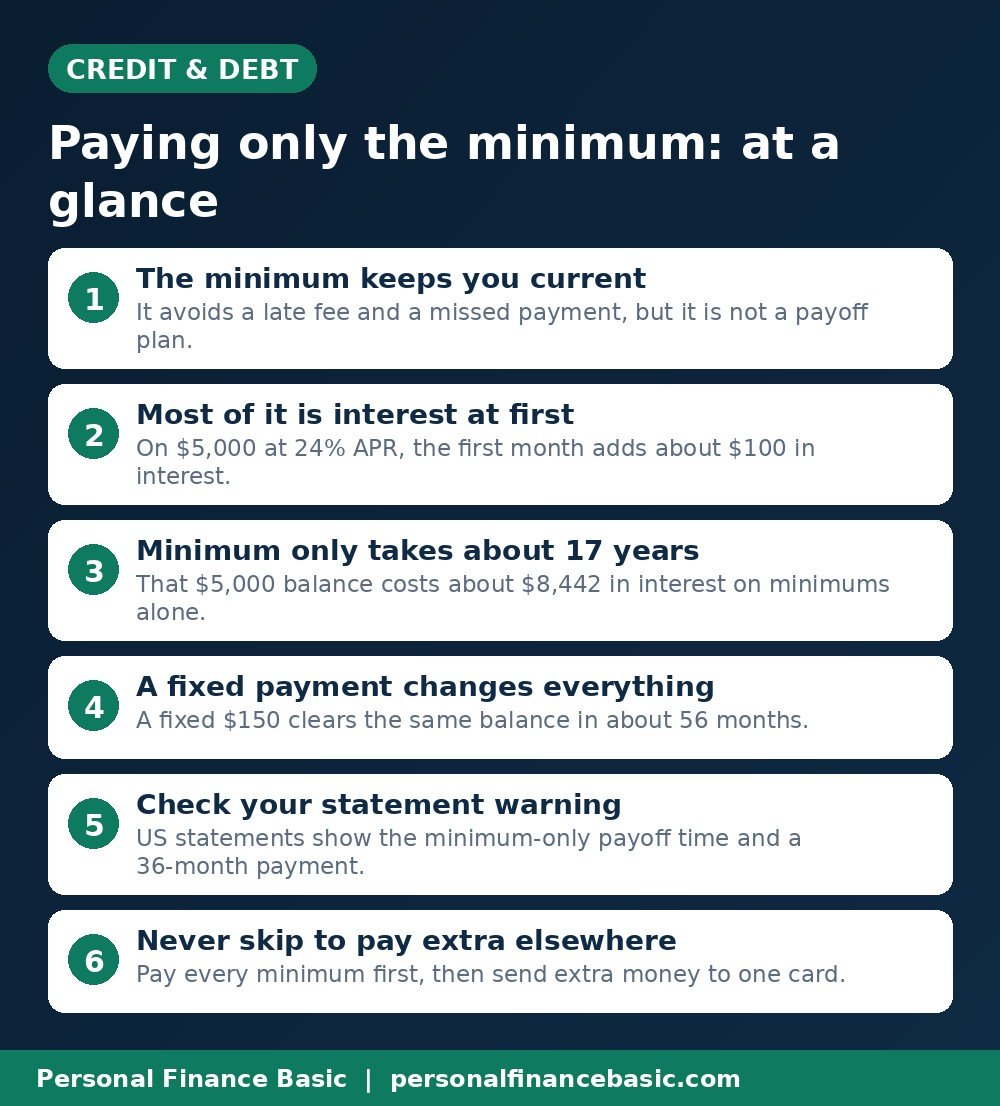
The main points from this guide, in one picture.
Frequently asked questions
Does paying only the minimum hurt my credit score?
Paying the minimum on time does not hurt your score the way a missed payment does. A high balance relative to your credit limit can still hold your score down, but on-time minimum payments protect payment history, the largest FICO factor.
How long does it take to pay off a card with minimum payments?
It depends on the balance, the APR, and the issuer’s formula. On a $5,000 balance at 24% APR under the common 1%-plus-interest formula, minimum-only payments take about 201 months and cost about $8,442 in interest. Your statement’s minimum payment warning gives the figure for your actual balance.
Is a fixed payment really that much better?
Yes. In the $5,000 example, a fixed $150 a month clears the balance in about 56 months with about $3,322 in interest, saving about 12 years and about $5,120 compared with minimum-only payments. The payment does not shrink, so more of each payment reaches the balance as interest falls.
Should I pay the minimum on all cards or extra on one card?
Do both: pay the minimum on every card, on time, then send all extra money to one card. Sending extra to the highest APR card saves the most interest. Sending extra to the smallest balance first gives a faster win. Either method works if you keep paying.
What if I cannot even pay the minimum?
Contact the issuer before the due date about a hardship program, or speak with a nonprofit credit counselor. Do not ignore the bill, since a missed payment adds fees and can damage your credit record.
This guide is general education, not financial or tax advice. Your card terms, rates, and options depend on your issuer and your situation. If debt feels unmanageable, speak with a nonprofit credit counselor or a qualified financial professional about your own case.
Related reading: How to Pay Off Credit Card Debt on a Low Income and What Is a Good Credit Score in the US?