Most budgets assume the same paycheck every two weeks. That works if your pay never changes. It does not work if you freelance, drive for a delivery app, work on commission, get tips, or pick up seasonal work. In a good month the budget feels easy, and in a slow month it falls apart.
The fix is to budget on your lowest month instead of your average. A budget built on the lowest month still works when income drops, and good months become a bonus, not a rescue.
Start with your lowest month, not your average
Take a freelancer named Maya. She designs websites, and her income over the last six months was $2,400, $3,100, $2,600, $3,800, $2,900 and $3,500. Her average month is $3,050. Her lowest month is $2,400.
If Maya budgets on the $3,050 average, she is short in three months out of six. Built on $2,400, the budget works every month, and the extra money in good months goes into savings.
To find your own lowest month, look at the last 6 to 12 months of income, using bank deposits or pay records, not memory. If one month was unusually low because you were sick or took time off, use the second-lowest month instead.
The table below shows Maya’s six months. The average looks comfortable. The lowest month is the number that matters.
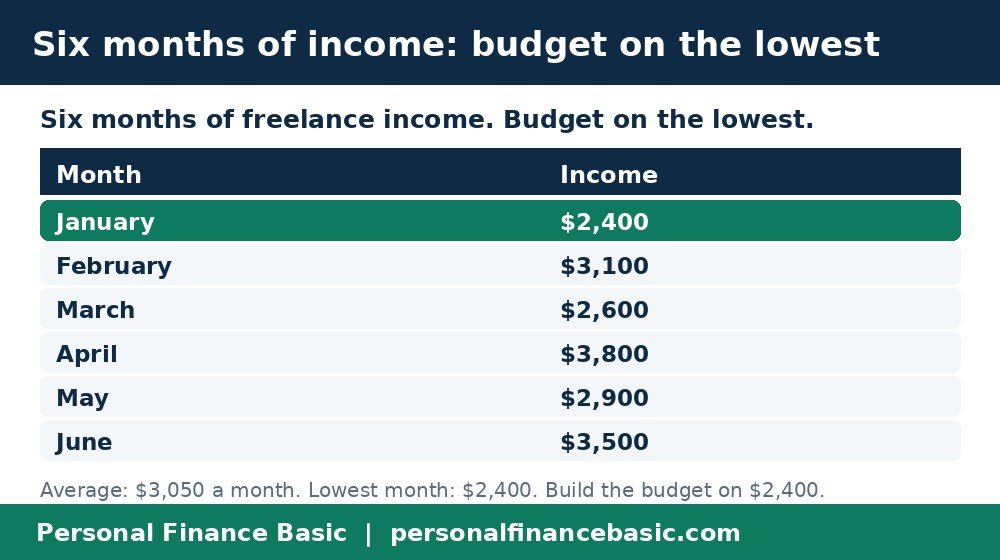
Six months of freelance income. The average is $3,050, but the budget is built on $2,400.
Build the baseline budget
The baseline budget covers the costs you cannot skip, using only your lowest month’s income: rent, utilities, phone, insurance, transport, groceries and minimum debt payments. These are the bills that must be paid even in a slow month.
Maya’s baseline on $2,400: rent $1,100, groceries $350, transport $150, utilities and phone $180, insurance $120, minimum debt payments $100, and personal spending $100. That adds up to $2,100, leaving $300 in her lowest month.
Keep the baseline lean. This is not the budget for a good month. It is the budget that keeps the lights on when work slows down. Eating out, streaming services and new clothes sit outside the baseline. They get funded from good months, not from the baseline.
If your baseline costs are higher than your lowest month’s income, that is useful information. It means the fixed costs need attention: a cheaper phone plan, or a lower rent at the next move.
The buffer: how good months pay for slow ones
The buffer is a separate savings account that holds one month of baseline costs. Its only job is to cover the months when income drops below the baseline. It is not an emergency fund, and it is not savings for a holiday. It is working money that smooths out the ups and downs.
Here is how it works for Maya. Her baseline costs are $2,100 a month. In April she earns $3,800, $1,700 above her baseline, so that extra goes into the buffer. If a month ever comes in at $1,800, the buffer covers the $300 shortfall.
Build the buffer before you save for anything else. The first goal is one month of baseline costs, $2,100 for Maya, then three months, or $6,300. After that, extra income can go to other goals.
Keep the buffer in a separate account from your spending money. If it sits in your checking account, it will get spent. Move money into it on payday, the same day the income arrives.
If you are self-employed, set tax money aside first
If you work for yourself, no employer takes tax out of your pay. Self-employment tax is 15.3 percent of your net profit, made up of 12.4 percent for Social Security and 2.9 percent for Medicare. It applies to 92.35 percent of your net profit, and it is separate from income tax.
A common rule is to set aside 25 to 30 percent of each payment for taxes. On a $4,000 payment, that means moving $1,000 to $1,200 into a separate tax account the day the money arrives. The 15.3 percent self-employment tax alone takes a large share, and income tax takes more, so 25 percent is a starting point, not a guarantee.
The IRS expects estimated tax payments four times a year, on April 15, June 15, September 15 and January 15. If you expect to owe $1,000 or more for the year, you generally need to pay in these quarterly instalments to avoid penalties. Setting the money aside with each payment means the bill is covered when the date arrives.
Give every good month a job
When a good month arrives, decide where the extra money goes before you spend it. First, top up the buffer if it is below your target. Second, fund your savings goals. Third, pay extra toward debt, starting with the highest interest rate.
This order protects you. If the extra money goes to debt first and the buffer is empty, the next slow month forces you back onto a credit card.
Split each payment the day it arrives. Tax money goes to the tax account first, baseline money goes to checking, and everything left over goes to the buffer until it is full.
What to do when a month comes up short
Even with a good plan, a bad month happens. When it does, use the buffer first. Then cut the flexible spending: cook at home, pause subscriptions, and delay any spending that can wait a month.
Keep paying the minimums on every debt. A missed payment hurts your credit score and adds fees. If the shortfall is large, call the lender before the due date. Some will move a due date or offer a short hardship plan, and asking costs nothing.
Look for a quick way to add income in the same month: an extra shift, a small job, or selling something you no longer use. A few hundred dollars can be the difference between using the buffer and going into debt.
At a glance
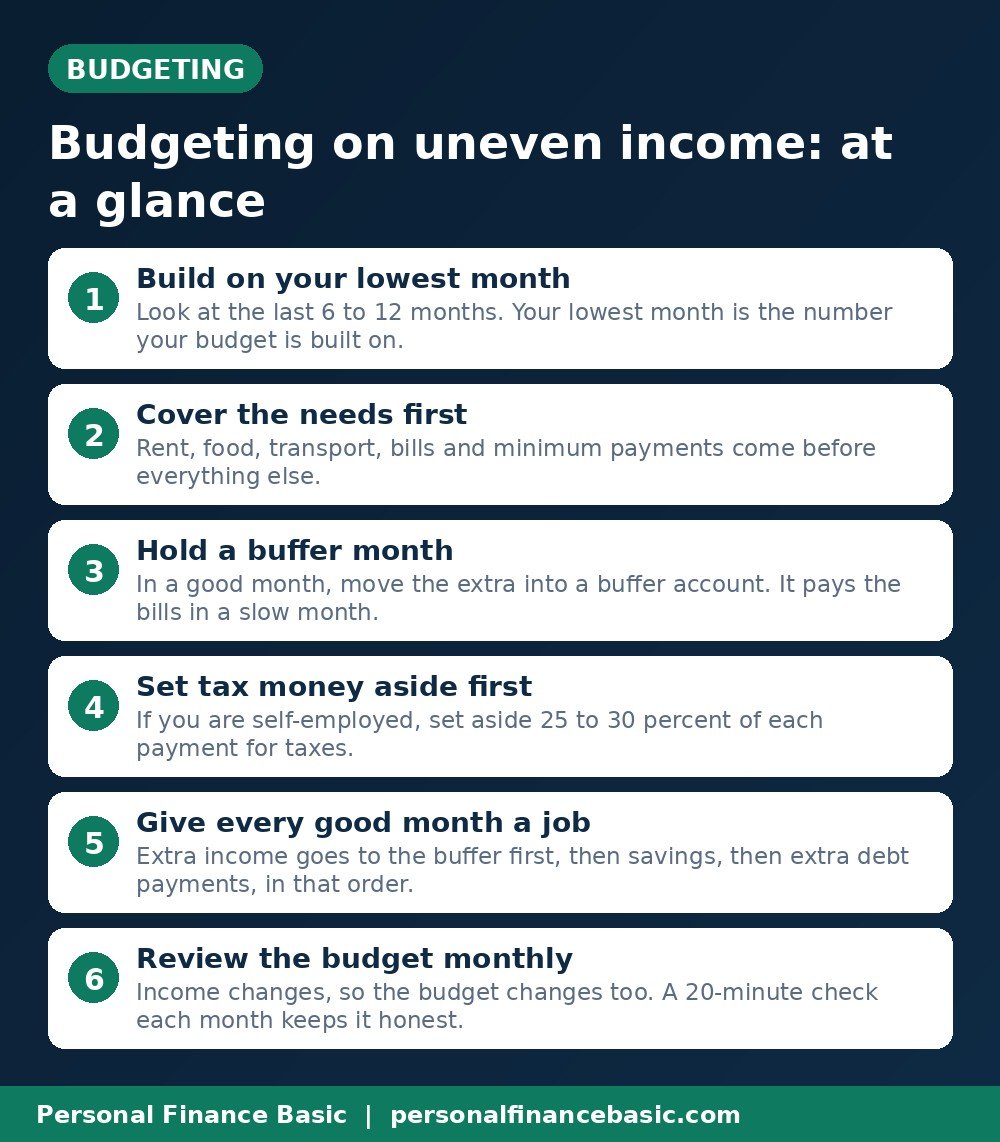
The main points from this guide, in one picture.
Frequently asked questions
How do I budget if my income is different every month?
Find your lowest normal month from the last 6 to 12 months and build your budget on that number. Cover the fixed costs first, keep a buffer account for slow months, and treat good months as a bonus.
How much should I keep in a buffer account?
Start with one month of baseline costs, then build toward three months. For Maya that means $2,100 first, then $6,300.
What percentage should I set aside for taxes if I am self-employed?
A common rule is 25 to 30 percent of each payment. Self-employment tax alone is 15.3 percent, and income tax is on top of that. Put the money in a separate account the day each payment arrives, and pay the IRS in quarterly instalments.
Should I pay off debt or build a buffer first?
Build the buffer first. Keep paying the minimums on your debts, but send extra money to the buffer until it holds at least one month of costs. Without a buffer, the next slow month can push you back onto a credit card.
What if my lowest month does not cover my fixed costs?
That means the fixed costs need to change, not the budget. Look at the largest fixed costs first: rent, car costs and insurance. A cheaper phone plan helps, but it will not close a large gap.
This guide is general education, not financial or tax advice. The right amounts depend on your income, costs, and goals. Consider speaking with a qualified financial adviser or tax professional about your own situation.
Related reading: How to Budget on a Biweekly Paycheck and Sinking Funds: What They Are and How to Start One