Your card never says no. You tap it for coffee, tap it for groceries, tap it at the gas station, and by the end of the month you have spent $400 more than you planned and you cannot say where it went.
Cash envelope budgeting is the old fix for that problem. You put a set amount of cash in an envelope for each type of spending, and when the envelope is empty, you stop. It worked when cash was how most people paid. Does it still work now? Cash was only 14% of US payments in 2024, according to the Federal Reserve’s 2025 Diary of Consumer Payment Choice, down from 31% in 2016.
Here is how it works today, what it costs, where it breaks, and how to run a version of it without giving up your cards.
The short answer
Yes, it still works, but only for the spending you can control week to week. Cash makes spending visible: you can see the envelope getting thinner. A card hides the running total until the statement arrives, and by then the money is gone.
The quick framework:
- List the flexible spending you control each week: groceries, dining out, gas.
- Set a monthly cash amount for each category, based on what you actually spend.
- Withdraw the total on payday and fill the envelopes.
- Spend only from the envelopes for those categories.
- When an envelope is empty, stop spending in that category or move money from another envelope on purpose.
Quick decision guide:
- Overspend mostly on groceries and eating out? Envelopes will help most there.
- Already track every dollar in an app and stick to it? Envelopes add little.
- Hate carrying cash or pay mostly online? Use the hybrid version in Step 5 instead.
Step 1: Pick the right categories
Only flexible spending goes in envelopes: the categories where the amount changes week to week and you decide each purchase, such as groceries, dining out, fun money, gas and household items.
Fixed bills stay in the bank. Rent, utilities, loan payments, insurance and subscriptions do not belong in envelopes. They are the same amount every month, and most are paid by autopay anyway.
- Best for: groceries, dining out, fun money and gas, the categories where small daily choices add up.
- Not for: rent, bills, loan payments or anything you pay online.
Step 2: Set honest amounts with a real example
Take Maya, who brings home $3,000 a month. Her envelopes look like this: groceries $600, dining out $200, fun money $150, gas and transport $180, household items $100. That is $1,230 in cash envelopes, or 41% of her pay. The other $1,770 stays in the bank for rent, bills and savings.
Each envelope also has a weekly amount. Groceries are $150 a week. Dining out is $50 a week. Fun money is about $38 a week. If Maya spends $190 on groceries in week one, she has $410 left for the other three weeks, or about $137 a week. The envelope does the math for her.
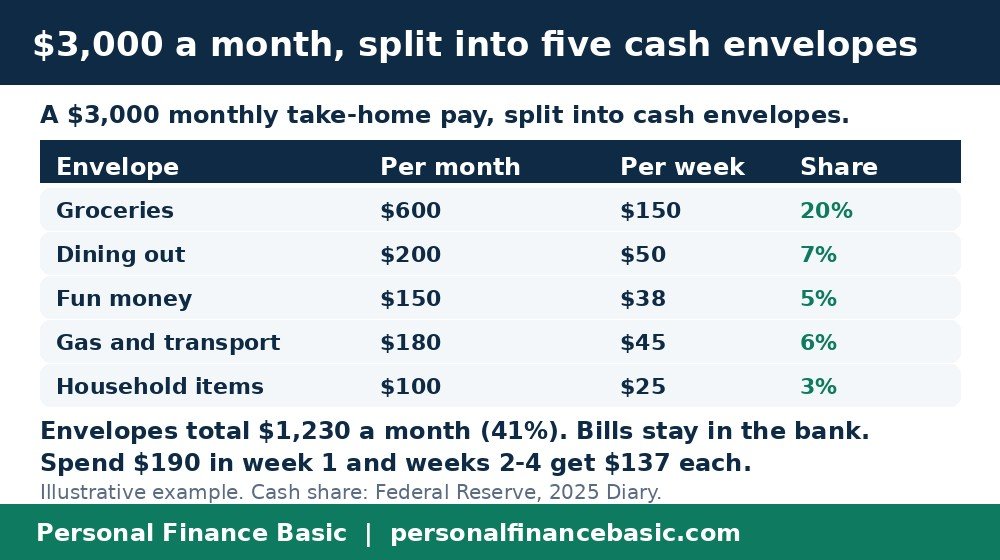
$3,000 a month, split into five cash envelopes. Fixed bills stay in the bank.
Track your real spending for one month first, then set each envelope to that number, rounded down slightly. If you spent $640 on groceries last month, a $600 envelope is a stretch. A $450 envelope is a fantasy.
- Best for: anyone whose spending drifts $100 or more above plan in the same categories every month.
- Not for: a month with unusual costs, such as a holiday or a car repair. Set those aside separately.
Step 3: Run the week on cash
Withdraw the envelope cash on payday, in one trip. Money in the bank feels available. Money in an envelope feels spent already.
Keep the envelopes separate from your other money, so you cannot spend them by accident. When an envelope is empty, you have three honest choices: stop spending in that category, move cash from another envelope and accept the trade, or break the rule and use a card. The third choice kills the system. Break it more than once a month and the envelopes are decoration.
Leftover cash at month end is the reward. Move it to savings, or roll it into next month’s fun money envelope.
Step 4: Know what it costs in a card world
The biggest cost is card rewards. If you earn 2% back on card spending, moving $1,230 a month to cash gives up about $24.60 a month, or about $295 a year. That is the price of the system for Maya, and it is worth paying only if the envelopes save her more than $295 a year.
Cash is also harder to use online. Subscriptions, online orders and bill splitting with friends all need a card or an app. Cash also carries a small risk of loss or theft, and it earns no interest while it sits in an envelope.
| Method | Cost | When you notice overspending | Effort | Best for |
|---|---|---|---|---|
| Cash envelopes | About $295 a year in lost rewards | At the checkout | One withdrawal a month | People who overspend in set categories |
| Budgeting app | Free to a monthly fee | When you check the app | Daily logging or linking accounts | People who like data and check often |
| No system | Nothing up front | When the statement arrives | None | No one, for long |
Illustrative. The rewards figure assumes 2% back on $1,230 a month.
Step 5: Try the hybrid version
You do not have to go all cash. The hybrid version keeps the best of both: cash for the two or three categories where you overspend most, and cards for everything else.
Maya might keep cash envelopes only for groceries and dining out, at $800 a month, and pay the rest by card. She still gets the visible limit where it matters, and she keeps her rewards on the rest. When the grocery envelope is empty, she stops, even though the card is in her wallet.
- Best for: anyone who pays mostly by card but overspends in one or two categories.
- Not for: spending you cannot do in cash, such as online shopping and subscriptions.
At a glance
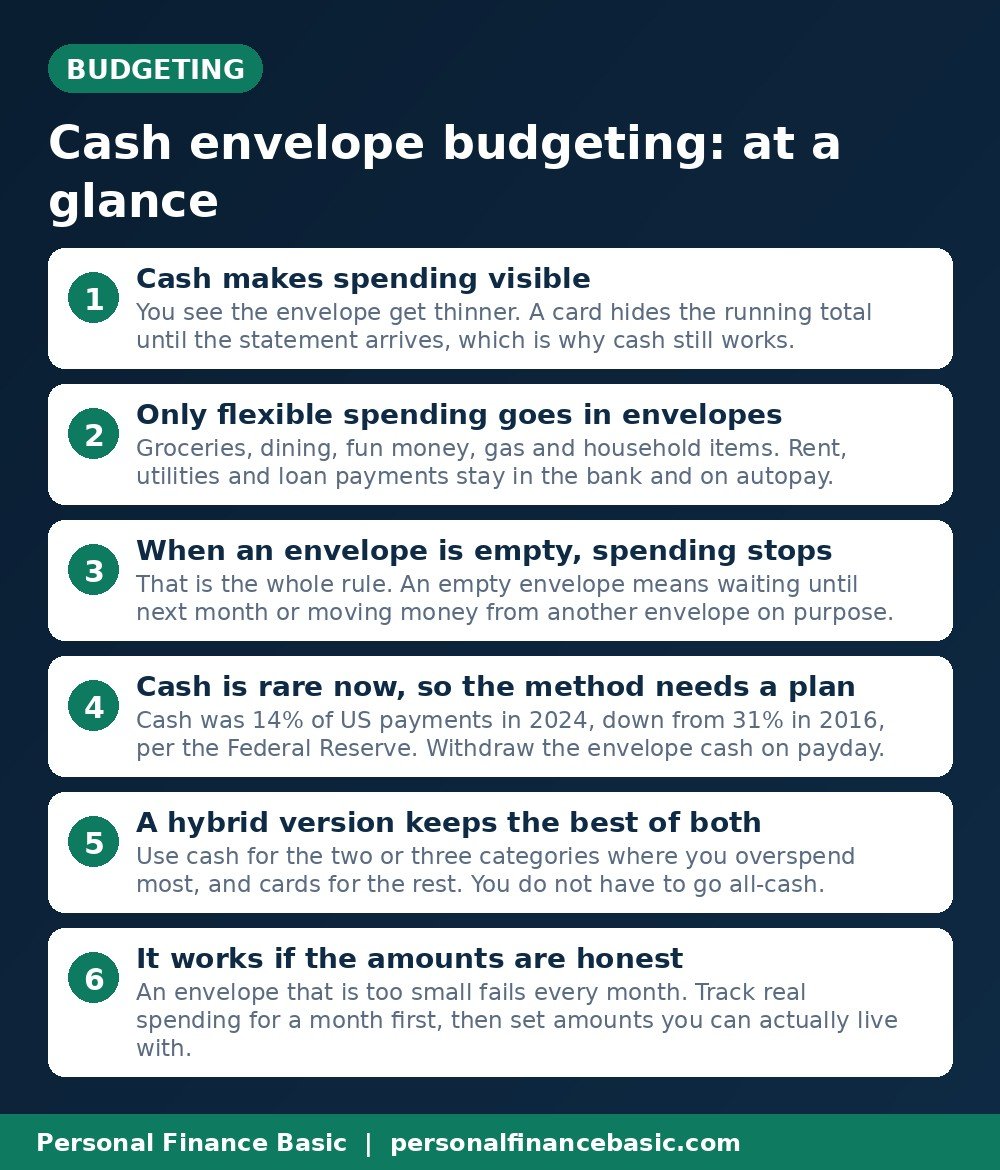
The main points from this guide, in one picture.
Frequently asked questions
Does cash envelope budgeting still work if I mostly pay by card?
Yes, in a hybrid form. Use cash for the one or two categories where you overspend most, and keep paying by card for the rest.
How much cash should I put in each envelope?
Start with what you actually spent last month, rounded down slightly. If you spent $640 on groceries, try $600.
What do I do when an envelope runs out early?
Stop spending in that category, or move cash from another envelope and accept the trade. Using a card to cover the gap breaks the system.
Is it safe to carry that much cash?
Take out one week at a time instead, or keep the envelopes at home and take only what you need for the day. Lost cash is gone, unlike a lost card you can freeze.
Do I lose credit card rewards with envelopes?
Yes, on whatever you move to cash. At 2% back, $1,230 a month costs about $295 a year. The system is worth it only if it saves you more than that.
The bottom line: cash envelope budgeting still works, because the problem it solves has not changed. Cards hide the running total, and cash shows it. Use envelopes for the spending that drifts, keep cards for the rest, and set amounts you can actually live with.
This post is general education, not financial advice. The $3,000-a-month example is illustrative; your own amounts will differ.
Related reading: The 50/30/20 Rule With US Examples ($3,000 a Month) and Sinking Funds: What They Are and How to Start One