
You and your partner split the rent, the utilities and the groceries. One of you pays, the other pays you back, and every month someone is owed $137.42 and nobody remembers why. A joint bank account ends that dance: both of you put money in and pay bills from it.
It also hands your partner full access to the money: either owner can withdraw the whole balance. The FDIC covers joint accounts at $250,000 per co-owner, so a couple’s joint accounts are covered up to $500,000 at one bank. That is the trade: simple shared bills on one side, shared risk on the other.
Here is how it works, what it covers, where it goes wrong, and how to set one up so it helps instead of hurting.
The short answer
A joint bank account is a checking or savings account owned by two or more people. Both names are on it, both owners can deposit and withdraw, both get debit cards, and either owner can take out all the money without the other’s permission.
The quick framework:
- Open it together, with both owners present and ID in hand.
- Agree what the account pays for, and what stays personal.
- Fund it with enough for the shared bills, and no more than you both trust each other with.
- Check it together each month, so surprises are small and early.
- Keep a personal account each, so neither of you is ever locked out of all your money.
Quick decision guide:
- Married or living together with shared bills? A joint account for those bills usually makes life simpler.
- Just dating, or still building trust? Keep separate accounts and split bills another way for now.
- Running a household with one earner? A joint account gives the non-earner real access to the family money.
Step 1: Understand what joint ownership means
Joint ownership is full ownership for each person: you both own the whole balance, not half each. Either of you can deposit, withdraw, write checks, close the account or take out the entire balance. The bank will not stop one owner from emptying it, and will not ask the other first.
An authorized user, by contrast, can spend but does not own the money and cannot close the account. It is also different from a power of attorney, which lets someone act for you but does not make them an owner.
Most joint accounts pass to the surviving owner automatically when one owner dies, without probate. That is called a right of survivorship. Ask the bank to confirm it when you open the account, since the rule depends on the account type and your state.
- Best for: couples and family members who already trust each other with money and share regular bills.
- Not for: a new relationship, or anyone you would not trust with your whole balance.
Step 2: Know what the FDIC covers
Joint accounts get their own FDIC coverage, separate from each owner’s single accounts. The limit is $250,000 per co-owner, so a couple’s joint accounts at one bank are covered up to $500,000 in total.
Take John and Mary, the FDIC’s own example: three joint accounts totaling $600,000 at one bank. Each co-owner’s share is $300,000, since the FDIC treats joint shares as equal. That puts $50,000 of each share above the $250,000 limit, so $100,000 is uninsured.

How much FDIC cover a joint account gets.
The fix is simple: open an account at a second insured bank, or move some money into each person’s single accounts. The FDIC’s free EDIE calculator can check your mix.
Step 3: Weigh the real pros
The first pro is simple bills: one account pays the rent, the utilities, the groceries and the internet. Nobody tracks who owes whom, and nobody waits for a transfer before the electric bill is due.
The second pro is transparency: both owners see every transaction. A joint account makes the household money visible to both people, which is the basis of any shared budget.
The third pro is access in an emergency: if one partner is in hospital or traveling, the other can still pay every bill. A single account can freeze a household at the worst moment.
Step 4: Weigh the real cons
The biggest con is the same as the biggest pro: either owner can take all of it. In a breakup, one partner can empty the account before the other notices. If your partner has debts, a creditor with a court order can also reach the joint balance, even for a debt that is only theirs.
Overdrafts are shared too. If one owner overdraws the account, both owners are responsible for the fees and the negative balance. One partner’s impulse spending also shows up in the balance the other is counting on for rent.
Closing the account is not always simple either: most banks need both owners to agree, and if the relationship has broken down, that can be hard to get. That is why the account should never hold all of either person’s money.
| Setup | How bills work | Main risk | Best for |
|---|---|---|---|
| Joint account only | One pot for all bills | Either owner can take all of it | Married couples |
| Separate accounts only | Split every bill by hand | Slow; one partner can be locked out | New couples |
| Joint plus personal | Shared bills from joint, the rest personal | Needs a monthly funding habit | Most couples |
Account rules vary by bank; check yours before opening.
Step 5: Set it up the safe way
Open it together, in person, with a photo ID and Social Security number each. Decide what it is for: shared bills and groceries, not personal spending. Write the list down.
Fund it by standing transfer, not by feel. If your shared bills are $2,500 a month and you are paid biweekly, transfer $1,250 per paycheck. When the funding is automatic, the account never runs dry because someone forgot.
Keep a personal account each, with enough for a month of spending and a small cushion. Check it together once a month. Ten minutes, both of you looking at the same screen, catches problems while they are still small.
At a glance
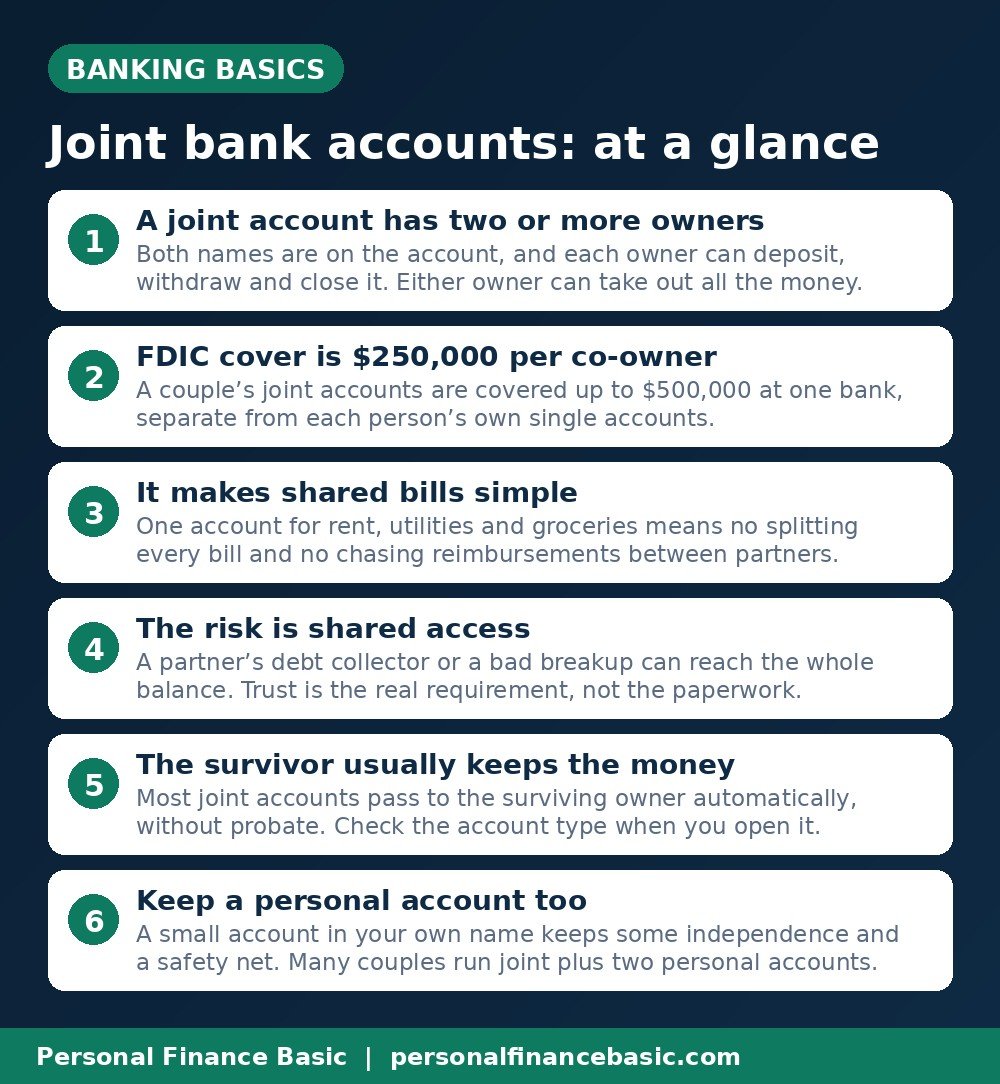
The main points from this guide, in one picture.
Frequently asked questions
Can one owner take all the money from a joint account?
Yes. Each owner can withdraw the entire balance, and the bank will not stop them. Only open one with someone you trust with the whole amount.
How much FDIC insurance does a joint account get?
Joint accounts are insured up to $250,000 per co-owner, so a couple’s joint accounts at one bank are covered up to $500,000.
What happens to a joint account when one owner dies?
Most pass to the surviving owner automatically, without probate. Ask the bank to confirm the right of survivorship when you open it.
Can a creditor take money from a joint account?
Yes, in many states a creditor with a court order for one owner’s debt can reach the joint balance. Some states protect part of the other owner’s share.
Do both owners need to be present to open a joint account?
Usually yes. Most banks need both owners in person with photo ID and a Social Security number. Some let one owner start online, but both must verify identity before it opens.
The bottom line: a joint account is the simplest way to run shared bills, and the riskiest to open with the wrong person. Open it with someone you trust fully, fund it only for shared costs, and keep a personal account each.
This post is general education, not financial or legal advice. Check with your bank and the FDIC’s EDIE calculator.
Related reading: What Is FDIC Insurance and Why It Matters and How to Open Your First Bank Account in the US