
Most budgets fail because they are too detailed. The 50/30/20 rule survives because it has only three numbers to remember. It splits your take-home pay into needs, wants, and savings, and shows at a glance whether the split is working.
This guide explains the rule, works it out for $3,000 a month in the United States, and shows how to adjust it when real life does not fit the neat percentages.
Where the rule comes from
The 50/30/20 rule was popularized by Elizabeth Warren, then a Harvard bankruptcy law professor, and her daughter Amelia Warren Tyagi in their 2005 book All Your Worth: The Ultimate Lifetime Money Plan. Their argument was simple: a budget people actually follow beats a perfect budget people abandon.
The rule divides after-tax income, the money that lands in your bank account after tax and payroll deductions, into three buckets. Needs get 50%. Wants get 30%. Savings and extra debt payments get 20%. The percentages are targets, not laws, and a starting point for spending that has drifted out of balance.
The three buckets, defined
Needs are the bills you must pay to live and work: rent or mortgage, groceries, utilities, basic phone and internet, transport to work, insurance premiums, and minimum debt payments. If you stopped paying one, you would face serious consequences, such as losing your home, transport, or coverage.
Wants are everything you choose rather than require: dining out, streaming subscriptions, a gym membership, new clothing beyond replacement basics, travel, hobbies, and gifts. Wants are not waste. The rule deliberately protects 30% for them, because a budget with no room for enjoyment rarely lasts a month.
The 20% bucket covers an emergency fund, retirement contributions, other saving goals, and any debt payment above the minimum. That last point is the one people get wrong most often: minimum payments are needs, because you must make them. Only the extra amount belongs in the 20% bucket.
The rule on $3,000 a month
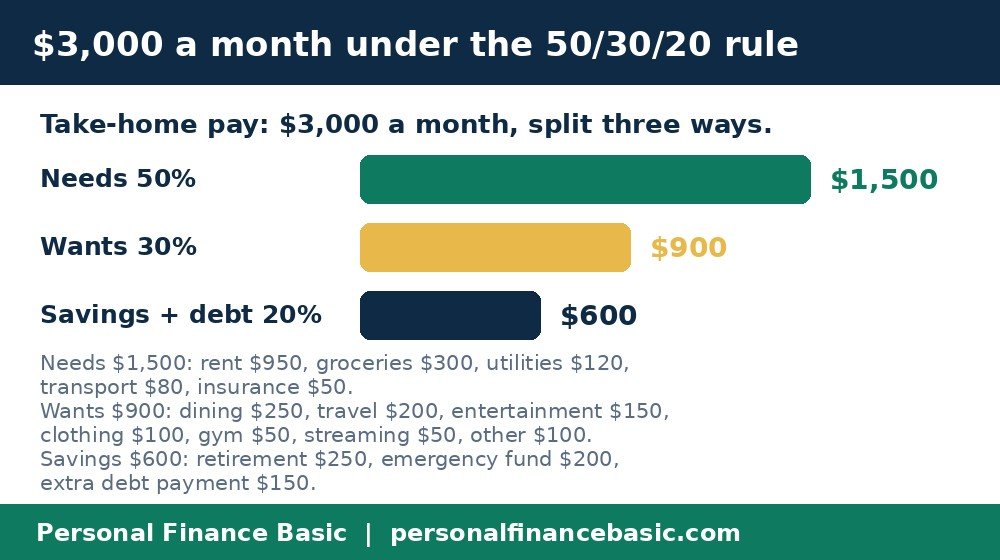
On $3,000 a month, the split is $1,500 / $900 / $600.
Take-home pay of $3,000 a month splits as follows. Needs get $1,500: rent $950, groceries $300, utilities $120, transport $80, and insurance $50. Wants get $900: dining out $250, a travel fund $200, entertainment $150, clothing $100, a gym membership $50, streaming $50, and other chosen spending $100.
Savings and debt repayment get $600: $250 to retirement, $200 to an emergency fund, and $150 as an extra payment above the minimum on a debt. The three buckets add back to $3,000. If your own numbers do not add up this cleanly, the rule has done its job: it has shown you where the gap sits.
Start from take-home pay, not gross pay
The most common mistake is applying the rule to gross pay, the salary figure before tax. If you earn $4,000 gross but take home $3,000 after tax, health insurance premiums, and retirement deductions, then 50/30/20 on $4,000 sets needs at $2,000, which is $500 more than your real income allows.
Make one adjustment: if retirement money is deducted from your paycheck, count it toward the 20% savings bucket, or the rule will understate your savings. To find your take-home figure, use actual bank deposits over the last two or three months. If your income varies, use a conservative monthly average, and treat months above it as a bonus to savings.
Sorting the borderline items
Real spending rarely sorts itself neatly. Groceries are a need, but premium snacks and prepared meals inside the grocery bill are closer to wants. A basic phone plan is a need; the latest handset upgrade is a want. A car payment for the vehicle you need for work is a need; the upgrade to a larger model is a want.
Two sorting rules help. First, ask whether you would keep paying for it if your income dropped by a third. If not, it is a want. Second, split mixed bills honestly: if grocery spending is $400 a month and about $100 is treats, record $300 as a need and $100 as a want. Debt needs the same split. A mortgage, student loan, or store card minimum is a need, because missing it damages your credit and triggers fees. The extra payment that clears debt faster belongs in the 20% bucket, and saves the most interest.
When needs pass 50%
In many US cities, rent alone breaks the rule. A $1,700 rent on $3,000 take-home pay is already 57% of income before groceries, utilities, or transport. High housing costs are the most common reason the percentages bend.
When needs pass 50%, protect the 20% savings share first and trim wants, not savings. A 60/20/20 split, with needs at 60% and wants at 20%, keeps the habit of saving alive while housing costs are high. Avoid 70/30/0, where wants stay untouched and saving drops to nothing, leaving no buffer for the next emergency.
If needs pass 60% even after trimming wants, the problem is usually structural: rent, transport, or a loan payment too large for the income. Then the useful move is a larger change, such as a cheaper home, a roommate, or a shorter commute, rather than a tighter spreadsheet. A budget rule can show you the gap, but it cannot close a gap of that size on its own.
Putting the rule into practice each month
First, write down your take-home pay and list your fixed needs. Second, set up an automatic transfer for the 20% bucket on payday, before the money can drift into wants. Third, give wants a single pot rather than a dozen small limits: one $900 wants budget is easier to track than separate limits for dining, streaming, clothing, and entertainment. When the pot runs out, wants spending stops until next month. Fourth, review once a month, for about 30 minutes: add up the three buckets from your statements, compare them with 50/30/20, and move one number for the next month.
What the rule does not cover
The rule says nothing about which savings goal comes first. An emergency fund of one month’s expenses usually comes before extra debt payments, because without it the next car repair goes back on a card. High-interest debt usually comes before long-term investing, because a 24% card rate is a cost few investments beat. Retirement matching usually comes first of all.
The rule also does not adjust for life stages: young children raise needs, near-retirement raises the savings rate needed, and a large debt may mean a temporary split until it clears. The percentages are a starting shape, not a verdict on your choices.
At a glance
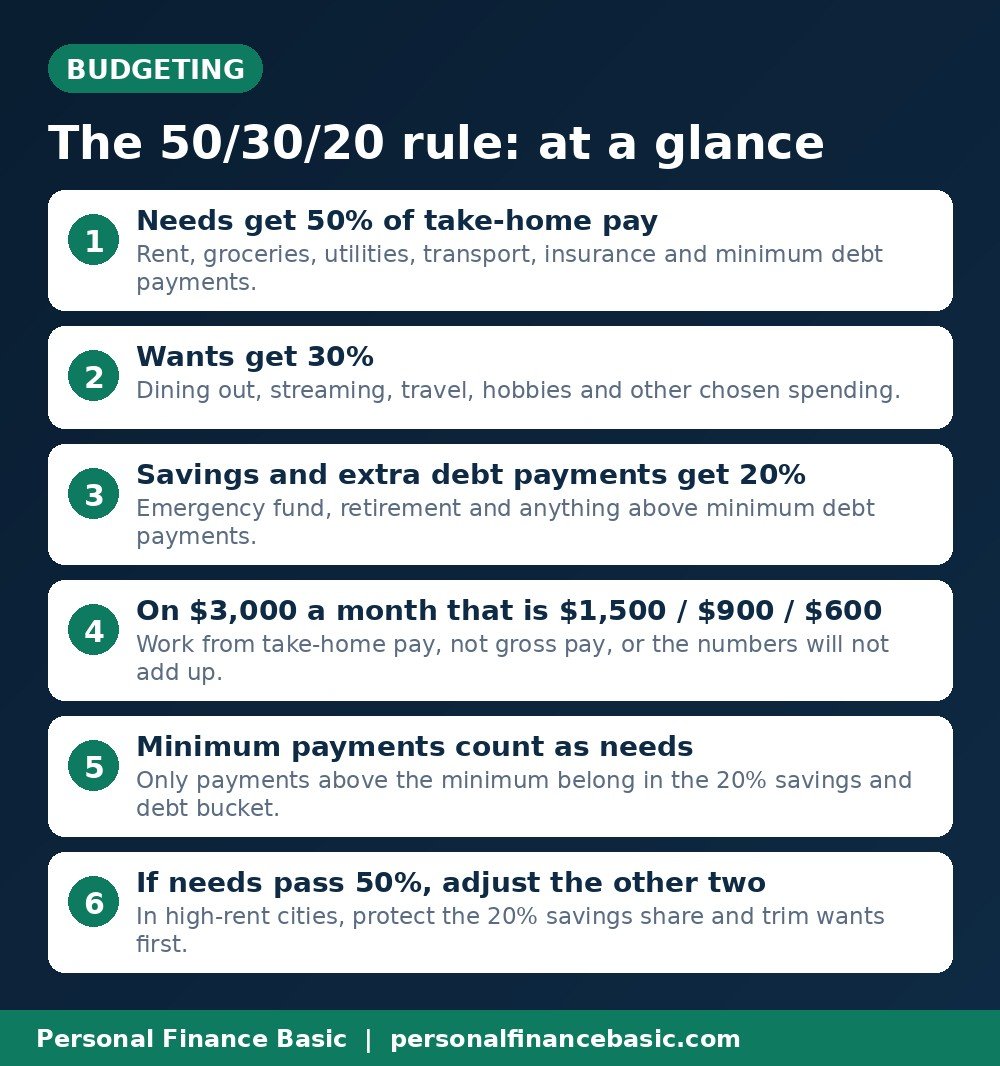
The main points from this guide, in one picture.
Frequently asked questions
Should I use gross pay or take-home pay?
Take-home pay. Count retirement deductions from your paycheck toward the 20% savings bucket, so your savings are not understated.
What if my rent alone is more than 50% of my income?
Hold the 20% savings share if you can, cut wants to 20% or less, and treat the gap as a housing problem to solve over time.
Do minimum debt payments count as needs or savings?
Needs. You must make them. Only payments above the minimum count toward the 20% bucket.
Can I save more than 20%?
Yes. The 20% figure is a floor to aim for, not a ceiling.
How often should I check my split?
Once a month. Add up the three buckets from your statements, compare them with the target, and adjust one number for the next month.
This guide is general education, not financial advice. Your rent, tax, and debt situation will change the right split for you. Consider professional advice before making large financial decisions.
Related reading: How to Budget on a Biweekly Paycheck and How to Start Investing With $100 a Month