On 20 November 2026, the University of Michigan released its final November survey, and the headline number for your money is not sentiment. It is what Americans expect prices to do next. People now expect prices to rise 3.7% over the next year, down from 4.7% in October and 4.3% in the preliminary survey.
That is a full point drop in one month, and the lowest reading since February. Sentiment rose too, to 51.5 from 48.0 in October, but it is still about 9% below February. So this is a better month, not a good one.
Here is what the survey found, why expectations matter more than the mood number, and what it does and does not mean for your budget.
The short answer
Americans expect prices to rise more slowly than they did a month ago, and they feel a little better about the economy. The final November reading puts sentiment at 51.5, up from 48.0 in October, and one-year inflation expectations at 3.7%, down from 4.7%.
The quick framework:
- What happened: sentiment up, expected inflation down a full point, and cheaper gas helping lower-income households.
- What changed most: expectations jumped to 52.9, while current conditions slipped to 49.4.
- What it means: slower expected price rises take pressure off household budgets, but they do not cut the prices you already pay.
- What to do: nothing drastic. Keep the budget and the emergency fund, and do not read one survey as a turn in the economy.
Quick decision guide:
- Budget feeling tight because prices kept rising? This survey says the rise should slow, not reverse.
- Waiting to make a big purchase until prices fall? Expectations of 3.7% still mean prices rising, just more slowly.
- Wondering if the economy has turned a corner? One better month after a weak autumn is not a turn.
What the survey found
The final November numbers improved on the preliminary survey in most places. Sentiment finished at 51.5, against 51.0 preliminary and 48.0 in October. The expectations index, which asks about the months ahead, rose to 52.9 from 50.9 preliminary and 48.8 in October.
Current conditions went the other way, slipping to 49.4 in the final reading, below the 51.0 preliminary figure but above October’s 46.7. People feel better about the future than about today.
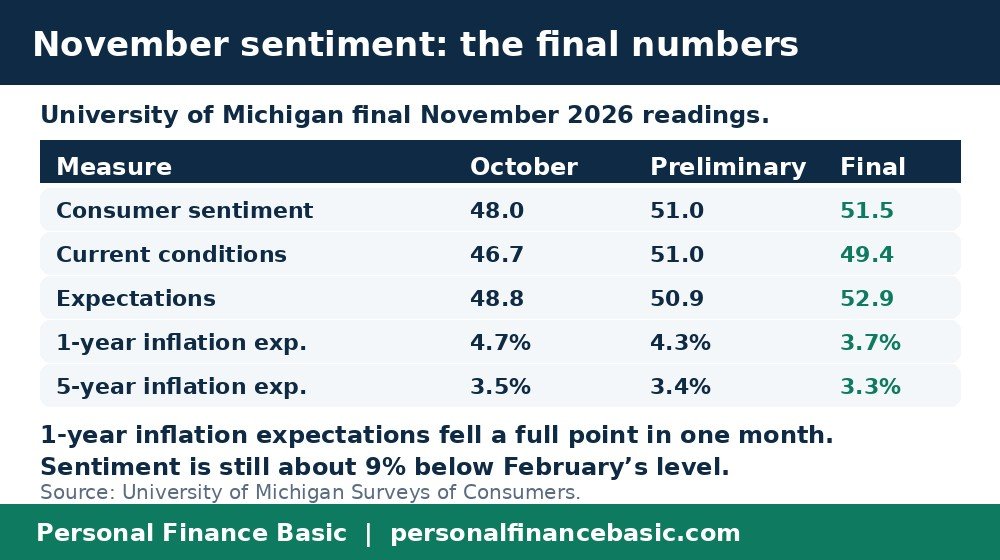
November sentiment: the final numbers. One-year inflation expectations fell a full point in one month.
The inflation numbers moved most. One-year expectations finished at 3.7%, down from 4.3% preliminary and 4.7% in October. Five-year expectations eased to 3.3% from 3.4% preliminary and 3.5% in October. Joanne Hsu, the survey’s director, said sentiment rose about 7% this month, led by post-election gains in expected business conditions, and that current personal finances improved for low-wealth consumers, helped by falling gas prices.
- Best for: anyone watching whether price rises are slowing, since expectations are the earliest sign.
- Not for: predicting what prices will actually do. Expectations are a survey of feelings, not a forecast.
Why inflation expectations matter for your money
Inflation expectations matter because they shape what people do. If you expect prices to rise 5% next year, you buy now and ask for a bigger raise. If you expect 3.7%, the rush eases. That is why the Federal Reserve watches this survey closely: expectations that stay high can keep prices rising.
A full point drop in a month is a big move for this measure. October’s consumer price report showed prices rose 0.4% in the month, so prices on the shelf have not fallen. What changed is what people think comes next.
Cheaper gas is part of it. Hsu pointed to falling gas prices helping lower-wealth consumers, who spend a bigger share of income on fuel and food. When the gas bill drops, the household budget feels it at once.
| Measure | October | Preliminary | Final | What changed |
|---|---|---|---|---|
| Consumer sentiment | 48.0 | 51.0 | 51.5 | Up 3.5 points in a month |
| Current conditions | 46.7 | 51.0 | 49.4 | Revised down from the preliminary |
| Expectations | 48.8 | 50.9 | 52.9 | Up 4.1 points in a month |
| 1-year inflation expectations | 4.7% | 4.3% | 3.7% | Down a full point in a month |
| 5-year inflation expectations | 3.5% | 3.4% | 3.3% | Down slightly |
Source: University of Michigan Surveys of Consumers, final November 2026 release, 20 November 2026.
What it does not mean
It does not mean prices are falling. An expected rise of 3.7% is still a rise. A $200 grocery bill would be about $207.40 in a year at that pace, and about $209.40 at October’s 4.7%. The difference is about $2 a month. Real, but not a windfall.
It also does not mean households feel good. Sentiment at 51.5 is still about 9% below February, and current conditions at 49.4 say people rate today as weak. The mood is split: expectations rose for independents and Democrats and fell for Republicans. A survey this divided is not a settled public mood.
And it does not settle what the Federal Reserve will do next. The Fed’s next rate decision is 8 to 9 December, and this survey is one input among many.
What to do with it
For most households, the honest answer is: keep the plan. A slower expected rise in prices is good news, but it changes nothing about this month’s bills. If your budget was tight in October, it is tight in November too.
Two small things are worth doing. First, if falling gas prices freed up $20 or $30 a month, send it to your emergency fund before it becomes spending. Second, if you waited for a sign that price rises are easing before a big purchase, this is a mild one, not a green light.
At a glance
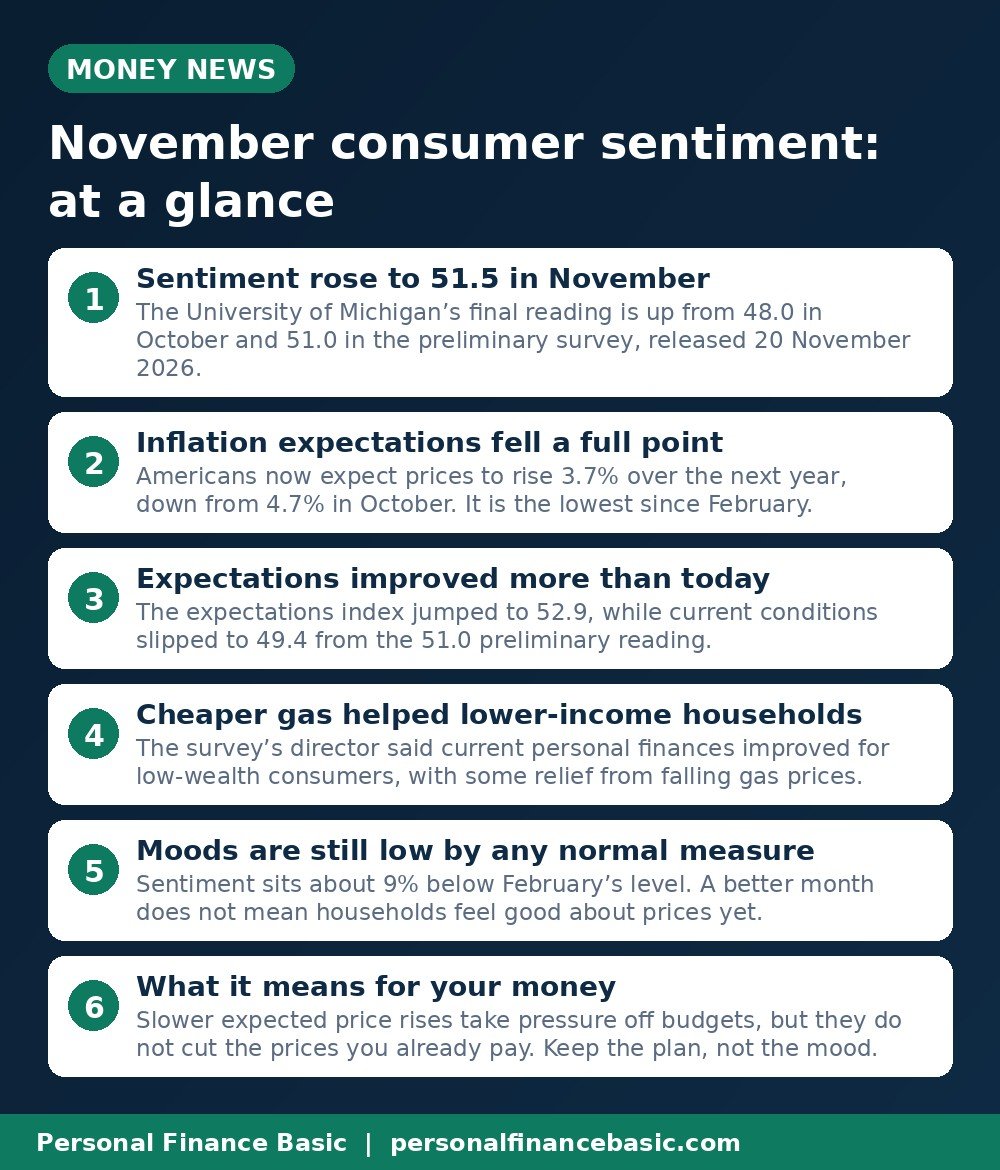
The main points from this guide, in one picture.
Frequently asked questions
What is consumer sentiment, and why does it matter?
It is the University of Michigan’s monthly survey of how Americans feel about the economy and their own finances. Feelings shape spending: people who feel worse spend less.
What does 3.7% inflation expectations mean in plain terms?
It means the average person surveyed expects prices to be 3.7% higher in a year. On a $200 weekly grocery bill, that is about $7.40 more a week.
Are prices actually falling now?
No. Prices rose 0.4% in October. What fell is what people expect prices to do next, from a 4.7% yearly pace to 3.7%.
Does this change what the Federal Reserve will do in December?
Not on its own. The Fed’s next decision is 8 to 9 December, and it weighs jobs, prices and many other reports. This survey is one input.
The bottom line: Americans expect prices to rise more slowly, and they feel a little better than in October. That is welcome, but sentiment is still low, prices are still rising, and one survey is not a turn. Keep the budget and bank the small savings from cheaper gas.
This post is general education, not financial advice. All figures are from the University of Michigan Surveys of Consumers, final November 2026 release, 20 November 2026.
Related reading: Prices Rose 0.4% in October: What the New Inflation Numbers Mean for Your Money and Fed Signals a Bigger December Rate Hike as Wholesale Prices Jump 6.5% in a Year