Most people in the US end up with two bank accounts: checking and savings. They look similar on a statement, and both are usually insured in the same way, but they are built for different jobs. Checking is for money moving in and out every day. Savings is for money you want to keep and let grow.
Understanding that difference helps you avoid fees you do not need to pay and keep emergency money separate from spending money. This guide explains how each account works, compares them side by side, and shows a simple way to use both together.
What a checking account does
A checking account is your everyday money hub. Your paycheck usually arrives here by direct deposit, and from here you pay rent, utilities, groceries, and card bills. It comes with a debit card, ATM access, and the ability to write checks or send electronic payments. Most checking accounts allow unlimited transactions.
Most checking accounts pay little or no interest. The national average for interest-bearing checking is around 0.06% a year, and many accounts pay nothing at all. That is not a flaw: a checking account is meant to make money easy to reach, not to grow it.
Fees are the part to watch. A checking account may charge a monthly maintenance fee, an overdraft fee if you spend more than your balance, and a fee for out-of-network ATMs. Many banks waive the monthly fee with direct deposit or a minimum balance, so check the waiver rules first. Overdraft fees, often around $35 per transaction at large banks, are the most expensive trap, and turning off overdraft coverage can prevent them.
What a savings account does
A savings account is for money you do not plan to spend right away. It earns interest, quoted as an annual percentage yield, or APY, which includes compounding. The national average savings APY is about 0.39%, while high-yield savings accounts at online banks often pay 4% or more, though rates are variable. That gap is large: $10,000 kept for a year earns about $39 at 0.39% and about $400 at 4%, before compounding.
Savings accounts usually do not come with a debit card for everyday spending. A federal rule once limited certain withdrawals to six per month; it no longer applies federally, but some banks still set their own limits, so read the terms. Moving money from savings to checking for a planned expense is easy. Using savings as a second checking account is not the idea.
Savings suits emergency funds, holiday spending, a house down payment, or any goal months away rather than days away. Money you do not see every time you open your banking app is also money you are less likely to spend on impulse.
Checking vs savings, side by side
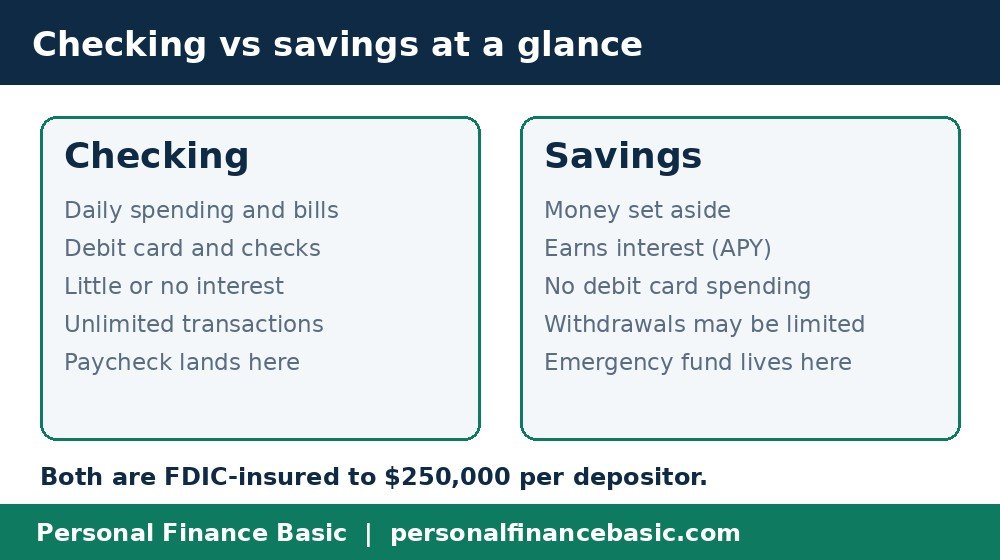
Checking moves money. Savings holds money. Most people need both.
The table below sums up the main differences. Details vary by bank, so treat these as typical patterns, not promises from any one institution.
Checking: purpose, daily spending and bills. Interest, little or none. Transactions, unlimited. Access, debit card, checks, ATMs, and electronic payments. Fees, monthly fee often waivable, plus overdraft fees. Savings: purpose, storing and growing money. Interest, yes, measured as APY, higher than checking. Transactions, fewer, and some banks limit withdrawals. Access, transfers to a linked account, usually no debit card. Fees, monthly fee sometimes, plus possible excess withdrawal fees.
One feature both share is deposit insurance. At an FDIC-insured bank, deposits are insured up to $250,000 per depositor, per bank, per ownership category, so an individual account and a joint account each get their own $250,000 of cover at the same bank. Credit unions have equivalent cover through the National Credit Union Administration, or NCUA, also up to $250,000.
How to use both accounts together
A simple setup works for most people. Have your paycheck deposited into checking, and set an automatic transfer to savings for the day after payday. Even $50 or $100 per paycheck builds up without a monthly decision. Bills come out of checking, and savings stays untouched except for its purpose.
Work out how much checking needs to hold. Add up your monthly bills and regular spending, then keep about one month of that in checking as a buffer, so a bill arriving early never triggers an overdraft. Money above that buffer can go to savings, where it earns more interest.
For an emergency fund, savings is the natural home, but it must stay reachable. An online high-yield savings account usually transfers to a linked checking account in one to three business days, which is fast enough for most emergencies and slow enough to stop impulse spending. If you want instant access, a savings account at the same bank as your checking account transfers at once.
What to look for before opening an account
Start with fees and waiver rules. An account with no monthly fee, or a fee you can waive easily with direct deposit, beats an account that pays slightly more interest but charges $12 a month. On a $1,000 balance, that fee is $144 a year, far more than a better rate would earn.
Next, compare the APY on savings, and check whether the rate applies to your whole balance or only above a threshold. Then check access: ATM networks, mobile check deposit, and transfer times. Finally, confirm deposit insurance, and be careful with accounts from firms that are not banks themselves, since some apps hold your money at partner banks.
Opening savings at the same bank keeps transfers instant, while an online bank often pays more interest. Many people do both: local checking for daily life and online savings for goals.
At a glance
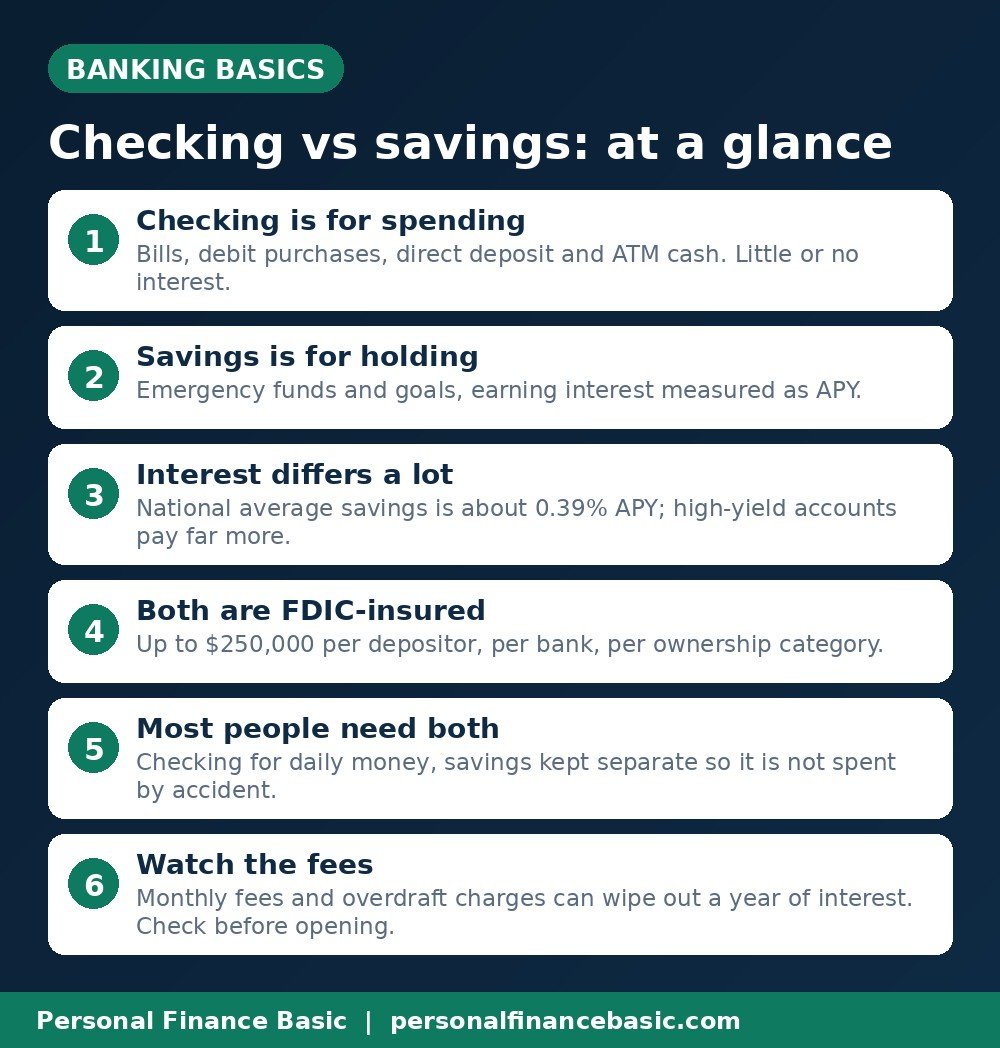
The main points from this guide, in one picture.
Frequently asked questions
Do I need both a checking and a savings account?
Most people do, because the two jobs are different. Checking handles daily spending and bills, while savings holds emergency money and goals where they earn interest and stay out of daily reach. You can manage with one account, but separating spending money from saved money makes overspending less likely.
Is my money safe in a checking or savings account?
At an FDIC-insured bank, deposits are insured up to $250,000 per depositor, per bank, per ownership category, and credit union accounts have equivalent NCUA cover. That protects you if the institution fails, not against fraud on your own account, so check statements regularly.
Why does my savings account pay so little interest?
Traditional banks often pay well below the national average, sometimes as little as 0.01%, while online banks pay much more because they have lower overhead costs. If your rate is near zero, comparing high-yield savings accounts is worth a few minutes.
Can I use a savings account to pay bills?
You can transfer money from savings to checking and then pay from checking, but savings accounts are not built for direct bill payments. They usually lack a debit card and check-writing, and some banks limit withdrawals. Keep bill money in checking and goal money in savings.
What happens if I overdraw my checking account?
The bank may decline the transaction or pay it and charge an overdraft fee, often around $35 per item. Repeated overdrafts add up fast. Turning off overdraft coverage, keeping a buffer in checking, and setting low-balance alerts are the simplest ways to avoid them.
This guide is general education, not financial advice. Account fees, rates, and terms vary by institution and change over time. Check the current terms of any account before opening it, and speak with a qualified financial professional for decisions about your own money.
Related reading: How to Budget on a Biweekly Paycheck and Car Loan Calculator