If you have ever applied for a credit card, a car loan, or a place to rent, a lender or landlord has probably looked at a number that sums up part of your borrowing history. That number is a credit score. It does not tell the whole story of your money, and it does not measure how hard you work or how much you earn. It is a short summary that lenders use, along with other facts, when they decide whether to lend and on what terms.
This guide explains the scale used in the United States, what counts as a good score, what goes into the number, and how to check and improve it over time.
What a credit score is
A credit score is a three-digit number based on the information in your credit reports. Those reports record accounts you have opened, how much you owe, and whether you have paid on time. Most lenders in the United States use a FICO score. FICO scores run from 300 to 850. A higher number usually means a lower risk to a lender, based on past payment patterns.
The FICO ranges, from 300 to 850
FICO groups scores into five ranges. Scores from 300 to 579 are called Poor. Scores from 580 to 669 are Fair. Scores from 670 to 739 are Good. Scores from 740 to 799 are Very Good. Scores from 800 to 850 are Exceptional. The labels help lenders talk about risk in a common way, but they are not a pass or fail mark.
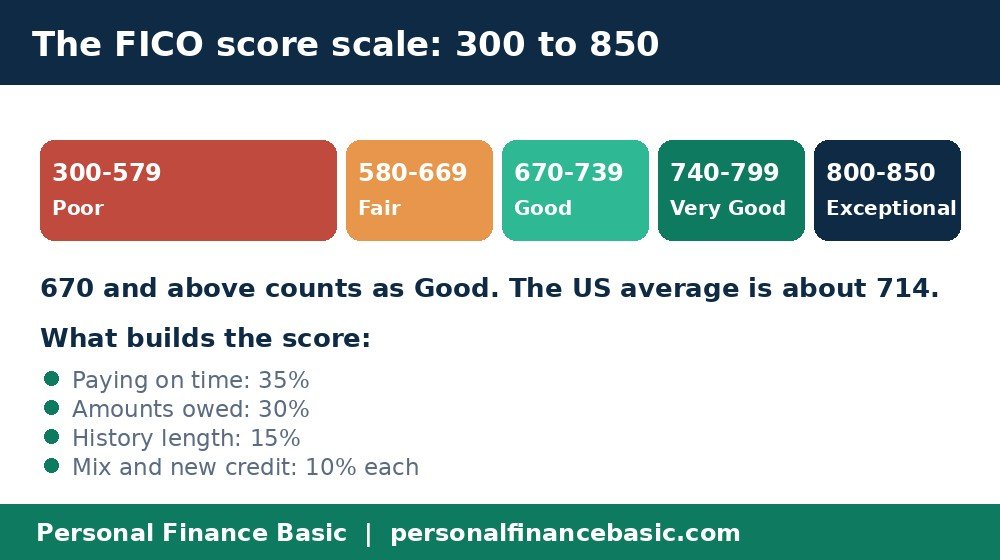
The United States average FICO score is about 714, which sits in the Good range. That average is useful as a point of comparison, but it is not a target you must hit by a set date. Lenders set their own rules, and the score needed for a given card or loan can differ from one lender to the next.
What goes into your score
Five factors make up a FICO score, and they do not carry equal weight. Payment history counts for 35 percent, which makes it the largest single factor. Amounts owed counts for 30 percent. Length of credit history counts for 15 percent. Credit mix counts for 10 percent, and new credit counts for 10 percent. Those weights explain why one missed payment can matter more than opening a new store card.
Payment history is a record of whether you paid each bill by its due date. Late payments, missed payments, and accounts sent to collection can lower a score. Amounts owed covers how much you owe, including how much of your available credit you are using. Length of history looks at how long your accounts have been open. Credit mix looks at the types of credit you have used, such as cards and installment loans. New credit looks at recent applications and newly opened accounts.
Credit utilization in plain terms
Credit utilization means the share of your available credit that you are using. If a card has a $1,000 limit and you owe $300 on it, your utilization on that card is 30 percent. Keeping card use under 30 percent of a limit is a common guide. For a $1,000 limit, that means keeping the balance under $300 when the lender reports it. Lower use is often better, but the guide is not a hard rule.
Utilization can change fast, because balances are reported each month. Paying a card down before the statement date can lower the balance that is reported, while a large purchase can raise it for that month even if you pay in full later. If you want a simple way to track what you owe, start with how to make a budget. A budget does not raise a score by itself, but it makes it easier to pay on time and to keep balances in check.
Why you have more than one score
You do not have one single credit score. You have many, because different providers use different models and different lenders may pull reports from different bureaus. VantageScore also exists, and it uses the same 300 to 850 scale as FICO. A VantageScore and a FICO score for the same person can differ, because the models weigh information in different ways.
The three main credit bureaus in the United States are Equifax, Experian, and TransUnion. Each holds its own report on you, and the reports may not match exactly. A lender may report an account to one bureau and not to another, or may update at a different time. That is another reason scores can differ.
How to check your score and your reports
Free credit reports are available at AnnualCreditReport.com from Equifax, Experian, and TransUnion. The site is the official place to request those reports. Read each report for accounts you do not recognize, balances that look wrong, and payments marked late when you paid on time. If you find an error, dispute it with the bureau that holds the report and keep a copy of what you send.
How to improve your score over time
Improvement takes months of on-time payments. There is no instant fix, and no service can remove accurate information from your reports before its time. The habits that help are steady rather than dramatic. Pay at least the minimum by the due date each month. Keep card balances low when you can. Avoid opening several new accounts in a short period unless you need them.
If you carry card debt, a clear payoff plan can help both your budget and your utilization. Two common plans are compared in our guide to debt snowball vs. debt avalanche. The snowball method pays the smallest balance first, while the avalanche method pays the highest interest rate first. Either plan works only if payments stay on time, so pick the one you are most likely to stick with.
At a glance

Frequently asked questions
What is a good credit score in the US?
On the FICO scale, 670 to 739 is Good, 740 to 799 is Very Good, and 800 to 850 is Exceptional. A score of 670 or above is a solid place to be, and higher scores usually bring more choices.
Is 714 a good credit score?
Yes. About 714 is the United States average FICO score, and it falls in the Good range. Lenders still look at income, debts, and other facts, so the score alone does not decide an application.
How much credit utilization should I aim for?
Under 30 percent of a limit is a common guide. On a $1,000 limit, that means under $300. Lower use is often better, but going over in one month is not permanent damage.
Why do my scores differ?
Different models, such as FICO and VantageScore, weigh information in different ways, and the three bureaus may hold slightly different reports. Small differences between scores are normal.
How fast can I raise my score?
There is no instant fix. On-time payments and lower balances help over months, not days. Be wary of anyone who promises a fast jump, since accurate information cannot be removed early.
This post is general education, not financial or tax advice. Your situation may differ, so check the details that apply to you before you act on them.