Your credit card statement arrives every month, and most people look at two numbers: how much they owe and when it is due. The rest of the page gets a quick glance, or none at all.
That is a missed chance. The statement tells you what borrowing cost you this month, how long the balance will take to clear, and whether a charge you do not recognize slipped in.
Here is how to read each one, with an example statement to follow along.
The short answer
Read the statement balance, the due date, and the minimum payment box first. Pay the statement balance in full by the due date and new purchases cost no interest. Pay less and interest starts on the unpaid part, and the grace period usually goes away until you pay in full again.
Work through it in five moves:
- Find the statement balance and the due date.
- Read the minimum payment box.
- Check the APR and the interest charged.
- Scan the charges line by line.
- Decide what to pay, and pay more than the minimum when you can.
Quick decision guide:
- Can pay the full balance? Pay it by the due date and skip the interest.
- Cannot pay in full? Pay as much as you can, and pay at least the minimum on time.
- See a charge you do not know? Dispute it within 60 days of the statement date.
What the numbers on an example statement mean
Take Maya, who has a card with a 24% APR. Her statement shows a balance of $1,248.60, a minimum payment due of $35, and interest charged of $18.40. The reason is the average daily balance: her balance averaged $920 over the billing cycle, because she paid part of it down mid-month. Interest is charged on that average, not on the statement balance. $920 times 24% divided by 12 months comes to $18.40.
That $18.40 is the first thing the minimum payment covers: of her $35 minimum, $18.40 goes to interest and only $16.60 off the balance.
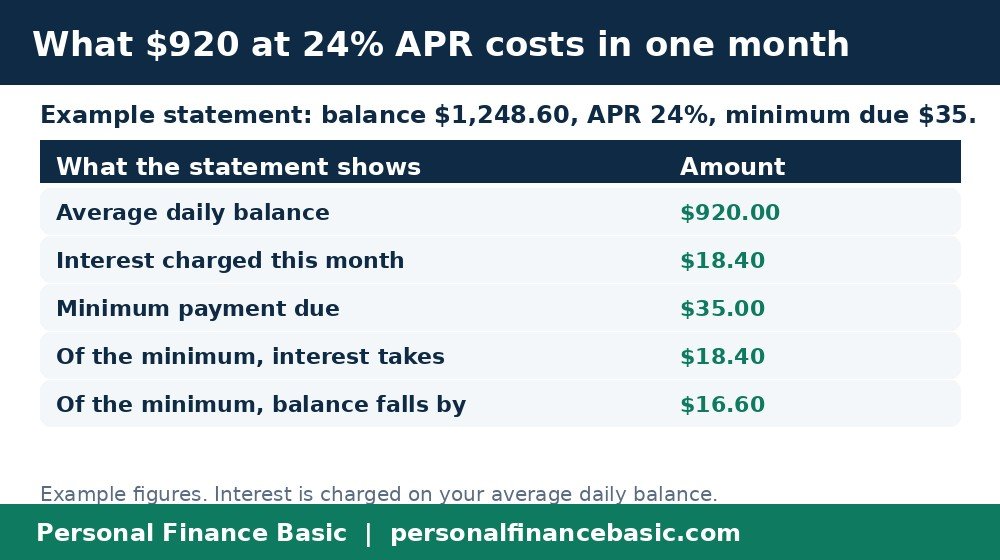
What $920 at 24% APR costs in one month.
Three ways to pay, compared
| What you pay | Total interest | Time to clear $1,200 |
|---|---|---|
| Full statement balance | $0 on new purchases | Done this month |
| Fixed $100 a month | About $186 | 14 months |
| Fixed $50 a month | About $451 | 34 months |
| Minimum only | About $2,864 | About 13.5 years |
Illustrative examples, based on a $1,200 balance at 24% APR with no new charges. Your statement shows your exact payoff time in the minimum payment box.
- Best for most people: paying the full statement balance. It is the only option with no interest on new purchases.
- Best for a balance you cannot clear at once: a fixed payment above the minimum. Even $50 a month instead of the minimum saves about $2,400 in interest on this example.
Step 1: Find the statement balance and the due date
The statement balance is what you owed when the cycle closed. The current balance in your app adds spending since then. Pay the statement balance, not the current balance, to avoid interest on new purchases.
Under the Credit CARD Act, the statement must reach you at least 21 days before the payment is due, and a payment received by 5 p.m. on the due date is not late, according to the Consumer Financial Protection Bureau. If the due date falls on a weekend or holiday, the next business day counts as on time.
Step 2: Read the minimum payment box
Near the top of the statement, a small box is required by law. It shows how long minimum-only payments would take, and the monthly payment that would clear the balance in about three years.
The minimum is usually 1 to 3 percent of the balance, with a floor of about $25 to $40. Paying it keeps the account current and avoids a late fee, but it does not stop the interest.
Step 3: Check the APR and the interest charged
Your APR is the yearly cost of borrowing. A card can have more than one: one for purchases, another for cash advances, and sometimes a penalty rate. Cash advances usually have no grace period, so interest starts the day you take the money.
The interest charged line shows what borrowing cost you this cycle. If it looks high for the balance you see, the average daily balance is the reason: a balance that sat high most of the month costs more than one paid down early. If the line is zero, you paid in full and the grace period did its job.
Step 4: Scan every charge
Read the transaction list line by line, at least once a month. Look for charges you do not recognize, subscriptions you forgot about, and any charge listed twice.
If you find an error, you have 60 days from the statement date to dispute it in writing, sent to the billing inquiries address, not the payment address. Keep a copy. The card company must look into it, and it cannot charge interest on the disputed amount while it does.
Step 5: Decide what to pay
If you can pay the statement balance in full, do it, and the card costs you nothing in interest. If you cannot, pay the largest fixed amount you can afford every month, set to pay automatically so a busy month never turns into a late fee.
Set up autopay for at least the minimum as a safety net, then pay extra by hand when you can. A fixed $100 a month clears a $1,200 balance in just over a year; minimum payments alone take about 13.5 years.
At a glance
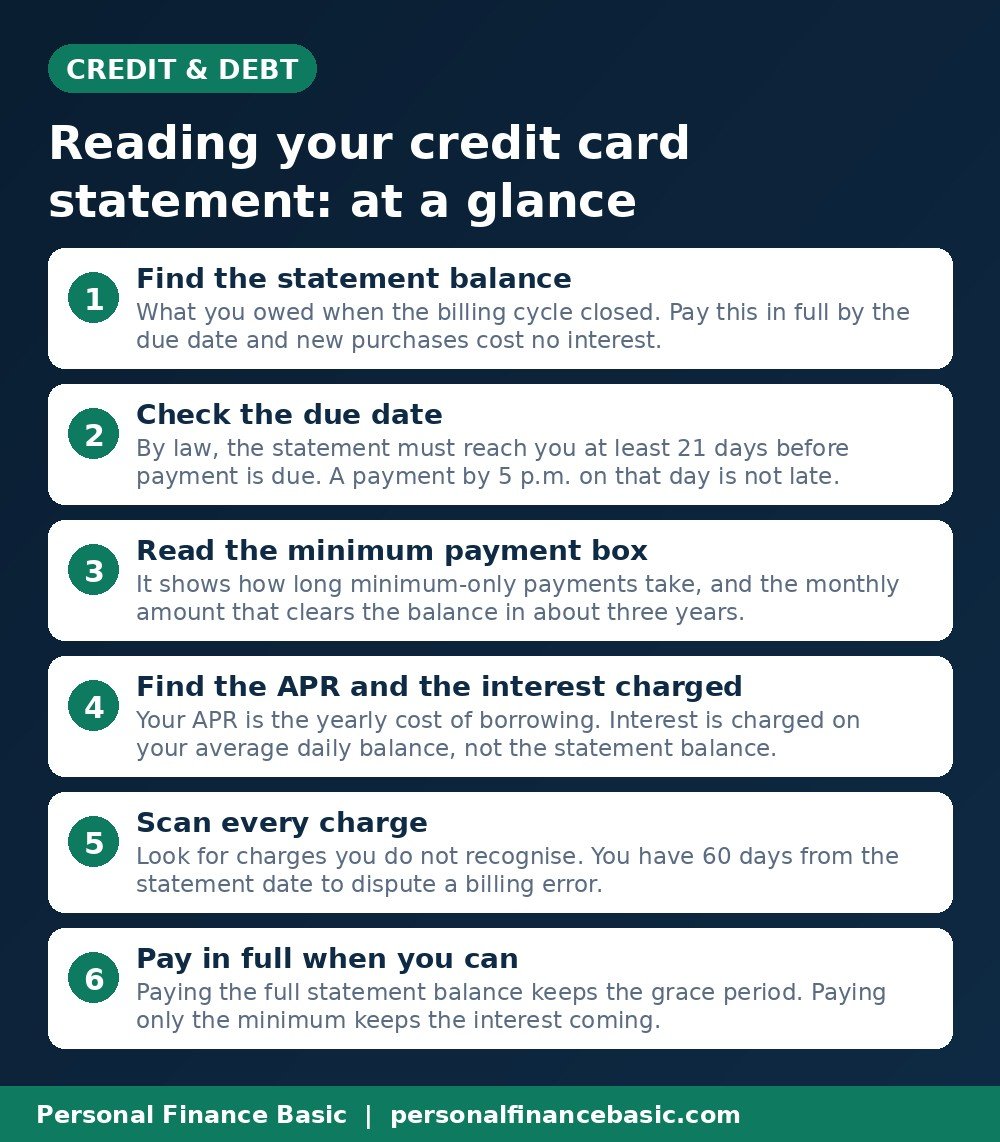
The main points from this guide, in one picture.
Frequently asked questions
What is the difference between the statement balance and the current balance?
The statement balance is what you owed when the cycle closed; the current balance adds spending since then. Pay the statement balance in full by the due date to avoid interest on new purchases.
Does paying only the minimum hurt my credit score?
Paying the minimum on time does not hurt your score by itself. But a high balance that stays high raises your credit utilization, which can pull your score down. Paying more lowers the balance faster.
What happens if I miss the due date by one day?
A payment received after 5 p.m. on the due date can count as late, and a late fee can apply. A payment 30 days late can be reported to the credit bureaus. If you are one day late, pay right away and call the issuer: many waive a first late fee.
Why did I get charged interest even though I paid in full?
If you carried a balance the month before, you may have lost the grace period. Interest can also trail a payoff: the first statement after you pay in full can still show interest for the days before your payment arrived. Pay the next statement in full too.
Where do I find my APR on the statement?
Look near the interest charged section, usually on the first page or the back. It lists each APR that applies to your account, with the balance and interest for each.
The bottom line: find the statement balance, the due date, and the minimum payment box, then pay in full when you can. Five minutes a month is the cheapest way to keep a card from costing you money.
This guide is general education, not financial advice. Your card terms, APR, and balance decide what applies to you.
Related reading: What Happens If You Only Pay the Minimum on a Credit Card? and What Is APR? A Plain-English Guide With Examples