APR shows up on every credit card offer, loan estimate, and card statement. Most people see the number and move on, yet it decides how much borrowing costs.
This guide explains APR: what it includes, how it differs from a simple interest rate, how monthly interest is worked out, and how to use it when you compare offers.
What APR means
APR stands for annual percentage rate: the yearly cost of borrowing money, shown as a percentage. If you borrow for a year at a given APR, it tells you roughly what share of the amount borrowed goes to interest and included fees over that year.
The Consumer Financial Protection Bureau (CFPB) describes APR as a broader measure than the interest rate alone, because it includes the interest rate plus fees you pay to get the loan. On a mortgage, the APR can include lender fees and closing costs. On a credit card, it is usually close to the interest rate, because fewer upfront fees are folded in.
That is why APR is the fair way to compare offers: two loans with the same interest rate can have different APRs if one charges higher fees.
APR and the interest rate are not always the same
The interest rate is the price charged for the money itself. The APR adds in most extra costs of borrowing. With no extra fees, the two numbers can be identical. With fees, the APR is higher.
Take a $10,000 loan repaid over five years. At a 7% APR, the monthly payment is about $198, with about $1,881 in total interest. At a 5% APR, it is about $189 a month. Small differences matter when the amount is large or the term is long.
APR is not the same as APY
APR and APY sound alike, but they point in opposite directions. APR is what borrowing costs you. APY, or annual percentage yield, is what savings earn you, with compounding included. Compounding means earning interest on interest already added, so a savings account with a 4% rate paid monthly earns slightly more than 4% over a year. APY captures that extra amount. The simple rule is this: APR appears on borrowing, APY appears on savings.
Fixed APR and variable APR
A fixed APR stays the same for the life of the loan, unless the lender gives notice of a change under the card agreement. That makes planning easier, because the monthly cost does not move with the market. A variable APR moves up or down with a benchmark rate, usually the prime rate, plus a margin stated in the card agreement. Most US credit cards use variable APRs, which is one reason card rates rose sharply when benchmark rates rose in 2022 and 2023, and have stayed high since.
The different APRs on one credit card
A credit card statement often lists several APRs. The purchase APR applies to ordinary shopping. The balance transfer APR applies to debt moved from another card, often at a low rate for a set number of months. The cash advance APR applies to cash taken out with the card, and is usually the highest rate, with interest starting at once and no grace period. The penalty APR applies if you pay late, often close to 30%, and can stay for months. An introductory APR, often 0% for 12 to 18 months, ends with the regular APR taking over on any balance left.
Check which APR applies to what you plan to do. A 0% intro offer on balance transfers does not mean new purchases are cheap, and a cash advance can cost far more than the headline rate suggests.
How monthly interest is worked out
Although APR is a yearly rate, card interest is usually charged monthly. A rough monthly rate is the APR divided by 12. A $1,000 balance at 24% APR adds about $20 of interest in one month if no payment is made. A $3,000 balance at the average rate for accounts that pay interest, 22.36%, adds about $56 in one month. In practice, issuers use a daily periodic rate, the APR divided by 365, applied to the average daily balance, so the result can be slightly higher. The grace period matters here: if you pay the full statement balance by the due date, most cards charge no interest on purchases at all.
A worked example: the same balance at three APRs
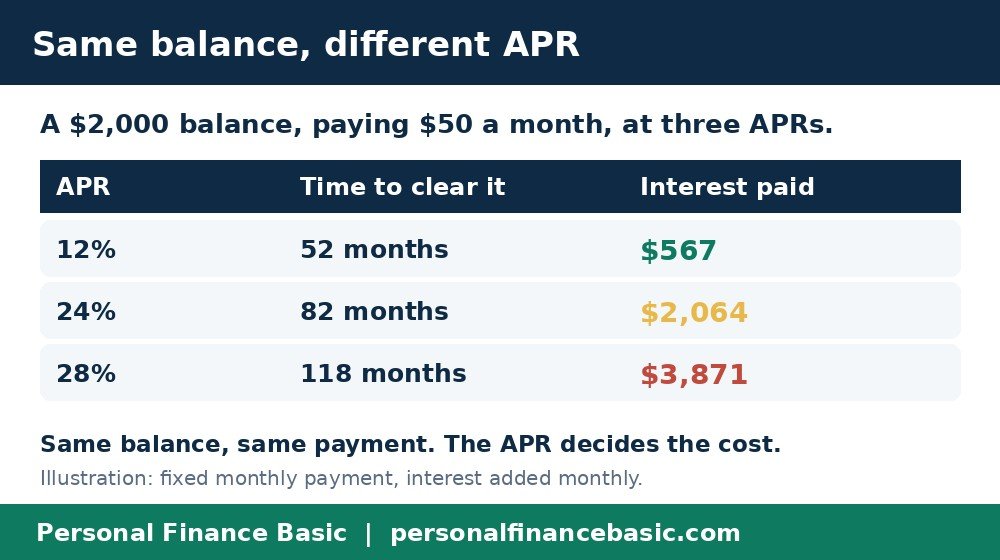
The same balance, the same payment. The APR decides the cost.
Start with a $2,000 balance and a fixed payment of $50 a month. At 12% APR, it clears in about 52 months, with about $567 in interest. At 24% APR, it takes about 82 months, with about $2,064 in interest, more than the original balance. At 28% APR, it takes about 118 months, nearly ten years, with about $3,871 in interest. Raise the payment instead: at 24% APR, paying $100 a month clears the same balance in about 26 months, with about $580 in interest. A lower rate helps, and a higher fixed payment helps even more.
What is a typical APR right now?
According to the Federal Reserve’s G.19 consumer credit release, the average APR on card accounts assessed interest was 22.36% in August 2026. Across all card accounts, including people who pay in full and are never charged interest, it was 21.19%.
That average hides a wide range: strong credit histories are often offered rates well below it, while people building credit or carrying store cards can face rates above 28%. Check whether a rate shown is ongoing or a temporary intro rate.
How to use APR when you compare offers
Compare the ongoing APR, not the intro rate, unless the balance will be cleared before the intro period ends. Check whether the APR is fixed or variable, and what happens if you pay late. Look at fees outside the APR, such as annual, balance transfer, and cash advance fees. Finally, run the monthly math: divide the APR by 12 and multiply by the balance you expect to carry. If that interest is larger than your planned payment, the balance will grow even while you pay.
At a glance
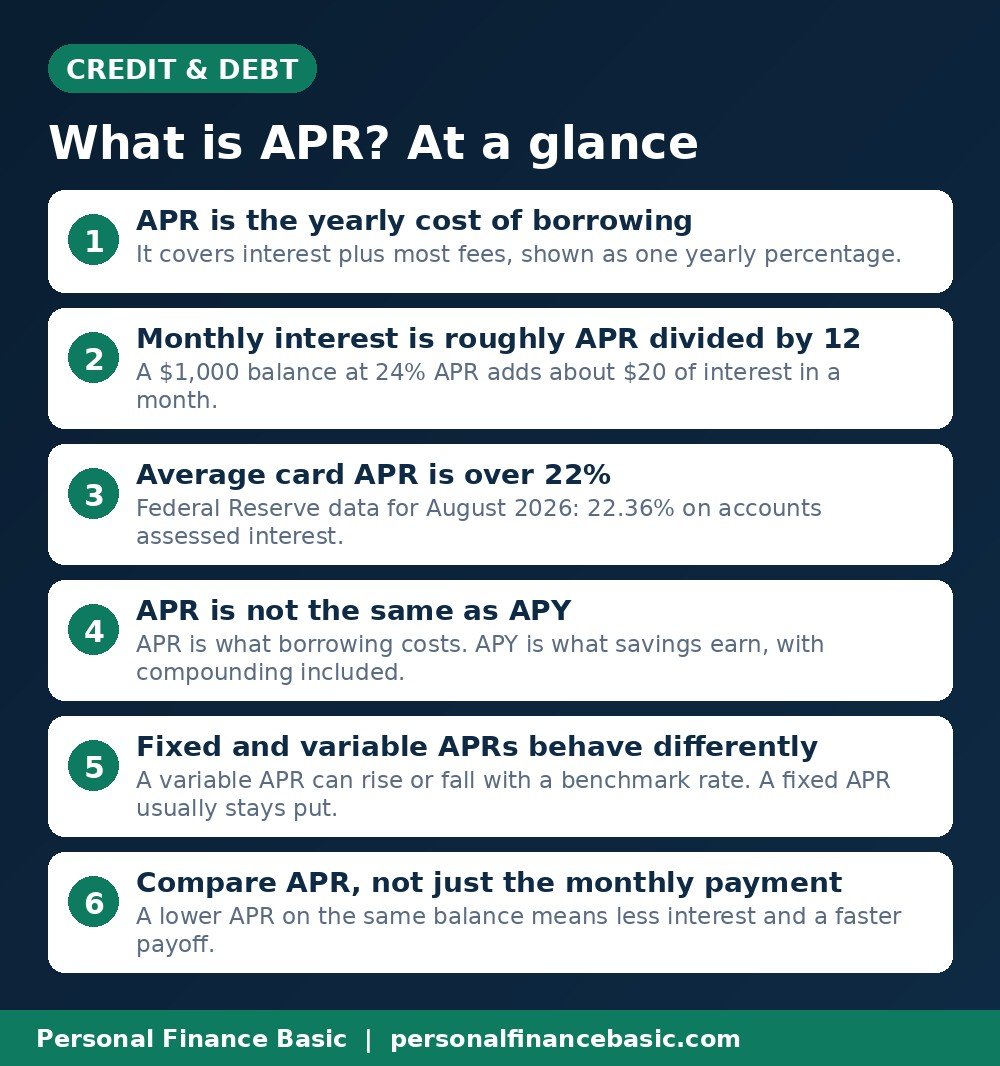
The main points from this guide, in one picture.
Frequently asked questions
Is a lower APR always better?
Usually, when the amount, term, and fees are the same. But a higher APR card with no annual fee can beat a lower APR card with a large annual fee, so compare the full cost.
Why did my APR go up when I did nothing wrong?
Most cards use a variable APR tied to the prime rate. When the benchmark rises, your APR rises with it, even if your payments were on time.
Does a 0% APR offer mean borrowing is free?
Only during the intro period, and only for the transaction type covered, usually purchases or balance transfers. The regular APR applies to any balance left when the period ends.
Can I ask for a lower APR?
Yes. Issuers can lower a rate on request, especially for customers with a steady payment record. There is no guarantee, but a short call costs nothing.
What is a good APR for a credit card?
It depends on your credit history and the card type. A useful benchmark is the Federal Reserve average of 22.36% for accounts assessed interest in August 2026. Well below that is strong; well above it means carrying a balance will be expensive.
This guide is general education, not financial advice. APRs, fees, and card terms change, and your own rate depends on your credit history and the issuer’s terms. Read the card agreement before you apply.
Related reading: What Happens If You Only Pay the Minimum on a Credit Card? and How to Improve Your Credit Score in 6 Months