Maya owes $6,000 on a credit card that charges 22.36% APR. She pays $350 a month, and the balance barely moves. In the first month alone, about $112 of her payment goes to interest, and only about $238 touches the debt. At that pace it takes her 21 months and $1,296 of interest to clear it.
A balance transfer card offers 0% interest for up to 21 months, and it can be a way out. But the card charges a fee for the transfer, the 0% rate ends on a fixed date, and new purchases can cost interest from day one. Here is how it works and where the traps are.
The short answer
A balance transfer moves debt from a high-interest card to a new card with a 0% introductory APR, usually for 12 to 21 months. You pay a one-time fee of 3% to 5% of the amount you move. Pay the full balance off before the 0% period ends and you save most of the interest. Leave a balance behind and it jumps to the card’s regular APR.
The quick framework:
- Check the 0% period, the fee, and the transfer deadline before you apply.
- Divide the balance, fee included, by the number of 0% months.
- Pay that fixed amount every month.
- Do not use the new card for purchases.
- Clear the balance before the 0% period ends.
Quick decision guide:
- Owe $3,000 or more at 20% APR or higher? A transfer is worth pricing out.
- Can you pay it off inside the 0% window? It probably saves you money.
- Cannot pay it off in time? Compare the fee plus leftover interest against staying put.
Step 1: Understand what a balance transfer actually is
A balance transfer is a payment, not a payoff. You apply for a new card, and once approved you ask the new card company to pay off some or all of the balance on your old card. The debt moves; it does not shrink.
During the 0% window, every dollar you pay goes toward the debt instead of interest. Two details matter: the 0% rate applies only to transfers made in the first 60 to 120 days, and the balance cannot come from a card issued by the same bank.
Step 2: Work out the fee and the monthly payment
Almost every transfer card charges a fee of 3% to 5% of the amount you move, added to your balance on day one. On $6,000, a 3% fee is $180 and a 5% fee is $300.
Here is Maya’s example. Her balance is $6,000 at 22.36% APR, the average rate on accounts assessed interest in the third quarter of 2026, according to the Federal Reserve. Paying $350 a month on the old card, she clears it in 21 months and pays $1,296 in interest. Move it to an 18-month 0% card with a 3% fee, and the balance becomes $6,180, or about $343 a month. She clears the debt three months sooner and pays $180 instead of $1,296, saving about $1,116. With a 5% fee the balance is $6,300, the payment is $350 a month, and she still saves about $996.
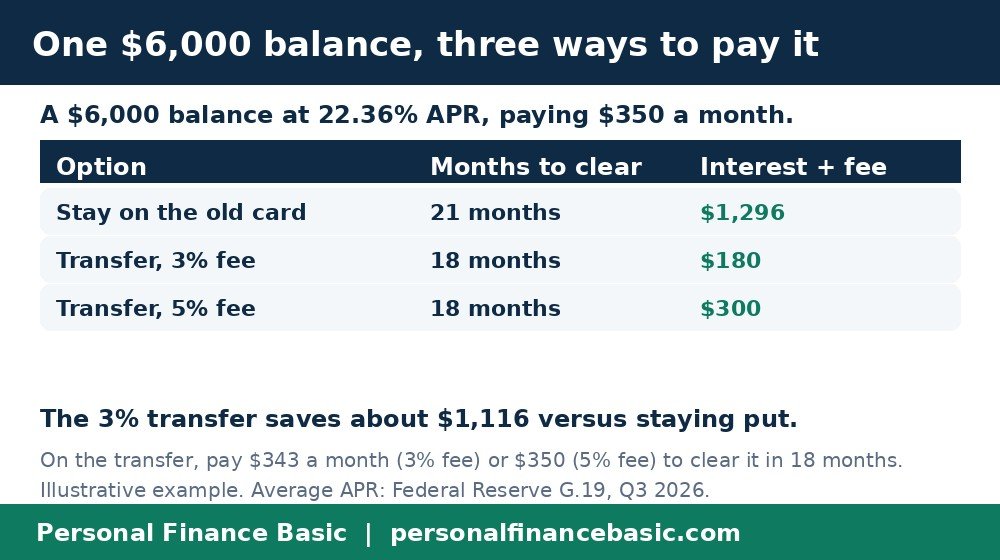
One $6,000 balance, three ways to pay it. The transfer only wins if you clear it inside the 0% window.
- Best for: a balance of $3,000 or more at a high APR, with a steady income and a realistic plan to clear it inside the 0% window.
- Not for: someone who can only pay the minimum, or who is still adding new charges each month.
Step 3: Compare offers on three numbers, not one
The longest 0% period is not always the best deal. Three numbers decide the real cost: the length of the 0% period, the transfer fee, and the regular APR that applies when the intro period ends. A 21-month 0% card with a 5% fee can cost more than an 18-month card with a 3% fee, depending on how fast you pay. As of November 2026, the longest 0% windows are 21 months, with fees of 3% to 5%.
| What to compare | Good | Watch out |
|---|---|---|
| 0% period | 18 to 21 months | Under 12 months |
| Transfer fee | 3% of the balance | 5%, or a fee on every transfer |
| Regular APR after intro | Under 20% | Over 25% |
| Transfer window | 120 days to transfer | Only 60 days to transfer |
| Annual fee | $0 | A fee that eats the savings |
Illustrative comparison. Offers change; confirm the current terms on the card company’s website before you apply.
Step 4: Avoid the four traps
Most transfers that fail do so for one of four reasons, and all four are avoidable. First, new purchases: many transfer cards charge interest on new purchases from day one, even while the transferred balance sits at 0%. Do not shop on the transfer card. Second, the minimum payment: it is often 1% of the balance, and paying only the minimum on Maya’s $6,180 would leave most of it unpaid when the 0% period ends. The fixed payment from step 2 is the one that matters.
Third, the missed deadline: any balance left when the 0% period ends starts gathering interest at the regular APR at once, so set a reminder for two months before the end date. Fourth, a late payment: it can end the 0% period early on some cards and hurt your credit score, so set up autopay for at least the fixed amount, a few days before the due date.
Step 5: Apply, transfer, and close the loop
Apply, then start the transfer as soon as you are approved, inside the transfer window. Transfers take a few days to a couple of weeks, so keep paying the old card until the transfer shows as complete. Keep the old card open if it has no annual fee, since closing it can raise your credit utilization.
At a glance
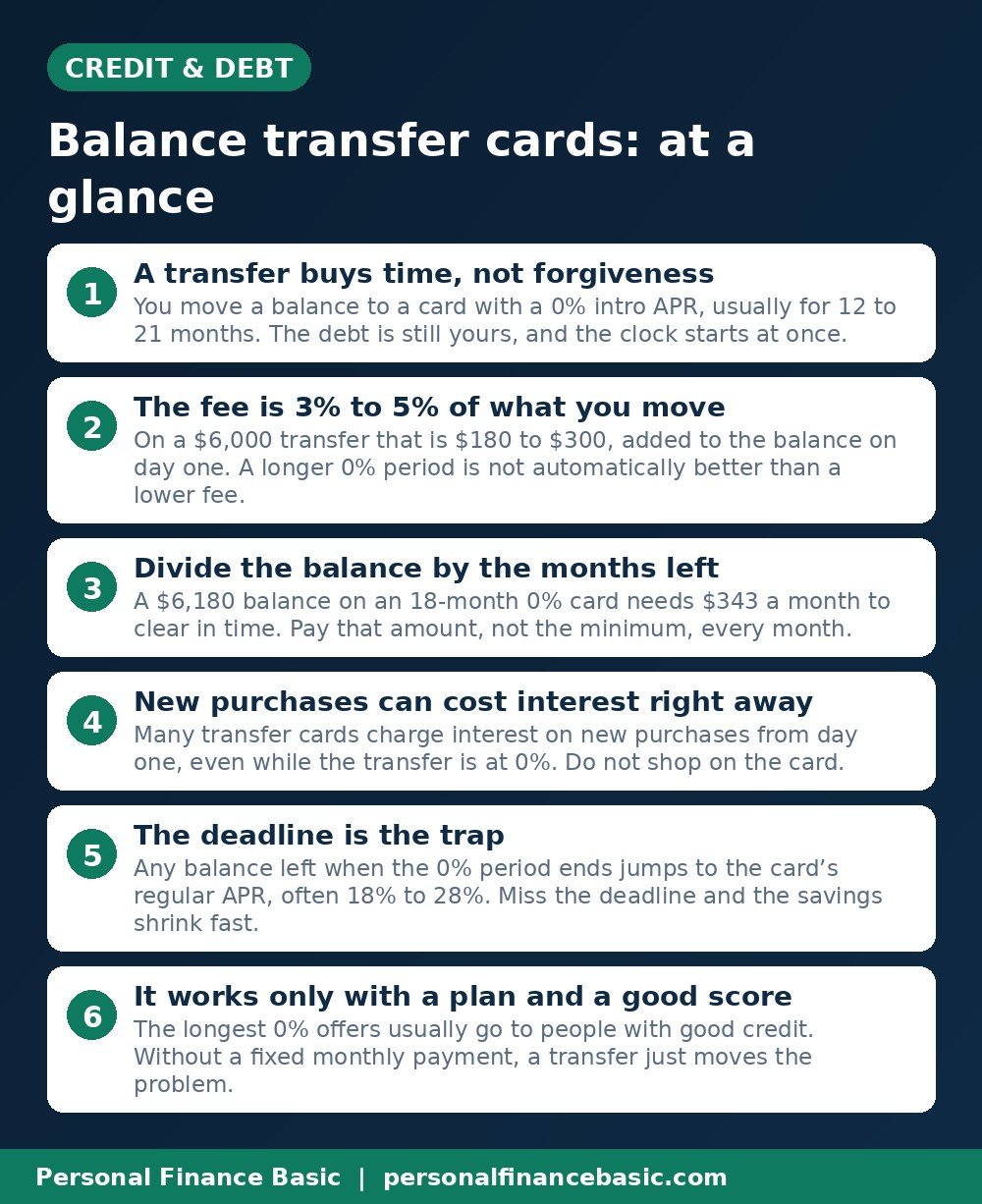
The main points from this guide, in one picture.
Frequently asked questions
Does a balance transfer hurt my credit score?
A new application adds a hard inquiry, so your score can dip at first. Paying the balance down lowers your credit utilization, which usually helps it over time.
How much can I transfer?
Usually up to your new card’s credit limit, often only 75% to 90% of it. If your limit is lower than your balance, transfer part of it and leave the rest behind.
Can I transfer a balance from the same bank?
No. Card companies do not let you transfer a balance between two of their own cards.
What happens if I still owe money when the 0% period ends?
The leftover balance starts charging interest at the card’s regular APR, often 18% to 28%.
Is a balance transfer better than a personal loan?
It depends on how fast you can pay. A transfer is usually cheaper for balances you can clear in 12 to 21 months. A personal loan can be better for larger balances that need three to five years.
The bottom line: a balance transfer is a pause button on interest, not a payoff. On a $6,000 balance it can save about $1,100, but only if you pay about $343 a month and clear it before the 0% period ends. Work out your number before you apply, then set it on autopay.
This post is general education, not financial advice. The $6,000 example is illustrative; your fee, rate and monthly payment will depend on the offer you receive and your credit profile.
Related reading: What Happens If You Only Pay the Minimum on a Credit Card? and How to Pay Off Credit Card Debt on a Low Income