You know algebra cold, or you speak Spanish, or you passed the SAT with a score friends still ask about. That knowledge is worth money, and online tutoring is one of the fastest ways to turn it into a side income.
The average US tutor earns $26.37 an hour, per Indeed data from June 2026. Beginners usually start at $15 to $25 an hour, and test prep tutors earn $40 to $75.
Here is how to get started, step by step, from picking your subject to your first paying student.
The short answer
Pick one subject you know well, join a tutoring marketplace to find your first students, set a rate between $20 and $30 an hour, and teach a few hours a week. Most tutors land their first student within two to four weeks.
The quick framework:
- Pick one subject you could teach tomorrow, with no new study.
- Choose a route to students: a marketplace, a managed platform, or your own clients.
- Set a starting rate, and know what the platform keeps.
- Run a few trial sessions and collect reviews.
- Raise your rate as reviews build, and move your best students to direct bookings.
Quick decision guide:
- Want students fast and can set your own rate? Start on a marketplace.
- Want steady sessions without finding clients? Try a managed platform, at a lower rate.
- Already have people asking you for help? Go independent from day one.
- Good at test prep or a hard subject? Charge more, because those students pay more.
Step 1: Pick one subject you can teach tomorrow
The fastest start is the subject you already know. If you use algebra at work, tutor algebra. If you grew up speaking Spanish, tutor Spanish. The subject you would need to relearn is the wrong first pick.
Demand is strongest for STEM subjects like calculus, chemistry and coding, for language tutoring, especially Spanish and English as a second language, and for SAT, ACT and graduate test prep, which pays the most.
Pick one subject for your first profile, not five. A profile that says “I teach algebra” gets booked; one that lists ten subjects looks unfocused.
- Best for: one subject you know well enough to explain without notes.
- Not for: a subject you studied years ago and would need to relearn first.
Step 2: Choose how you will find students
There are three routes to students, and they pay very differently. A marketplace brings students to you but takes a cut of about 25%. A managed platform sets your rate and hands you sessions, but pays less. Going independent means you keep everything, but you find every student yourself.
| Route | How pay works | Typical rate | Best for |
|---|---|---|---|
| Marketplace | You set the rate; platform takes about 25% | $15 to $65 an hour | Starting fast |
| Managed platform | Platform sets the rate | $12 to $40 an hour | Steady sessions |
| Independent | You keep it all; you find students | $40 to $100+ an hour | After you have reviews |
Rates from Indeed, Salary.com and platform fee pages, 2026. Figures are typical ranges, not guarantees.
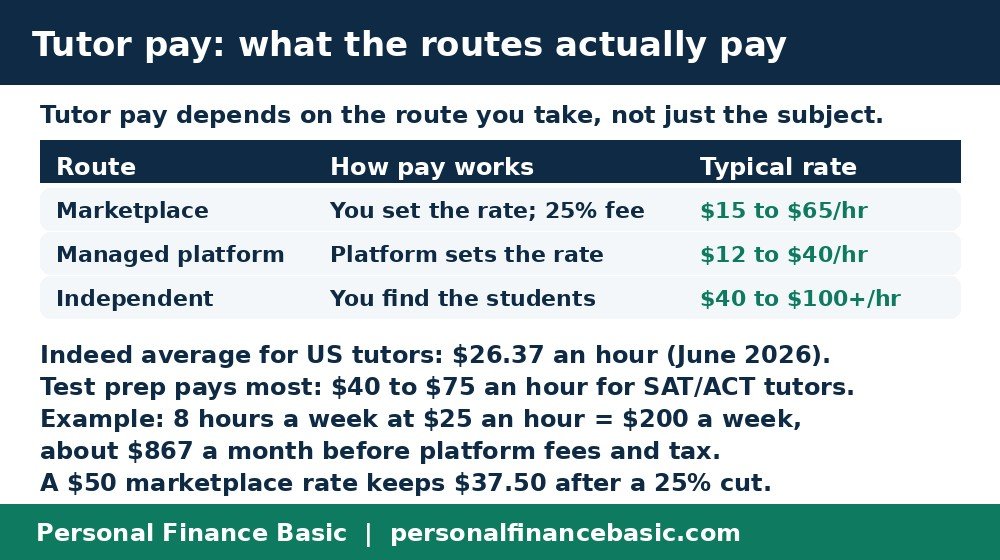
Tutor pay depends on the route you take, not just the subject.
Here is the catch: the cut is real. A $50 rate on a marketplace that takes 25% pays you $37.50 an hour, and some platforms keep the full fee for your first lesson with each new student. Read the fee terms before you set your rate.
Step 3: Set a rate that survives the platform cut
Your rate is a guess until students book, so start in the middle and adjust. For general school subjects, $20 to $30 an hour gets bookings. For test prep, start at $40 to $50.
Do the math on a real week. Eight hours a week at $25 an hour is $200 a week, or about $867 a month before platform fees and tax. On a marketplace keeping 25%, that same week pays $150. Set your rate from what you keep: to pocket $25 an hour after a 25% cut, charge about $33.
Raise your rate by $5 after your first five reviews, and again after ten: students pay for proof, and reviews are the proof.
- Best for: a starting rate of $20 to $30 for school subjects, $40 to $50 for test prep.
- Not for: undercutting everyone at $10 an hour to get bookings; it fills your calendar with students who leave.
Step 4: Run your first sessions like a pro
Your first sessions decide your reviews, and your reviews decide your rate. Keep it simple: a quiet room, stable internet, a laptop with a camera, and a headset, tested before the first session, not during it.
Start each session with one question: what does the student need to be able to do by the end of the hour? Then teach to that answer, and end with one thing to practice before the next session.
Offer a short trial lesson or a free 15-minute chat. It lowers the risk for a new student. Be honest when you cannot help: a student you turn away politely costs you nothing.
Step 5: Grow from a few hours to steady income
The first month is about reviews, not money. Five good reviews let you raise your rate and get picked over tutors with none, so ask every happy student for a review right after the session.
After two or three months, move your regular students to direct bookings. You keep the full rate and stop paying the platform for students you already have.
Tutoring income is taxable, just like any side income. Set aside part of each payment for tax, and track every session, fee and expense. Most platforms treat tutors as independent contractors, so no tax is withheld. And no platform guarantees hours: treat tutoring as extra income on top of your job, not a replacement for it, until you have six months of steady bookings.
At a glance
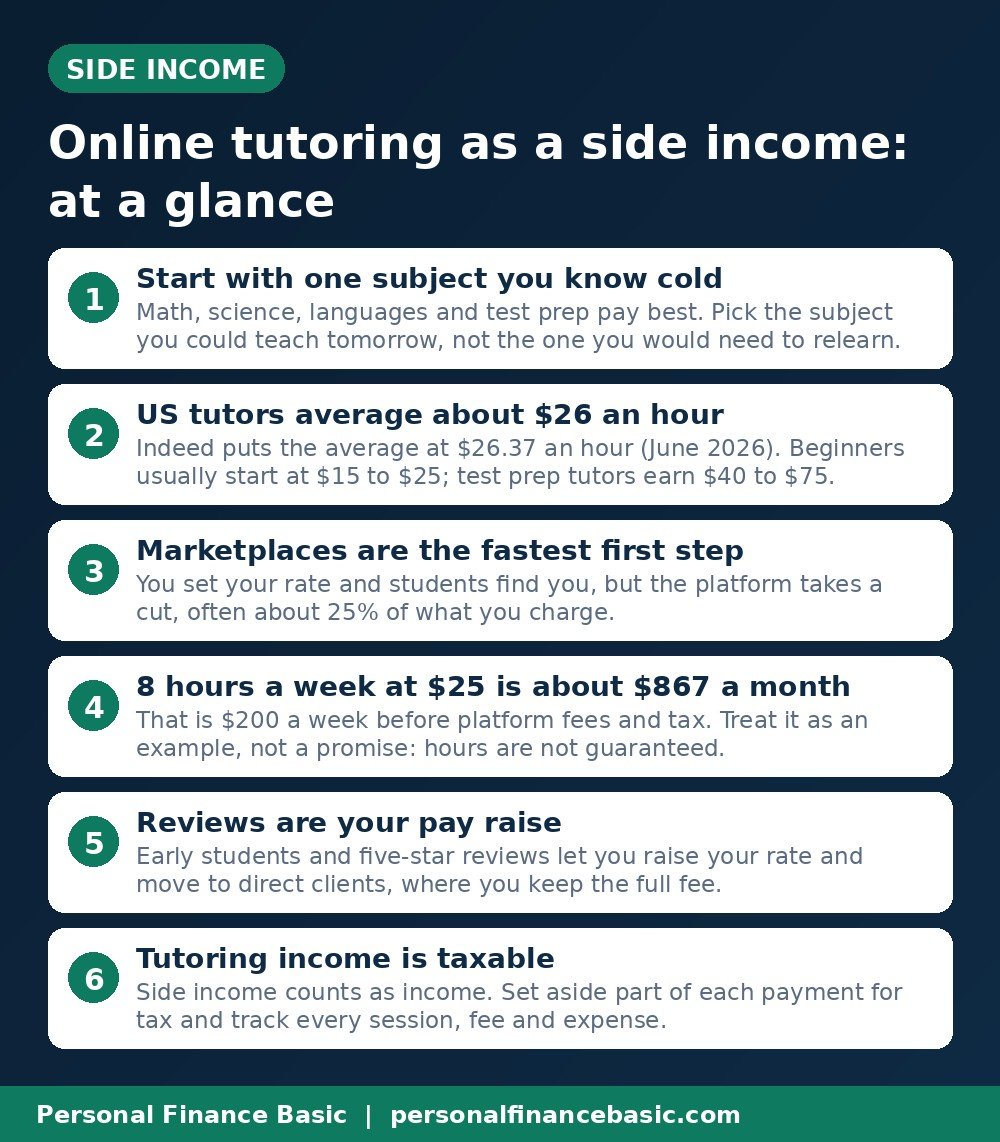
The main points from this guide, in one picture.
Frequently asked questions
Do I need a teaching degree to tutor online?
No. Most marketplaces accept tutors without a teaching degree as long as you can show subject knowledge. Some managed platforms ask for a bachelor’s degree or current college enrollment.
How much can I earn tutoring online?
The average US tutor earns $26.37 an hour, per Indeed in June 2026. Beginners start at $15 to $25, and test prep tutors earn $40 to $75. Eight hours a week at $25 is about $867 a month before fees and tax.
Which subjects pay the most?
Test prep pays the most, at $40 to $75 an hour for SAT and ACT tutors, then coding and professional skills at $50 to $75 and up. General school subjects pay $20 to $45.
How do I get my first student?
Join a marketplace, write a profile about one subject, set a starting rate, and offer a short trial lesson. Most tutors get their first student within two to four weeks.
Do I pay tax on tutoring income?
Yes. Tutoring income counts as income, and most platforms treat tutors as independent contractors, so no tax is withheld. Set aside part of each payment and report it when you file.
The bottom line: pick one subject you know well, start on a marketplace at $20 to $30 an hour, and collect reviews. Eight hours a week at $25 is about $867 a month before fees, and that is a real side income from evenings you already have free.
This post is general education, not financial or tax advice. Tutor pay and platform fees change often; check current rates and terms before you sign up.
Related reading: How to Start Freelancing on the Side While You Have a Job and Do You Pay Tax on Side Income in the US? Beginner Basics