An emergency fund is money set aside for the bills you cannot plan for: a car repair, a broken furnace, a month without pay. It is not an investment and it is not a holiday fund. Its job is simple: to keep a bad week from turning into debt.
The question everyone asks is how much is enough. The usual answer is three to six months of essential expenses. That range is wide on purpose, because the right number depends on your job, your household, and your fixed costs.
What an emergency fund is for
Life sends bills that do not wait for payday. A transmission fails. A tooth cracks. Your hours get cut for a month. Without cash set aside, those costs land on a credit card, where interest rates often run above 20% APR. A $1,200 repair can cost $1,500 or more by the time you pay it off.
The fund also protects your other goals. Without it, a sudden bill can force you to stop retirement contributions, sell investments at a bad time, or borrow from family. With it, the same bill is an annoyance instead of a crisis. That is the whole point: the fund buys you time and choices when something goes wrong. One thing it is not for: everyday spending. A sale, a holiday, or a new phone are planned costs, even if they feel sudden.
The 3-to-6-month rule, in dollars
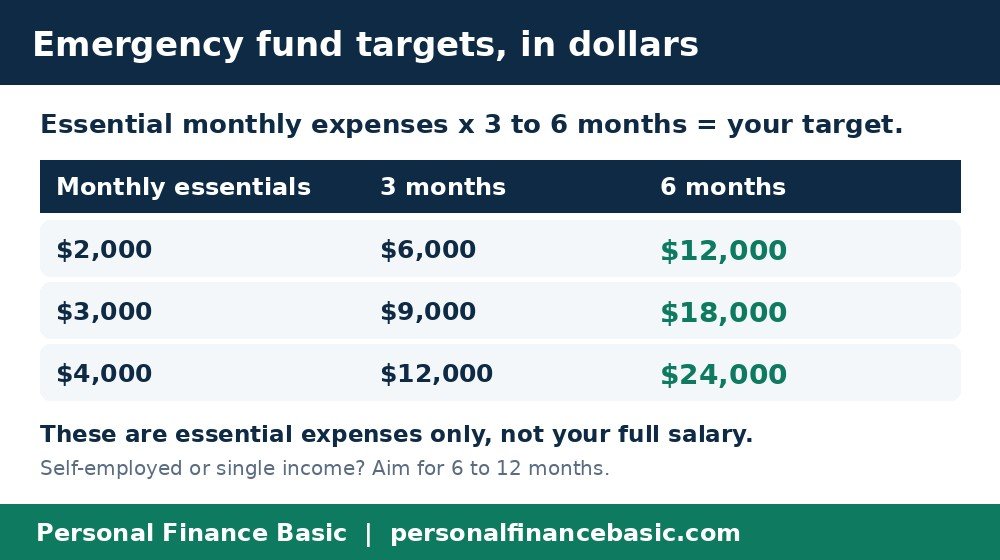
Essential expenses times 3 to 6 months. That is your target.
Here is the rule in dollars. If your essential expenses run $2,000 a month, the range is $6,000 to $12,000. At $3,000 a month, it is $9,000 to $18,000. At $4,000 a month, it is $12,000 to $24,000. Those are big numbers, and most people do not save them in one go. They build them over months and years, a little at a time.
Note the word essential. The fund covers what you must pay to keep life running, not your full spending. Rent, food, utilities, transport, insurance, and minimum debt payments count. Streaming services, eating out, and new clothes do not.
How to work out your number
Start by listing your essential monthly costs. Take a household with rent of $1,400, utilities of $200, groceries of $450, car costs of $350 for the payment, gas, and insurance, a phone bill of $70, and a minimum card payment of $80. That adds up to $2,550 a month.
Multiply that figure by 3 and by 6. Three months comes to $7,650. Six months comes to $15,300. That is the range for this household. The same math works at any level: add up the essentials, multiply by the number of months you want covered, and you have your target.
Use your real numbers, not a round guess. Two households with the same pay can have very different essential costs. A renter with no car payment might need $2,000 a month. A homeowner with a mortgage, two cars, and a child in daycare might need $5,000. Check your last three bank statements and add up the bills that repeat every month.
When 3 months is enough, and when you need more
Three months is a fair target when your situation is steady. Two incomes in the household, both jobs stable, good health insurance, no dependents, and low fixed debt all point to the lower end. If one income stopped, the other would still cover most of the bills.
Six months fits better when the risk is higher. A single income supporting the household, self-employment or freelance work, pay that changes month to month, or a job in a field where hiring moves slowly all argue for a bigger cushion. Parents with dependents usually want more too.
Some people keep nine to twelve months. Freelancers, business owners, and anyone whose income depends on one big client often do. There is no prize for the biggest fund, but there is real comfort in knowing a long job search would not touch your rent.
Where to keep the money
A high-yield savings account is the usual home for an emergency fund. The money is easy to reach, it earns a fair rate, and deposits are insured by the FDIC up to $250,000 per depositor, per bank, per ownership category. Top rates in late 2026 run around 4.2% to 4.5% APY, while the national average sits at 0.38% APY. On a $10,000 fund, that difference is worth about $380 to $410 a year.
Do not put the fund in stocks. The money must be there in full when you need it, and markets fall at the worst times. A fund that drops 20% in the same month you lose your job is not a safety net. The same logic rules out crypto and any investment that can lose value.
Do not keep it as cash at home either. Cash earns nothing, it is not insured if it is stolen or lost in a fire, and it is too easy to spend on things that are not emergencies. Keep a small buffer in checking for same-day needs, and the rest in savings.
How to build it without feeling it
Start with a starter goal of $500 to $1,000. That covers most common surprises: a car repair, a vet bill, a broken appliance. A small fund beats no fund. Then raise the goal to one month of essentials, then three, then six.
Automate it. Set a transfer for the day after payday, so the money moves before you can spend it. At $100 a month you save $1,200 in a year. At $200 a month you save $2,400. On a $9,000 target, $200 a month takes 45 months, while $500 a month takes 18 months.
Use windfalls to speed it up. A tax refund, a work bonus, or money from selling things you no longer need can jump the fund forward by months. If you get a pay rise, send half of the extra to the fund until it is full.
Keep the fund in a separate account with its own name, such as Emergency Fund. Most banks let you open a second savings account in a few minutes, and a separate account makes it harder to dip into by accident.
At a glance
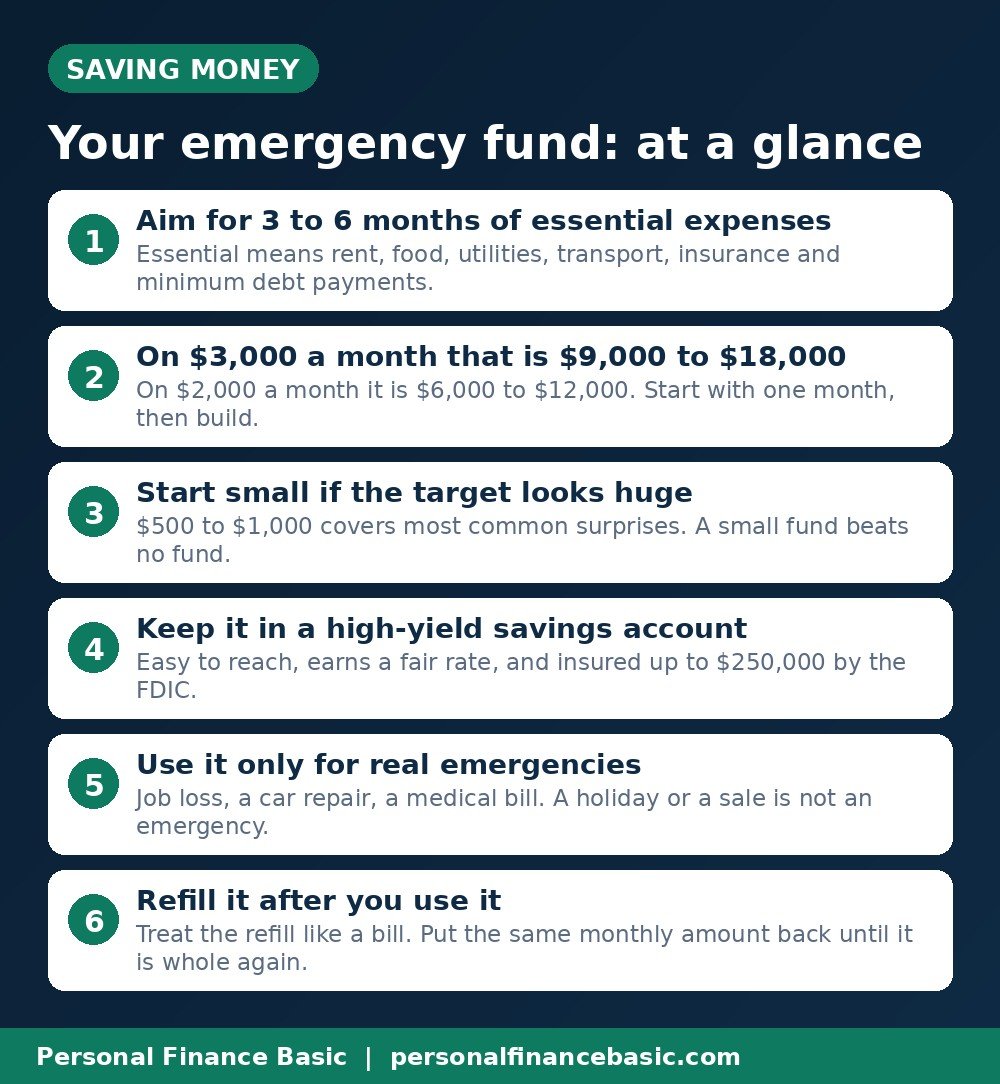
The main points from this guide, in one picture.
Frequently asked questions
Is $1,000 enough for an emergency fund?
As a starter, yes. It covers most single repairs and bills, and it stops small problems from going on a credit card. Treat it as step one, and keep building toward three months of essentials.
Should I pay off debt or build the fund first?
Do both in order. Save a starter fund of $500 to $1,000 first, then pay off high-interest card debt, then build the fund to its full target.
Does the money need to be in a separate account?
It helps. A separate high-yield savings account keeps the fund visible, earns interest, and makes it harder to spend by accident.
What counts as an emergency?
Job loss, a medical bill, a car repair, or a home repair you cannot put off. A holiday, a sale, or a new gadget does not count, even if it feels urgent. If you can plan for it, it is not an emergency.
How often should I check my target?
Once a year, or whenever your expenses change in a big way. A new rent, a new baby, or a paid-off car loan all change the monthly figure.
This guide is general education, not financial advice. Your right emergency fund size depends on your job, household, and costs. Consider speaking with a qualified financial adviser about your own situation.
Related reading: High-Yield Savings Accounts: What to Look For and The 50/30/20 Rule With US Examples ($3,000 a Month)