You are at checkout, and the total is $400. The store offers to split it into four payments of $100, with no interest. If you pay on time, it nearly is free.
Buy now, pay later has grown fast. The Consumer Financial Protection Bureau (CFPB) found that the five largest providers went from about $2 billion in loans in 2019 to $24.2 billion in 2021. Adobe expects Americans to put $21.3 billion of holiday spending on buy now, pay later this season.
Here is how it works, what it costs when a payment is missed, and when it beats a credit card and when it does not.
The short answer
Buy now, pay later splits a purchase into short installments, usually four payments over six weeks with no interest if you pay on time. It is still debt. Miss a payment and late fees apply.
The quick framework:
- Check the total cost, including interest on longer plans.
- Count every payment due before your next payday.
- Read the late-fee and returns terms before you accept.
- Know how it affects your credit report.
- Keep it to one plan at a time.
Quick decision guide:
- Buying something you already budgeted for, and you can pay it off in six weeks? A pay-in-4 plan is fine.
- Need more than six weeks to pay? A longer plan charges interest like a loan, so check the rate first.
- Buying from a store with a tricky returns policy? A credit card gives you stronger dispute rights.
- Already juggling two or three plans? Say no to another one.
Step 1: Work out what it really costs
The standard plan is called pay-in-4. You pay 25% at checkout, then three more payments every two weeks. A $400 purchase becomes $100 now and $100 three more times, with no interest if you pay on time.
The trouble starts with the longer plans. Some providers offer 6- or 12-month plans that charge interest, just like a loan, and the monthly payment hides the total.
Take a $1,000 purchase on a 12-month plan at 25% APR. The monthly payment is about $95, and the total paid is about $1,141, so $141 of interest. The same $1,000 split over four payments would cost $1,000, if you can pay it off in six weeks.
Always read the rate before you pick a longer plan.
- Best for: a planned purchase you can clear in six weeks.
- Not for: stretching a purchase you cannot afford into a year of payments.
Step 2: Count the payments against your paydays
One plan is easy to manage. Five are not. Each plan takes its payment on its own schedule, and the dates rarely line up with your payday.
Add up every payment due before your next payday, across all your plans. If three plans each take $75 in the same week, that is $225 gone before rent and bills.
The CFPB has warned about loan stacking, where people take out several small plans at once and the total becomes a real monthly bill. Set your own limit before you shop: one plan at a time, and never more than you could pay off from one paycheck.
- Best for: one purchase, one plan, paid off before the next big bill.
- Not for: covering a shortfall in your regular budget.
Step 3: Read the late-fee and returns terms
Miss a payment and the provider charges a late fee, though some charge nothing for a first miss. Some providers also pause your account until you catch up. A payment that stays unpaid can be sent to collections.
Returns are the part most people miss. With a credit card, federal law gives you the right to dispute a charge and get a refund while it is sorted out. Buy now, pay later does not have that protection.
The CFPB tried to fix this. In May 2024 it issued a rule treating many buy now, pay later providers like card issuers, with card-style dispute rights. In May 2025 the CFPB withdrew that rule, so today your dispute rights come from your provider’s own terms, not federal law.
That means if an item arrives broken or never arrives, you still owe the payments while you argue about it. Keep every receipt, photo and message, because your records are your only leverage.
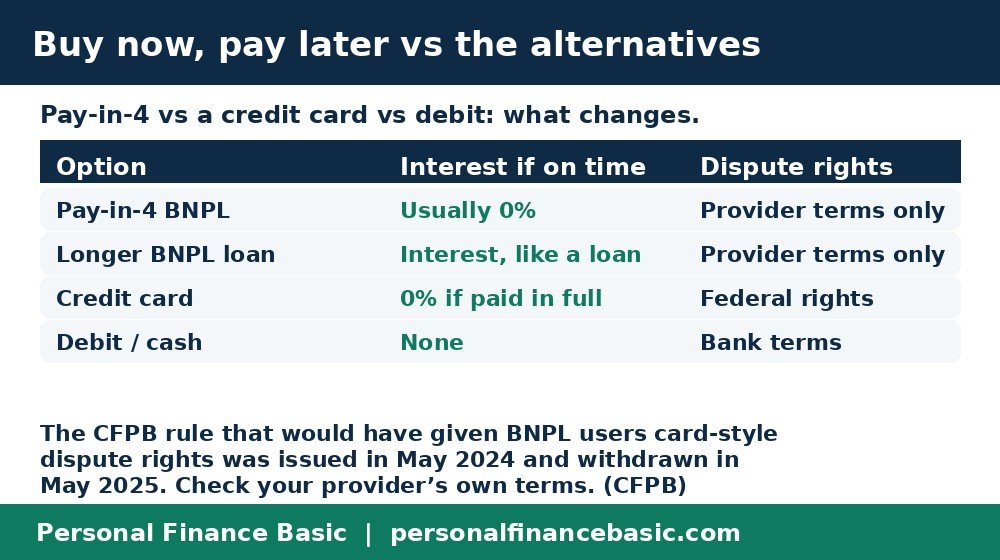
Buy now, pay later vs the alternatives.
- Best for: buying from a store you trust, where returns are easy.
- Not for: a big purchase from a seller you have never used before.
Step 4: Know how it affects your credit score
Paying a pay-in-4 plan on time may not help your credit score at all. The CFPB found that most buy now, pay later loans made in 2022 did not appear in credit records, because the providers were not reporting them to the credit bureaus.
That is changing. FICO said in June 2025 that it will include buy now, pay later data in its FICO Score 10 T, and some providers have started reporting. But it is not uniform yet, so do not count on on-time payments to build your credit.
The risk runs the other way. A missed payment sent to collections can land on your credit report for up to seven years. A forgotten $100 plan can do more damage than a $1,000 card balance you manage well.
- Best for: people who want to avoid a hard inquiry for a small purchase.
- Not for: building credit. A secured card or a small loan reported to the bureaus does that job better.
At a glance
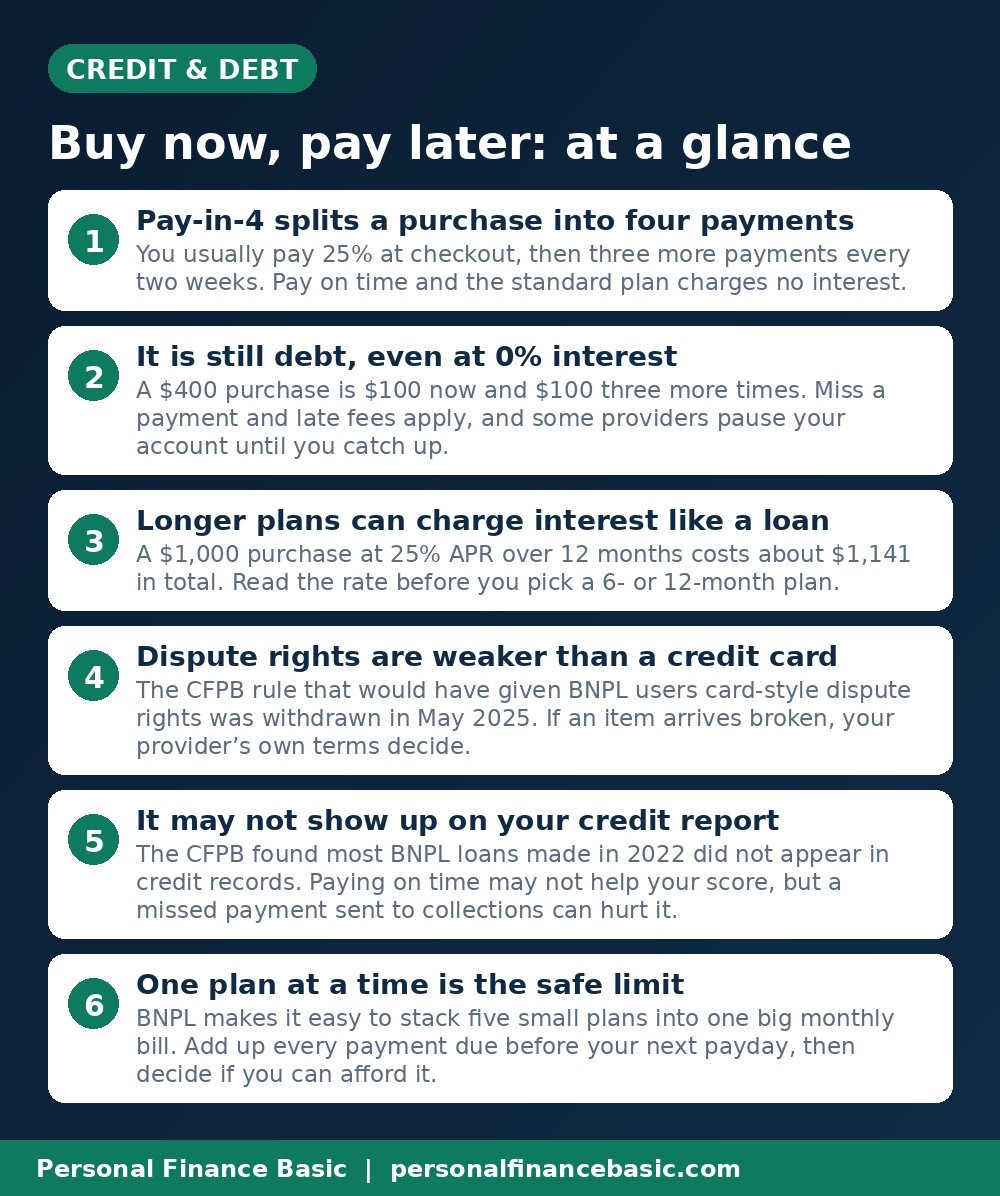
The main points from this guide, in one picture.
Frequently asked questions
Is buy now, pay later really interest-free?
The standard pay-in-4 plan is, if you pay on time. You pay 25% at checkout and three more payments every two weeks, with no interest. Longer plans of 6 or 12 months often charge interest, so check the APR first.
What happens if I miss a buy now, pay later payment?
You will usually be charged a late fee, and some providers pause your account until you catch up. If it stays unpaid, it can be sent to collections and hurt your credit score.
Does buy now, pay later affect my credit score?
A pay-in-4 plan usually uses a soft check that does not affect your score, and on-time payments often do not appear on your credit report at all. A missed payment sent to collections can hurt your score.
Can I dispute a buy now, pay later charge like a credit card charge?
Not in the same way. The CFPB rule that would have given buy now, pay later users card-style dispute rights was withdrawn in May 2025. Your rights now come from your provider’s own terms, so read them and keep your receipts.
Is buy now, pay later better than a credit card?
It depends. For a planned purchase you can clear in six weeks, pay-in-4 is cheaper than carrying a card balance, because there is no interest. For a bigger purchase, or one you might need to return, a credit card is better: it has federal dispute rights and a grace period.
The verdict
Buy now, pay later is a useful tool for one planned purchase you can clear in six weeks. It turns into a trap when you stack plans, pick a longer plan without reading the rate, or use it for things you cannot afford.
If you want to see what carrying a balance really costs, try our credit card payoff calculator, and read our guide to shopping the sales without overspending before the next big sale.
This post is general education, not financial advice. Buy now, pay later terms vary by provider, and rules can change; check the terms on your own plan before you accept it.