No. Checking your own credit score does not hurt it, not by one point. The Consumer Financial Protection Bureau (CFPB) says so plainly: checking your own credit report or credit scores does not affect your credit scores. Some checks do affect your score, and people mix up the two kinds. This guide explains the difference, what moves your score, and how to check your credit for free.
There are two kinds of credit inquiry. A soft inquiry happens when you check your own credit, when a lender sends you a prescreened offer, or when an existing creditor reviews your account. A hard inquiry happens when a lender checks your file because you applied for new credit. Only the hard kind can move your score, and even then the effect is small.
Soft inquiry vs hard inquiry
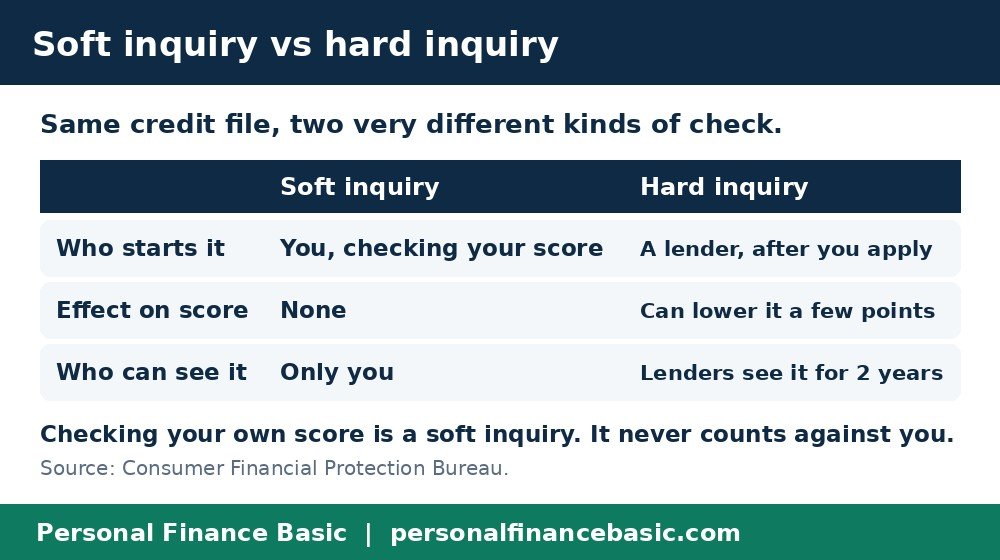
The check that hurts is the one a lender runs after you apply.
A soft inquiry is a look at your credit file that is not tied to an application for new credit. Checking your own score through your bank, your card issuer, or a credit bureau is a soft inquiry, as is a lender checking your file to send a prescreened offer. Soft inquiries do not affect your score at all; scoring models ignore them. They can appear on the version of your report that only you can see, but other lenders do not see them.
A hard inquiry happens when you formally apply for a credit card, a car loan, a mortgage, or another form of credit, and the lender pulls your report to decide. The lender needs your permission, given when you submit the application. A hard inquiry can lower your score by a few points, usually fewer than five, though the exact effect depends on the rest of your file. The effect is temporary: it stays on your report for two years but only affects a FICO score for about one year.
That is why the line between “check” and “apply” matters. Reading your score is a check; submitting an application is an application. A site that shows you a score and then asks you to apply for a card has moved from one to the other, so read the screen before you click through.
Where to check your score for free
You can get your credit reports free every week from AnnualCreditReport.com, the federally authorized source for reports from Equifax, Experian, and TransUnion. Federal law used to guarantee one free report per bureau per year; all three now let you check weekly. Checking there is a soft inquiry, so you can do it as often as you like.
Your credit report and your credit score are not the same thing. The report is the raw file: your accounts, balances, payment history, and inquiries. The score is a three-digit number calculated from that file, usually on the FICO scale of 300 to 850. AnnualCreditReport.com gives you the reports, not the scores. For the score itself, many banks and card issuers show it free, so check there before paying a site for one.
One warning: the score you see depends on the model, the bureau, and the date. FICO and VantageScore are different models and can give different numbers from the same file, and a score from Experian and one from TransUnion can differ too. Compare scores only when the model, bureau, and date match.
What actually moves your score
Hard inquiries are a small part of a credit score. Under the FICO model, new credit, which includes hard inquiries, counts for about 10%. Payment history counts for about 35%, amounts owed for about 30%, length of history for about 15%, and credit mix for about 10%. One hard inquiry matters far less than a missed payment or a balance close to its limit.
That is why your score can change shortly after you check it, even though the check did nothing. A card balance reported that week, a payment posted late, or a new account opened can all move the number. If your score drops the day after you check it, look at what else changed.
The fastest way to protect your score is steady: pay every bill on time, keep card balances well below their limits, and do not open several new accounts in a short period. Checking your own score fits into that routine; it is how you catch errors early.
Rate shopping does not have to cost you
One place where hard inquiries worry people is rate shopping: applying to several lenders to compare mortgage, auto loan, or student loan rates. Scoring models handle this with a special rule: multiple inquiries for the same kind of loan within a short window count as a single inquiry. The window is 14 to 45 days, depending on the model; the CFPB notes a 45-day window for mortgage shopping.
Keep your rate shopping close together: apply to the lenders you want to compare within a few weeks, not spread over months. Do not apply for a new credit card mid-mortgage, because that is a separate inquiry for a different kind of credit.
Before you apply for anything, check your own credit first. Look for errors: an account you do not recognize, a balance that is wrong, a payment marked late that you made on time. Errors like these can cost you a better rate or a loan approval, so dispute any you find before you apply.
How often should you check?
Once a month is enough for most people. Pick a date, such as the first of the month, and look at one bureau’s report or your bank’s free score. Checking weekly is fine too, since it costs nothing and hurts nothing, but a monthly habit is easier to keep.
When you check, look at more than the number. Read the accounts list and the balances, and check that every account belongs to you and the payment history is right. The number is a summary; the report is the detail behind it.
Checking your own credit is one of the few money habits with no downside. It costs nothing, takes a few minutes, and cannot lower your score. The check that can lower it follows an application, a choice you make when you decide to borrow.
At a glance
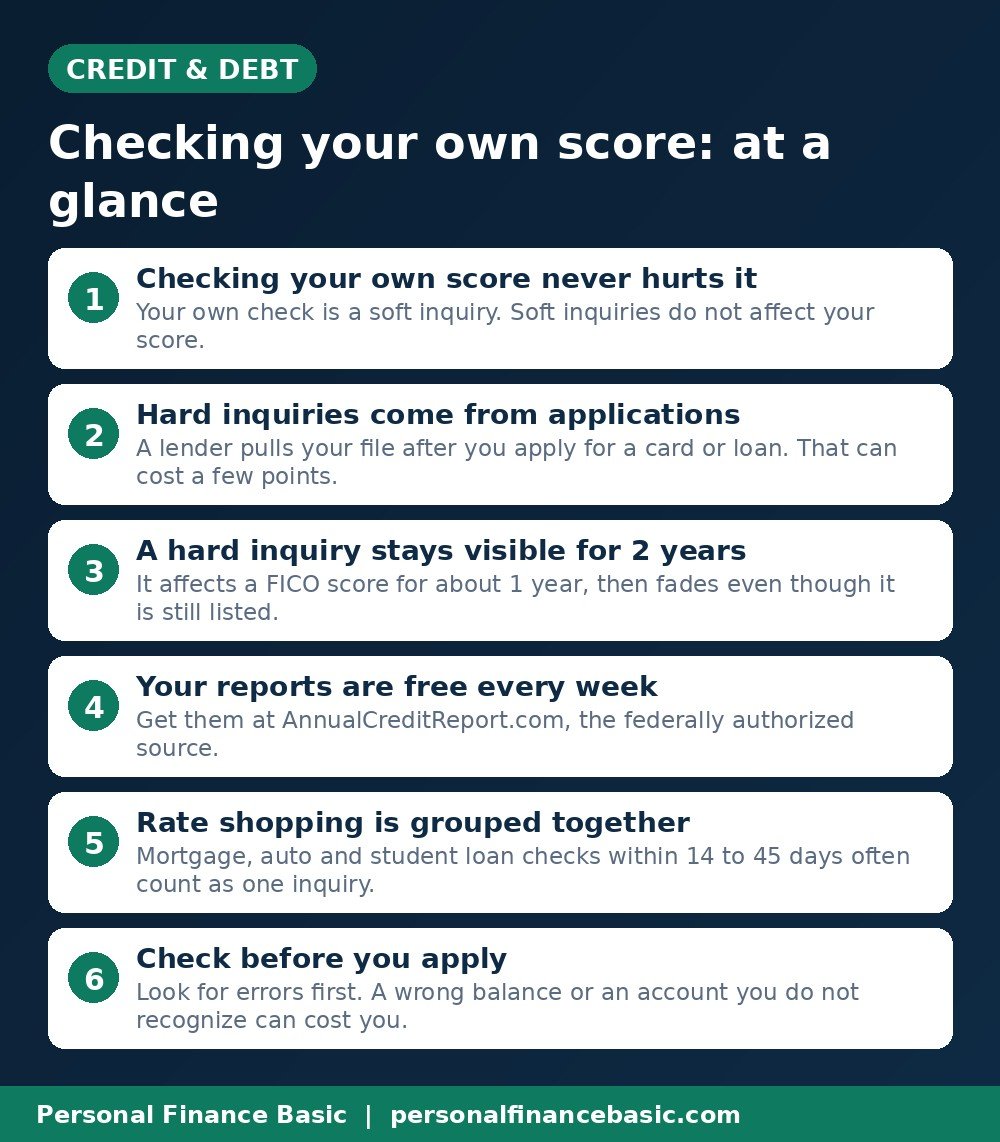
The main points from this guide, in one picture.
Frequently asked questions
Does checking my credit score on my bank’s app lower it?
No. A score shown by your bank or card issuer is a soft inquiry, and soft inquiries never affect your score.
Will applying for a credit card lower my score?
It can, by a few points, because the lender runs a hard inquiry when you apply. The effect is usually small and fades within about a year. One application matters far less than paying on time and keeping balances low.
How long does a hard inquiry stay on my report?
Two years. It only affects a FICO score for about one year, then stops counting, and after two years it disappears entirely.
Do lenders see my soft inquiries?
No. Soft inquiries appear only on the version of your report that you can see. Lenders see hard inquiries, accounts, balances, and payment history.
Is AnnualCreditReport.com really free?
Yes. It is the federally authorized source for free reports from Equifax, Experian, and TransUnion, and you can check each bureau’s report once a week for free. Watch out for look-alike sites that charge a fee or push a paid subscription.
This guide is general education, not financial advice. If you find an error on your report, dispute it directly with the credit bureau that lists it.
Related reading: How to Improve Your Credit Score in 6 Months and What Is APR? A Plain-English Guide With Examples