Most savings accounts pay almost nothing. The national average was 0.38% APY in October 2026, according to the FDIC: about $38 of interest in a year on $10,000. A high-yield savings account pays far more on the same money, with the same federal insurance behind it. Top rates in late 2026 run around 4.2% to 4.5% APY, or roughly $420 to $450 a year on $10,000.
The gap is real, but the label alone is not enough. Some top rates need direct deposit, apply only to the first $5,000, or drop after a few months. This guide covers what the account is, what the gap is worth in dollars, and what to check before you open one.
What a high-yield savings account is
A high-yield savings account is a regular savings account that pays a higher interest rate than the national average. It holds your money the same way and is insured the same way. The difference is the rate, and the reason is usually the bank: most high-yield accounts come from online banks, which have no branches to run and pass some of that saving on as a higher rate.
There is no special risk in the higher rate itself. Your deposit at an FDIC-insured bank is covered up to $250,000 per depositor, per bank, per ownership category, whether the account pays 0.01% or 4.5%, and a credit union account carries the same protection through the NCUA.
Rates on these accounts are variable. The bank can raise or lower the rate at any time, usually following the Federal Reserve’s benchmark rate, which stood at 3.75% to 4.00% after the Fed’s October 28, 2026 meeting. A rate you see today is a snapshot, not a promise.
The rate gap, in dollars
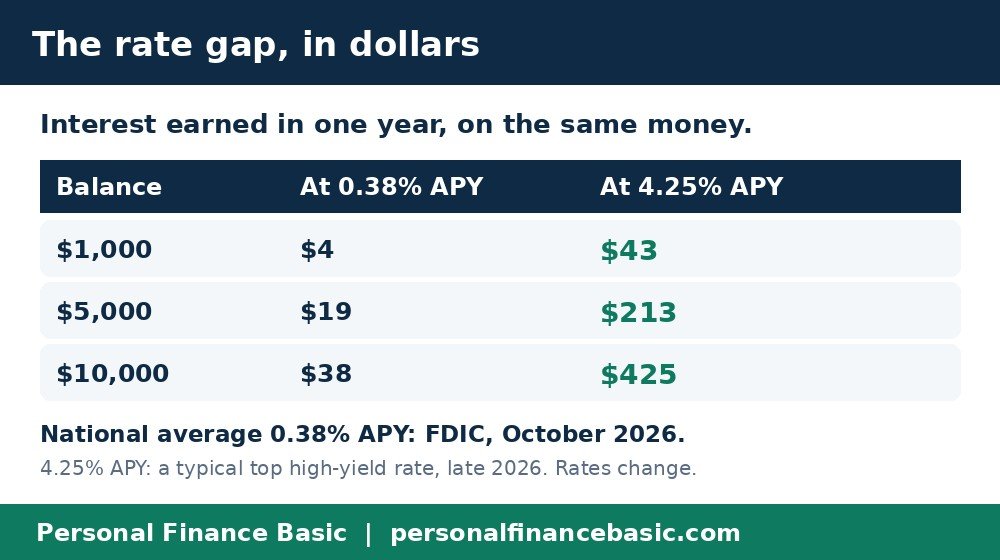
The same balance, the same safety. The rate decides what you earn.
Here is the gap in dollars. At the FDIC national average of 0.38% APY, $1,000 earns about $4 in a year, $5,000 earns about $19, and $10,000 earns about $38. At 4.25% APY, a typical top rate in late 2026, the same balances earn about $43, $213, and $425.
On a $10,000 emergency fund, the difference is about $387 a year, for doing nothing different except choosing a different account. On $1,000, it is about $39 a year. The gap grows with the balance, so the bigger your cash savings, the more the choice matters.
These are one-year figures, before tax. Interest is taxed as ordinary income, and the bank sends a 1099-INT form if you earn $10 or more in a year.
APY is the number to compare
Two rates show up on savings accounts: the interest rate and the APY, or annual percentage yield. The interest rate is the simple yearly rate; the APY includes compounding, which means earning interest on interest already added. If a bank pays interest monthly, the APY is slightly higher than the stated rate.
Compare APY to APY. It is the only figure that already counts compounding. A 4.25% APY and a 4.20% interest rate are not the same thing, and the APY is the one that tells you what you actually earn in a year.
What to look for before you open one
First, check the rate and how it is earned. The headline rate is not always the rate every dollar earns: some accounts pay the top rate only up to a limit, such as the first $5,000, and a much lower rate above that. Others require direct deposit or a linked checking account. Read the rate disclosure and work out what rate your balance would earn.
Second, confirm the insurance. The bank should be FDIC-insured, or the credit union NCUA-insured. You can check a bank on the FDIC’s BankFind Suite site in about a minute. If the account is offered through a fintech app, find out which partner bank holds the money and confirm that bank is insured.
Third, look for fees and minimums. The best high-yield accounts charge no monthly fee and ask for no minimum balance. Some charge a fee if the balance falls below a set amount. A $5 monthly fee wipes out the extra interest on a $1,000 balance at 4.25% APY, which earns about $3.54 a month. The fee matters more than the rate when the balance is small.
Fourth, check how fast you can get your money out. Transfers to an outside bank usually take one to three business days, though some offer same-day transfers to a linked checking account. For an emergency fund, a two-day wait is fine if you keep a checking buffer. For money you might need tonight, it is not.
Fifth, watch for promo rates. Some accounts open with a high rate that drops after three or six months. Note the end date and what the rate falls to: a 5% promo that drops to 1% after three months earns less over a year than a steady 4.25%.
What this account is for, and what it is not for
A high-yield savings account is the right home for money you need within the next year or two: an emergency fund, a house down payment, a holiday fund, or tax money set aside for April. The money stays safe, earns a fair return, and is there when you need it.
It is not an investment account. A 4.25% return does not keep up with the stock market over ten or twenty years, and it is not meant to. Money you will not touch for a decade belongs in investments; use the savings account for money that has a job soon.
How to switch without missing a beat
Opening a high-yield account takes about ten minutes online: your name, address, date of birth, Social Security number, and a link to your current bank account. The bank verifies your identity, and the first transfer usually takes a few days to clear. Transfer a small test amount first, confirm it arrives, then move the rest. Do not close your old account until the new one is working, and check the rate every few months.
At a glance
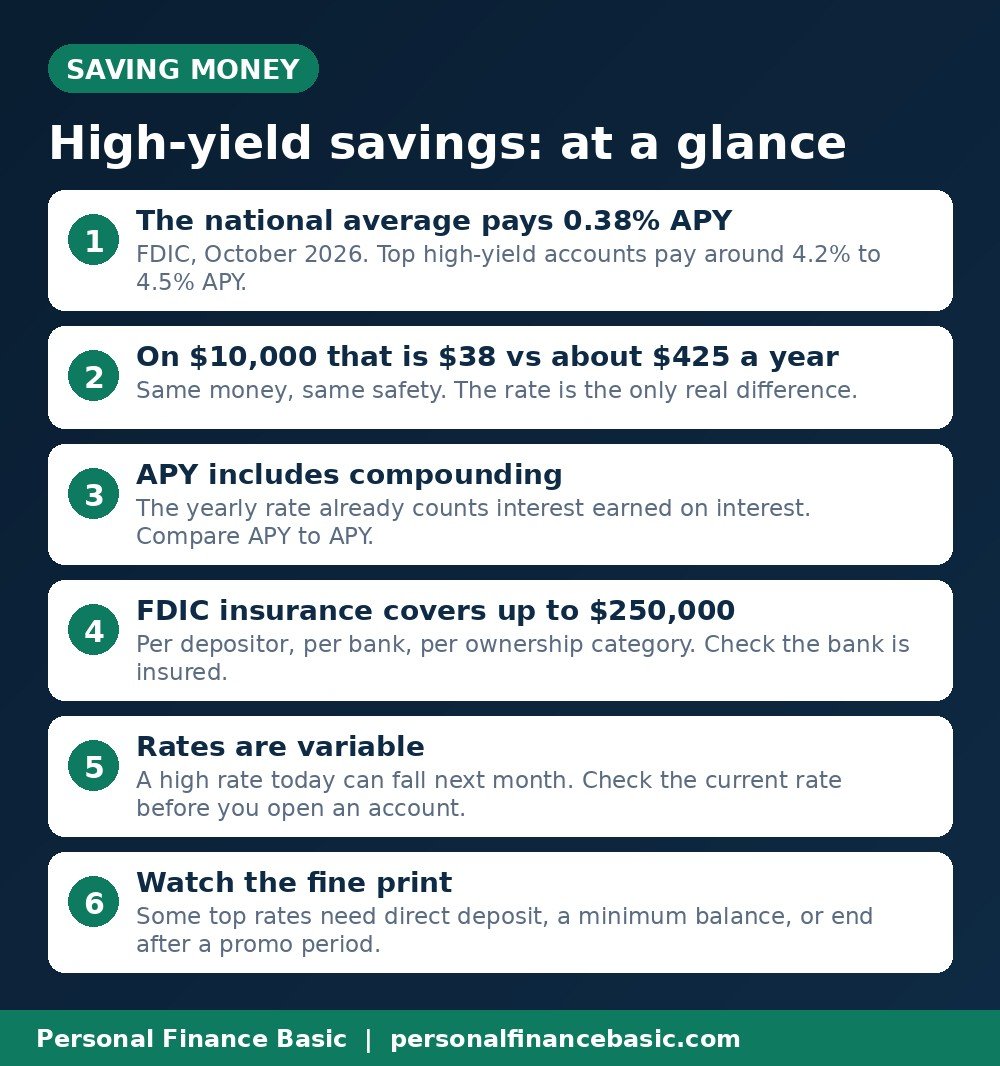
The main points from this guide, in one picture.
Frequently asked questions
Is my money safe in a high-yield savings account?
Yes, if the bank is FDIC-insured or the credit union is NCUA-insured. Coverage is up to $250,000 per depositor, per bank, per ownership category.
Why do online banks pay so much more?
Online banks have no branches to staff and maintain, so their costs are lower, and many pass part of that saving to savers as a higher rate.
Can the rate go down after I open the account?
Yes. High-yield savings rates are variable and usually move with the Federal Reserve’s benchmark rate. Check your rate every few months, and switch if your account drifts far below the top rates.
Is there a catch with the top rates?
Sometimes. A top rate may require direct deposit, apply only up to a balance limit, or last only for a promo period. Read the rate disclosure first.
Should I move my emergency fund to a high-yield account?
For most people, yes. An emergency fund sits untouched for months or years, so it should earn a fair rate while it waits. Keep a small buffer in checking for same-day needs and the rest where it earns more. Check the transfer time first.
This guide is general education, not financial advice. Savings rates change often; the rates quoted here are from October and November 2026. Check the current APY, fees, and terms on the bank’s own site before you open an account.
Related reading: Checking vs Savings Account: What Is the Difference? and What Is an Index Fund? A Beginner Explanation