You pay rent every month and wonder when saving for a down payment stops feeling impossible. The median existing home in the US cost $416,700 in October 2026, according to the National Association of Realtors.
On that home, 3% down is $12,501, the minimum for some conventional loans for qualified first-time buyers. It is a target you can plan for, not a wall to jump in one go.
Here is how to pick your target, set a monthly number, and get it saved.
The short answer
You do not need 20% down to buy a home. You need a target amount, a monthly savings number, and a separate account the money goes into automatically.
The quick framework:
- Pick a home price, using local prices or the $416,700 national median.
- Choose a down payment: 3%, 3.5%, 10% or 20%.
- Add closing costs, usually 2% to 5% of the price.
- Divide the total by the months you have, and save that amount.
- Automate the transfer on payday so the money leaves before you can spend it.
Quick decision guide:
- Lowest cash to get in? Aim for 3% conventional or 3.5% FHA.
- Smallest monthly payment? Aim for 20% down.
- Buying within a year? Pick the smaller target and start now.
- Unsure about prices? Save the 3% target first, then keep going.
Step 1: Pick your price target
Start with the homes you would actually buy, not the national median. Look at recent sale prices where you want to live: a $250,000 home in one city and a $650,000 home in another need very different savings plans.
Take Maya, an example buyer. She wants a home around $400,000, close to the national median, and her numbers below use that price. Do not set the target from the most expensive home you could stretch to buy. Set it from a home you would be happy living in for five years or more.
- Best for: anyone who has not bought before and needs a concrete number to aim at.
Step 2: Choose your down payment percentage
The percentage changes three things: the cash you need, the size of your loan, and whether you pay mortgage insurance. Conventional loans allow 3% down for qualified first-time buyers; FHA loans allow 3.5% with a credit score of 580 or higher.
On the $416,700 median home, the amounts look like this at an example 7% rate on a 30-year loan:
| Down payment | Cash needed | Loan amount | Monthly principal and interest* | Insurance |
|---|---|---|---|---|
| 3% (conventional) | $12,501 | $404,199 | $2,689 | PMI |
| 3.5% (FHA) | $14,585 | $402,115 | $2,675 | MIP |
| 10% | $41,670 | $375,030 | $2,495 | PMI |
| 20% | $83,340 | $333,360 | $2,218 | None |
*Example at a 7% rate. Your rate depends on your credit, the market and the lender.
The gap between 3% and 20% down is about $471 a month in principal and interest alone. Mortgage insurance adds more: PMI at an example 0.5% of the loan a year is about $168 a month on the 3% loan. Conventional PMI can be cancelled at 20% equity; FHA insurance usually lasts the life of the loan under 10% down, plus a 1.75% upfront fee.
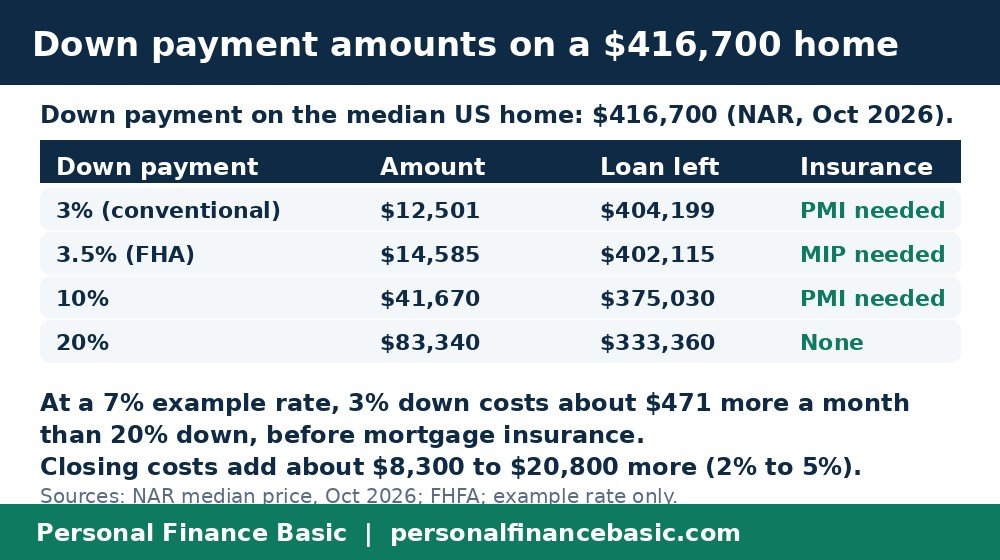
Down payment amounts on a $416,700 home.
A small down payment gets you in sooner with a higher monthly cost. A big one costs more time to save but buys a cheaper payment.
- Best for: 3% down suits buyers with steady income and good credit who want to buy within a year or two.
Step 3: Add closing costs and a cushion
The down payment is not the whole cash you need. Closing costs usually run 2% to 5% of the home price: about $8,300 to $20,800 on a $416,700 home. Some buyers ask the seller to cover part of this, but plan as if you pay it yourself.
Then add $2,000 to $3,000 for moving and the first month. Do not drain your emergency fund for the down payment. So Maya’s real target is not $12,501. With 3% down, closing costs of about $12,000 and a $2,500 cushion, her cash target is about $27,000.
Step 4: Set your monthly number
Divide the target by the months you have:
| Monthly saving | Months to $12,501 | Months to $27,000 (with costs) |
|---|---|---|
| $500 | 25 months | 54 months |
| $750 | 17 months | 36 months |
| $1,000 | 13 months | 27 months |
Simple division, before any interest earned. A savings account adds a little on top.
If the monthly number is more than you can save, change the timeline or the target, not the plan. Saving $500 a month for 25 months beats $1,000 a month for three months and giving up. Find it in three places: a spending cut, a bill you can lower, and extra income. A $200 cut, a $100 bill saving and $200 of extra income is $500 a month.
Step 5: Automate it, keep it separate, and speed it up
Open a separate high-yield savings account just for the down payment: money in checking gets spent, and money in a separate account feels off limits. Set an automatic transfer for payday; if you are paid biweekly, split the monthly number in half.
Check the balance every month, and move any windfall straight in: a tax refund, a work bonus, a rebate. A $2,000 tax refund is four months of $500 saving in one move. To speed things up, look at down payment assistance programs in your state or city, and ask family about a gift: lenders allow gift funds with a gift letter, and FHA loans allow the whole down payment to come from a gift.
Do not borrow the down payment on a credit card or a personal loan, and do not cash out a 401(k) to fund it. Borrowing can hurt your mortgage approval, and a retirement withdrawal usually means taxes and a penalty.
At a glance
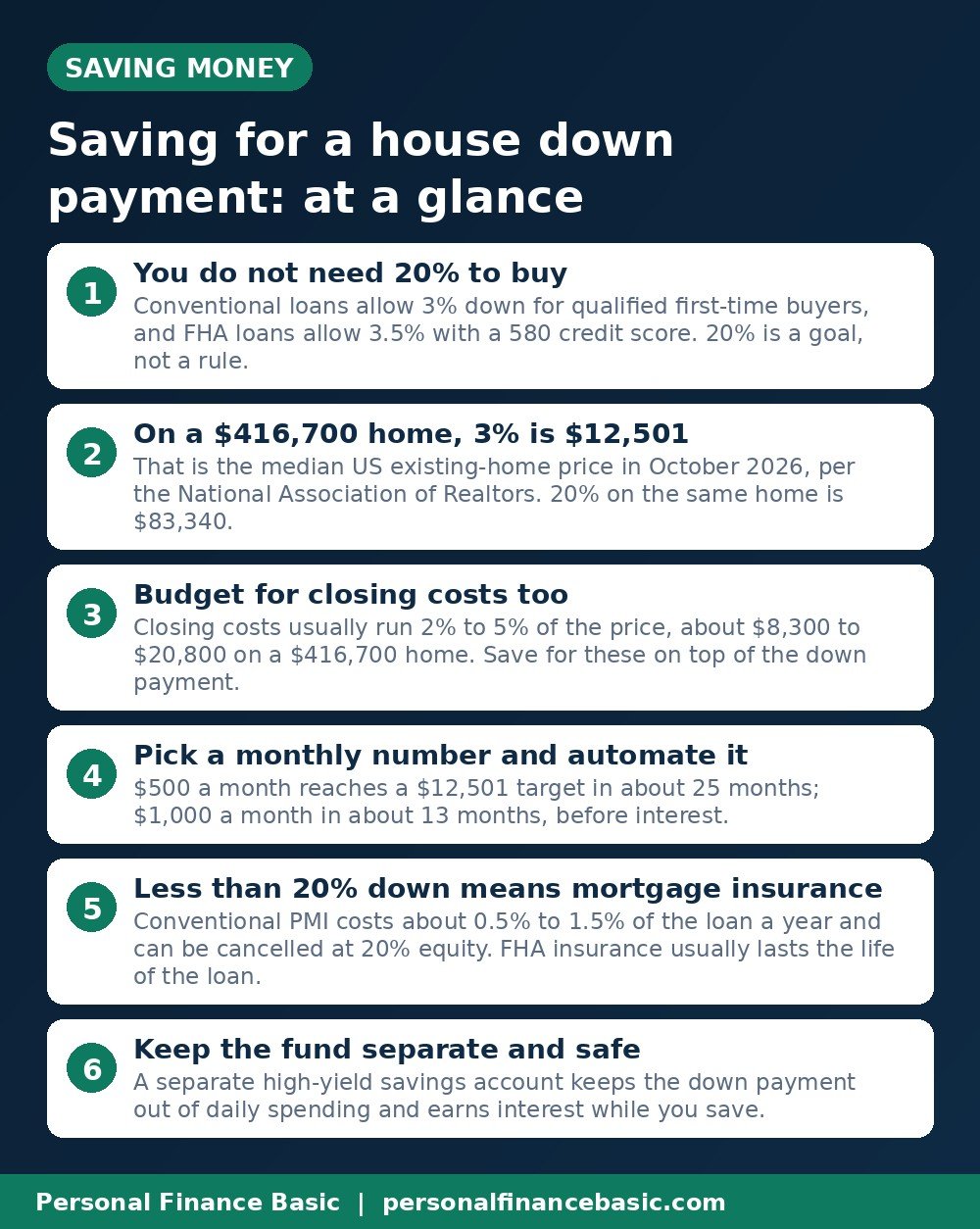
The main points from this guide, in one picture.
Frequently asked questions
How much down payment do I need to buy a house?
Conventional loans allow 3% down for qualified first-time buyers, FHA loans allow 3.5% with a 580 credit score, and 20% down avoids mortgage insurance. On the $416,700 median home, that is $12,501, $14,585 and $83,340.
Is 20% down still required?
No. The 20% figure is a threshold, not a rule. Putting 20% down avoids mortgage insurance, but most first-time buyers put down far less, around 8% according to the National Association of Realtors.
How long does it take to save a down payment?
It depends on the target and the monthly amount. Saving $500 a month reaches a $12,501 target in about 25 months, before interest; $1,000 a month gets there in about 13 months. Add closing costs to the target before you count the months.
Can I use gift money for a down payment?
Yes, in most cases. Lenders allow gift funds with a signed gift letter. FHA loans allow the whole down payment to come from a gift; conventional loans may require some of your own money, so ask the lender.
Should I keep saving for 20% or buy with 3% down?
It depends on your rent, your timeline and your local prices. If rent is high and prices are rising, buying sooner with 3% down can cost less than years of rent while you save. If you have time and low rent, saving toward 20% buys a cheaper monthly payment.
The bottom line: pick a home price, pick a percentage, add closing costs, and save a fixed amount every month. On a $416,700 home, 3% down is $12,501, and $500 a month gets you there in about two years.
This post is general education, not financial advice. Loan rules, rates and programs change, so check current terms with a lender or housing counselor before you buy.
Related reading: Car Loan Calculator and How Much Emergency Fund Do You Need? With $ Examples