Maya’s car needs a $375 repair, and payday is nine days away. The payday loan store on the corner will hand her $375 in twenty minutes, for a $56.25 fee due in two weeks. That sounds manageable.
It is not. That $56.25 fee on a two-week loan works out to an annual percentage rate of almost 400%, according to the Consumer Financial Protection Bureau (CFPB). If Maya cannot repay the full $431.25 on payday, she can pay just the fee and roll it over: that is how a $375 repair turns into $520 of fees over five months.
The short answer
A payday loan is a small, short loan, usually $500 or less, due in full on your next payday in two to four weeks. The lender charges a flat fee, commonly $15 for every $100 borrowed. The fee looks small because the loan is short. Stretched over a year, it is one of the most expensive ways to borrow.
The quick framework:
- Turn the fee into an APR, so you can compare it with anything else.
- Count what rollovers cost. Most loans get rolled over.
- Compare the cheaper options before you borrow.
- Build a small buffer, so the next $400 problem does not need a loan.
Quick decision guide:
- Can repay in full on payday? The damage is one fee, but it is still expensive.
- Cannot repay in full? Do not take it. A rollover charges the fee again.
- Member of a credit union? Ask for a Payday Alternative Loan first.
- Need more than two weeks? You need an installment loan or a payment plan.
Step 1: Turn the fee into an APR
A $15 fee on $100 sounds like 15%, but that covers only two weeks, and a year holds about 26 of them. The rate comes to 391%, which the CFPB rounds to almost 400%.
| Amount borrowed | Fee at $15 per $100 | Due in two weeks |
|---|---|---|
| $300 | $45.00 | $345.00 |
| $375 | $56.25 | $431.25 |
| $500 | $75.00 | $575.00 |
Fees at the common $15 per $100 rate, per the CFPB.
Compare that with a credit card. Borrowing $375 on a card at 22.36% APR for 14 days costs about $3.22 in interest, against $56.25 for the payday loan. Paying a payday loan on time also does not build your credit.
Step 2: See what a rollover really costs
Most payday loans are not repaid on time. In the CFPB’s study of more than 12 million storefront payday loans, more than 4 in 5 were rolled over or renewed within 14 days, and only about 15% of borrowers repaid without reborrowing within two weeks.
A rollover means paying only the fee on the due date, which extends the loan two more weeks. You still owe the full amount, and each rollover charges the fee again.
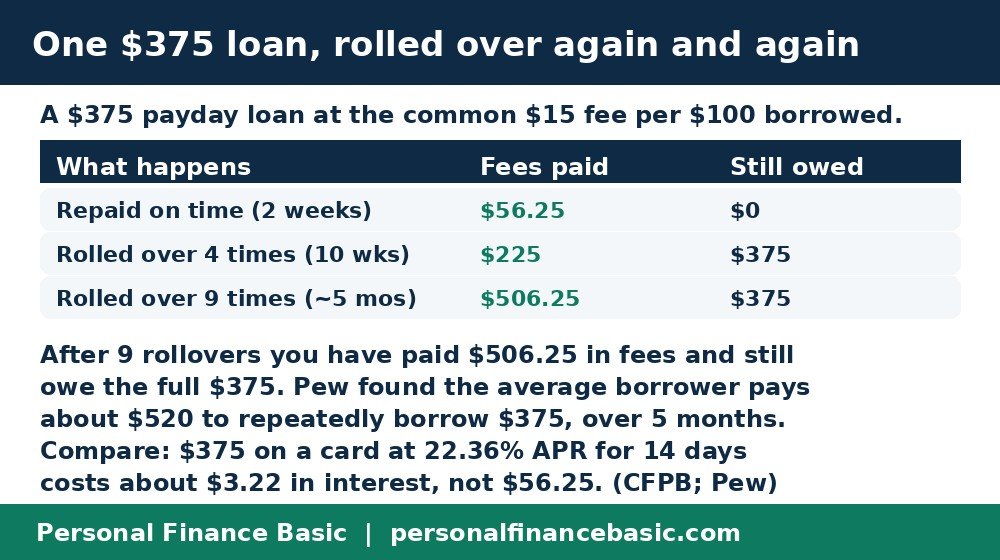
One $375 loan, rolled over again and again.
The Pew Charitable Trusts found the same pattern: the average borrower pays about $520 to repeatedly borrow $375, over about five months. Nine rollovers cost $506.25 in fees, and the borrower still owes the full $375.
Step 3: Compare the cheaper options, in order
Check these in order before a payday loan. Each costs less and gives you more time.
| Option | Cost for $400 | Time to repay |
|---|---|---|
| Credit union PAL | About $19 interest over 3 months, plus up to a $20 fee | 1 to 12 months |
| Credit card cash advance | About $20 fee, plus about $10 a month in interest | As you can pay it |
| Employer pay advance | Often free | Next paycheck |
| Payday loan | $60 every two weeks | 2 weeks, in full |
Illustrative examples at typical rates.
Credit union Payday Alternative Loans (PALs). Federal credit unions offer PALs of $200 to $2,000, with the APR capped at 28% and an application fee of at most $20. You repay in monthly installments over 1 to 12 months. A $400 PAL over three months at 28% APR costs about $139.60 a month and $18.81 of interest in total, plus at most a $20 fee: about $39 at most, against $60 every two weeks for a payday loan.
- Best for: anyone who belongs to a federal credit union, or can join one. This is the cheapest regulated small loan available.
- Not for: same-day cash if you are not already a member. PALs take a little time to set up.
Credit card cash advance. A typical cash advance charges a fee of about 5% of the amount, with a $10 minimum, and interest of about 30% APR from the day you take it, with no grace period. On $375, that is about a $19 fee and about $9.38 of interest a month. It is not a good habit, but it costs a third of a payday loan in the first month.
Employer pay advance or a negotiated bill. Ask your employer whether you can draw part of your next paycheck early; many allow it, and it usually costs nothing. Or call the biller and ask for a payment plan or an extra two weeks. A surprising number of bills can wait when you ask before the due date.
- Best for: a one-time shortfall with a fixed due date, and any bill that can be split.
- Not for: a gap that repeats every month. That needs a budget fix, not a one-time advance.
Step 4: Build a $400 buffer so it does not repeat
In the Federal Reserve’s 2025 survey of household finances, released in May 2026, 63% of adults said they would cover a $400 emergency with cash or its equivalent. The rest would borrow, sell something, or not pay at all.
Put $25 from each biweekly paycheck into a separate savings account, and you have $400 in about eight months. Put $50 in, and it takes about four months. Start the transfer on payday.
If you already have a payday loan, pay it in full on the due date if you can, and do not take out a new one to pay the old one. Check whether your state requires lenders to offer an extended payment plan: the CFPB notes that some states require a plan that spreads repayment over several months at no extra cost.
At a glance
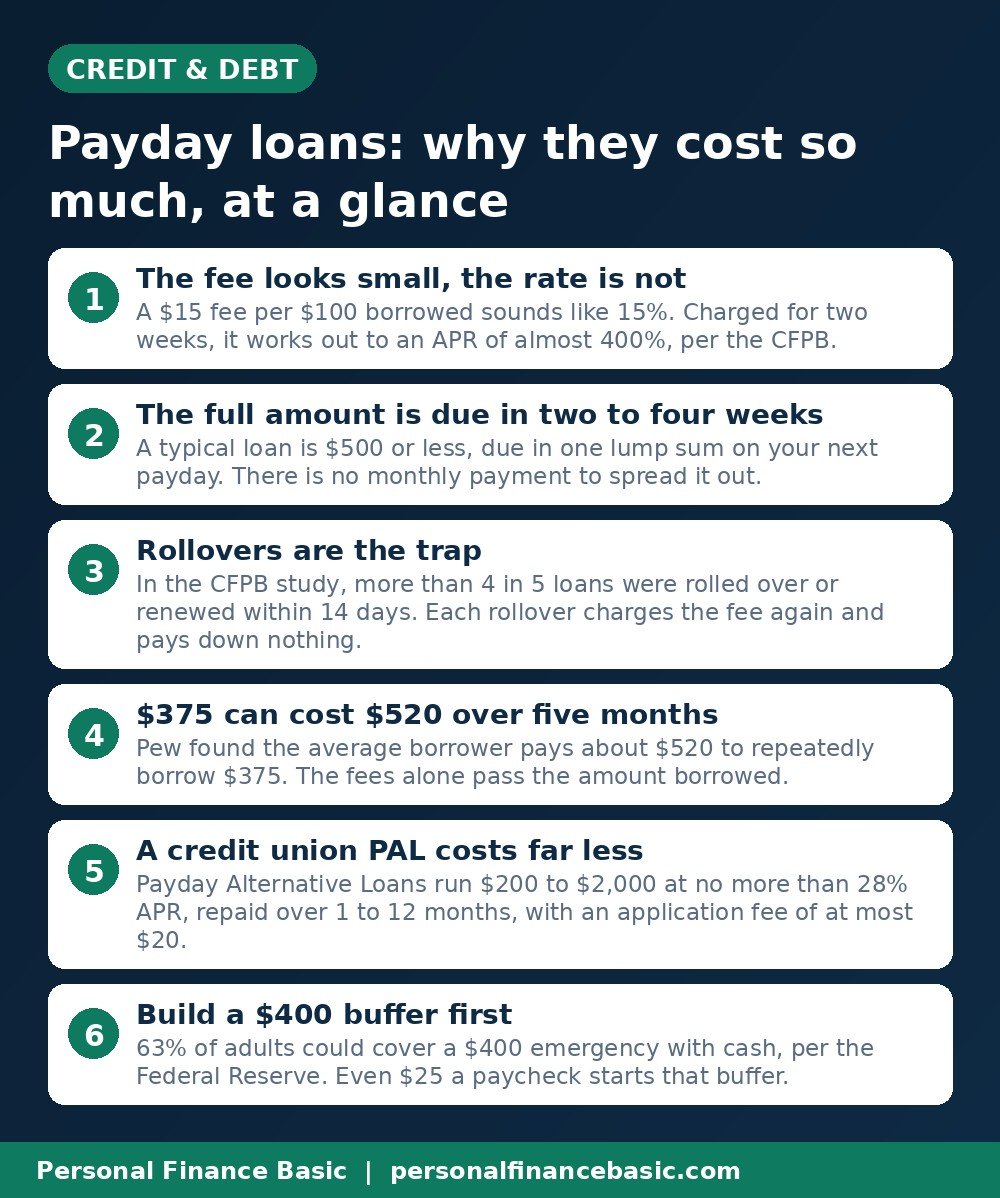
The main points from this guide, in one picture.
Frequently asked questions
What is the APR on a typical payday loan?
Almost 400%. The CFPB says a common fee of $15 per $100 borrowed works out to an APR of about 391% on a two-week loan.
How much does a $300 payday loan cost?
At $15 per $100, the fee is $45, so you repay $345 in two weeks. Roll it over once and you pay another $45 and still owe $300.
Do payday loans help your credit score?
Usually not. Payday lenders generally do not report to the credit bureaus, so on-time repayment does not build your score. But if the loan goes to collections, that can hurt it.
What is a Payday Alternative Loan?
A small loan from a federal credit union: $200 to $2,000, APR capped at 28%, application fee at most $20, repaid monthly over 1 to 12 months.
Are payday loans legal everywhere?
No. Rules vary by state, and some states cap fees low or ban payday lending outright. Rollovers are also limited or banned in some states.
The bottom line: a $15 fee per $100 sounds small, but it is 400% a year, and most loans get rolled over until the fees pass the amount borrowed. Check a credit union PAL, a pay advance, or a payment plan first.
This post is general education, not financial advice. Payday loan rules and fees vary by state; read the loan agreement before you borrow.
Related reading: How Much Emergency Fund Do You Need? With $ Examples and How to Pay Off Credit Card Debt on a Low Income