An index fund is one of the simplest ways to invest, and also one of the hardest to explain badly. It does not try to pick winners. It buys a whole market, or a large slice of one, and holds it.
This guide explains what an index fund is, what it holds, what it costs, and where it fits for a beginner. No fund, broker, or platform is recommended here.
What an index fund actually is
A market index is a list. The S&P 500, for example, is a list of about 500 of the largest companies traded in the United States. An index fund is a fund that buys the stocks on such a list, in roughly the same proportions, and tracks how the list performs.
When you buy a share of an S&P 500 index fund, you are not buying one company. You are buying a small piece of all of them at once: technology firms, banks, retailers, health care companies, and energy producers, in one purchase. If one company has a bad year, the other 499 are still in the fund.
That is the whole job of the fund manager: follow the list. There is no team of analysts trying to guess which stock will rise next, and no frequent buying and selling. Because the work is simple, the cost is low, which matters more than most beginners expect.
What is inside an index fund
Not every index fund tracks the S&P 500. Some track the whole US stock market, which includes thousands of companies of all sizes. Others track bonds, international stocks, or a single sector such as real estate.
A broad stock index fund is the usual starting point for a beginner, because it spreads money widely. A sector fund, by contrast, concentrates it: a fund that tracks only energy stocks rises and falls with one industry.
Two funds can track the same index and still differ slightly in cost, holdings, and dividend timing. The index is the same, but the fund is the product you actually own, so read the fund’s own details, not just the index name.
What index funds cost
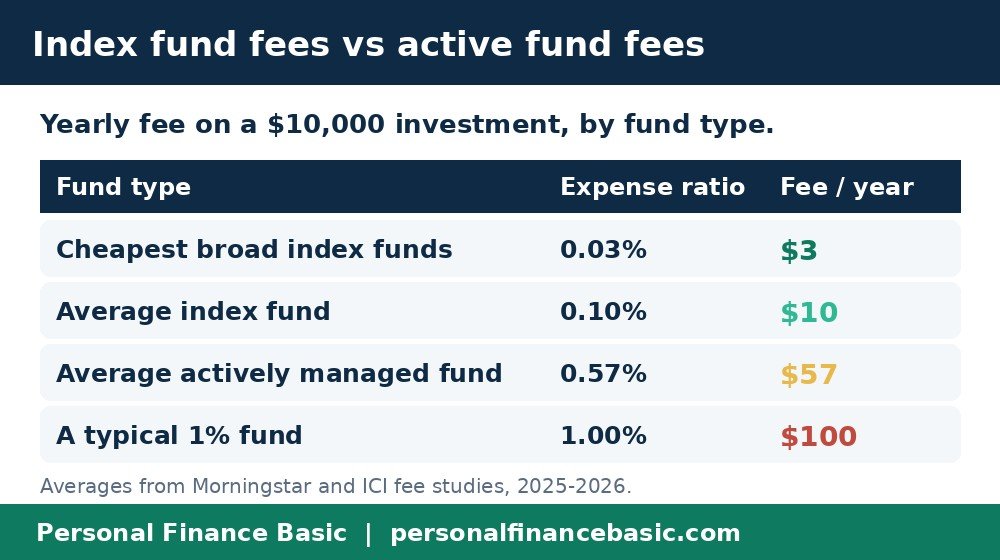
Fees on $10,000 a year. The cheapest broad index funds cost about $3; a typical 1% fund costs $100.
A fund’s yearly cost is called its expense ratio, shown as a percentage of the money in the fund. The cheapest broad index funds charge about 0.03% a year. On $10,000, that is $3. The average index fund charges about 0.10%, or $10 on the same amount. Actively managed funds, where a manager picks stocks, average about 0.57%, or $57.
The fee is taken from inside the fund, a little each day. You never get a bill for it. That makes it easy to ignore, which is a mistake: a fee you never see still comes out of your return every year.
Why a small fee matters over time
Take $10,000 invested for 20 years, with a gross return of 7% a year before fees. These are assumptions for illustration, not a forecast and not a promise. In a fund charging 0.03%, the balance reaches about $38,500. In a fund charging 1.00%, it reaches about $32,100. The only difference is the fee, and it costs about $6,400 over 20 years.
Low cost is not the only thing that matters. A fund that tracks a narrow or risky index can lose money even with a tiny fee. But when two funds track the same index, the cheaper one keeps more of the return, year after year.
Index funds and actively managed funds
An actively managed fund pays a manager to beat the market by picking stocks. Some do, in some years. Over long periods, most do not beat their index after fees. Data published by S&P Dow Jones Indices in 2026 showed that 79% of actively managed US large-cap funds underperformed the S&P 500 in 2025.
That does not make active funds useless. Some investors want a manager to avoid certain companies or to manage risk in a falling market. But for a beginner, the honest starting point is this: beating the market consistently is hard even for professionals, and paying a higher fee for the attempt lowers the odds further.
How to buy an index fund, step by step
First, decide where the money will live. Many people buy their first index fund inside a workplace retirement plan, such as a 401(k), or inside an IRA they open themselves. A regular taxable brokerage account is also possible, but retirement accounts have tax advantages that usually come first.
Second, pick the index. A broad US stock market index or an S&P 500 index is the common beginner choice. Third, compare funds that track it: check the expense ratio, the minimum investment, and whether the account charges its own fees on top.
Fourth, decide how much and how often. Many accounts accept small automatic monthly amounts. A regular amount, added whether the market is up or down, removes the need to guess the right moment to buy. Fifth, leave it alone and review once or twice a year, not daily.
Risks and limits to understand
An index fund is diversified, not safe. When the whole market falls, a broad index fund falls with it. In 2022, for example, the S&P 500 fell by about 19%, and index fund holders lost money that year like almost everyone else in stocks.
Diversification lowers the risk of one company failing. It does not remove market risk. That is why money needed within a few years, such as a house deposit, usually does not belong in a stock index fund. Funds can also lag their index slightly because of fees and trading costs; a gap of a few hundredths of a percent a year is normal.
At a glance
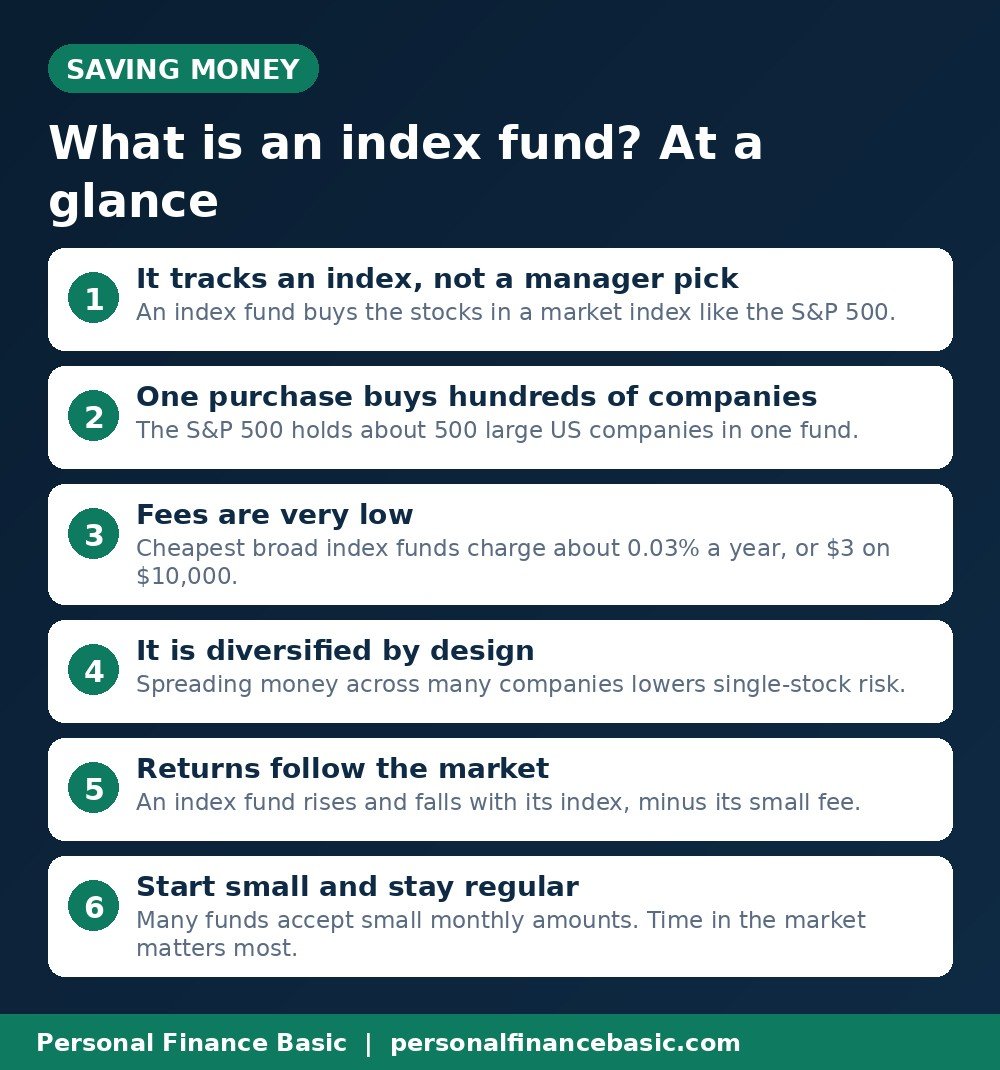
The main points from this guide, in one picture.
Frequently asked questions
How much money do I need to start?
Often very little. Many funds and accounts accept small amounts, and some have no minimum at all. A regular $50 or $100 a month is a real start. Check the minimum of the specific fund and account you use.
Is an index fund the same as an ETF?
Not quite. An index fund is a strategy: tracking an index. It can be sold as a mutual fund or as an exchange-traded fund (ETF). ETFs trade during the day like stocks; mutual funds price once a day after the market closes. Both can track the same index.
Can an index fund lose all my money?
Only if the entire index became worthless, which would mean hundreds of large companies failing at once. A broad index fund can fall sharply, as in 2022, but total loss is not a realistic scenario for a broad market fund.
Do index funds pay dividends?
Yes, when the companies in the index pay dividends, the fund collects them and passes them on, usually as cash or as reinvestment into more shares. Reinvesting dividends is the default in many retirement accounts and helps compounding.
Should I pick an S&P 500 fund or a total market fund?
For a beginner, either is a reasonable broad choice. The S&P 500 covers about 80% of the US stock market by value; a total market fund adds smaller companies too. Cost and consistency matter more than this choice.
This guide is general education, not financial or investment advice. Index funds carry market risk, and past returns do not predict future results. Check a fund’s current prospectus for its fees and holdings, and consider professional advice for your own situation before you invest.
Related reading: How to Start Investing With $100 a Month and Mutual Fund Calculator