Dan has $1,000 sitting in his savings account, and he keeps hearing two names: Treasury bills and I bonds. Both are loans to the US government, backed by its full faith and credit. Right now they pay very different rates: I bonds issued between 1 November 2026 and 30 April 2027 pay 5.51%, while Treasury bills pay about 4.26% to 4.50%.
That gap is real, but it is not the whole story. One pays you in weeks. The other locks your money away for a year.
Here is how each one works and how to choose.
The short answer
A Treasury bill, or T-bill, is a short-term loan to the government. You buy it below face value and get the full amount back at maturity, in 4 to 52 weeks. The discount is your interest.
An I bond is a savings bond that protects your money against inflation. Its rate has two parts: a fixed rate that never changes, plus an inflation rate that resets every 6 months. The current rate is 5.51%: a 1.40% fixed rate and a 2.04% six-month inflation rate, according to TreasuryDirect.
The choice comes down to one question: when do you need the money?
- Money you need in weeks or months: a T-bill.
- Money you can leave alone for a year or more: an I bond.
- Money you may need suddenly: keep it in savings.
Quick decision guide:
- Saving for a bill due in three months? A 13-week T-bill, which paid 4.257% at the 16 November auction.
- Setting aside money you will not touch for a year or more? An I bond at 5.51%, with the 1.40% fixed rate locked in for life.
- Building an emergency fund? Neither is first. Keep the first month of expenses in a savings account you can reach today.
- Worried about inflation? That is the I bond’s job: its inflation rate moves with prices.
How a Treasury bill works
A T-bill pays no interest along the way. You buy it at a discount and the government pays you the full face value at maturity.
The 13-week bill sold on 16 November 2026 paid 4.257%. A $10,000 bill cost $9,894.97 and matures on 18 February 2027. The $105.03 difference is the interest for 13 weeks.
The 26-week bill paid 4.467%. A $10,000 bill cost $9,782.11 and matures on 20 May 2027, earning $217.89. The 4-week bill paid 4.022% and the 52-week bill paid 4.496%. Rates change at every weekly auction, so these numbers are a snapshot, not a promise.
The minimum buy is $100, in $100 steps. Bills come in 4, 8, 13, 17, 26 and 52-week terms, and the 13 and 26-week bills auction every Monday. You can buy through TreasuryDirect or a brokerage, and sell a bill before it matures.
- Best for: money with a known date, like a tax bill in three months. You know the maturity date and the amount on day one.
- Not for: money you might need tomorrow.
How an I bond works
An I bond works differently. You buy it at face value, it earns interest every month, and the interest compounds twice a year.
The fixed rate is set when you buy and never changes for the life of the bond. For bonds issued from 1 November 2026 to 30 April 2027, it is 1.40%, the highest since 2006. The inflation rate resets every 6 months. Right now it is 2.04%, giving a composite rate of 5.51% for the first six months.
In dollars: a $1,000 I bond earns about $27.55 in its first six months at 5.51%. After six months the rate changes: your bond keeps the 1.40% fixed rate and gets whatever inflation rate Treasury announces next.
The rules are strict. The minimum buy is $25, and each person can buy up to $10,000 of electronic I bonds a year. You cannot cash an I bond in its first 12 months, and cashing it before 5 years costs the last 3 months of interest.
- Best for: money you can leave alone for at least a year, where beating inflation matters more than fast access.
- Not for: an emergency fund. The 12-month lock makes that impossible.
Treasury bills vs I bonds, side by side
Both are government-backed and both skip state tax. Here is the comparison.
| Treasury bill | I bond | |
|---|---|---|
| Term | 4 to 52 weeks | 30 years |
| Rate, November 2026 | 4.26% to 4.50% | 5.51% for six months |
| Rate after that | New auction rate | Fixed 1.40% plus new inflation rate |
| Minimum buy | $100 | $25 |
| Yearly limit | None | $10,000 per person |
| Cash out early | Sell on the market | After 12 months |
| State and local tax | None | None |
| Federal tax | Due at maturity | Deferred until cash-out |
Rates: Treasury auctions and TreasuryDirect, November 2026.
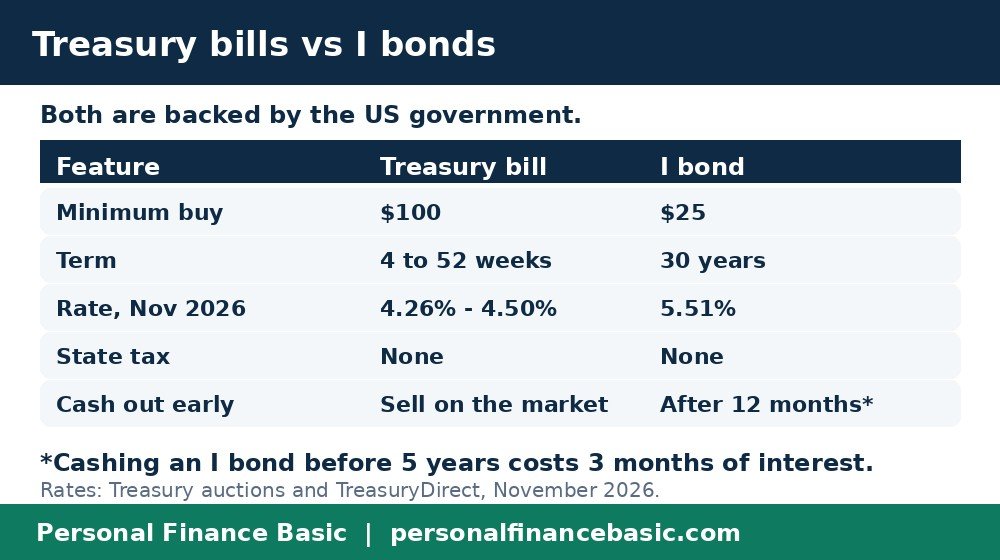
Both are backed by the US government. The differences are term, rate and access.
How to buy each one
Both are bought through TreasuryDirect, the Treasury’s site, or through a brokerage. TreasuryDirect sells bills in $100 steps and I bonds from $25. Since 28 October 2026, TreasuryDirect logins need ID.me.
For a T-bill, place a non-competitive bid before the auction closes at 11:00 a.m. Eastern on auction day. For an I bond, there is no auction: buy at face value any time. Buy before 30 April 2027 and you lock in the 1.40% fixed rate for life.
Which one fits your money
Think in dates, not in rates. If Dan needs his $1,000 for a car repair in two months, a T-bill is the wrong tool and an I bond is worse: it cannot be touched for a year.
If he will not need it for two years, the I bond is the stronger pick, as long as he accepts the 12-month lock and the 3-month penalty before year five.
At a glance
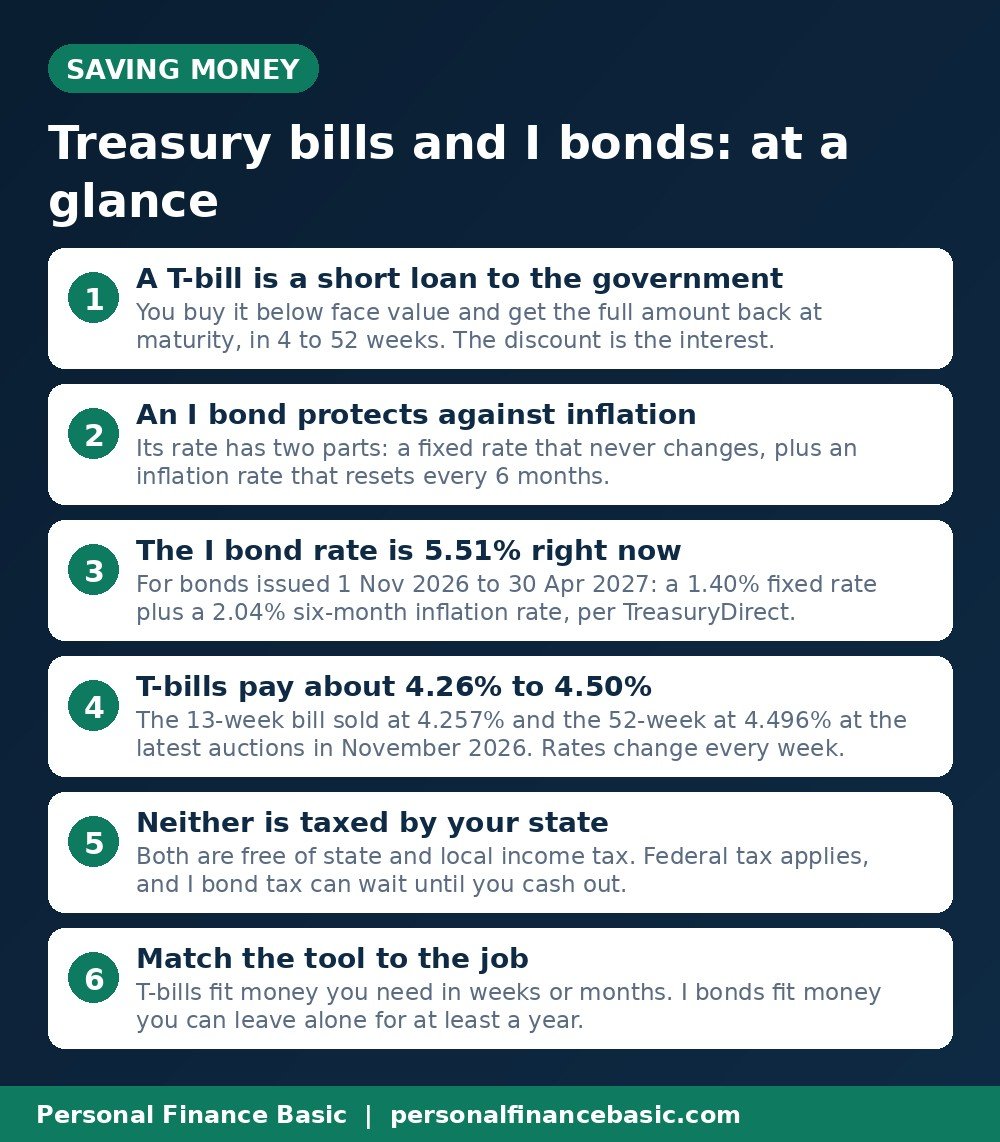
The main points from this guide, in one picture.
Frequently asked questions
Are Treasury bills and I bonds safe?
Both are backed by the full faith and credit of the United States. The risk is not default. It is that inflation outruns your rate, or that you need the money before you can get at it.
Do I pay state tax on T-bills or I bonds?
No. Interest from both is free of state and local income tax. Federal income tax still applies: for a T-bill it is due in the year the bill matures, and for an I bond you can wait until you cash it out.
Can I lose money on a T-bill?
Not if you hold it to maturity: the government pays the full face value. If you sell early, the price depends on rates that day, so you could get back slightly less than you paid.
What happens to my I bond rate after six months?
Your bond keeps its fixed rate forever and gets a new inflation rate every six months. A bond bought in November 2026 keeps the 1.40% fixed rate and gets a new rate in May 2027.
Can I buy more than $10,000 of I bonds a year?
Not electronically. The $10,000 limit is per person, per calendar year. You can also buy up to $5,000 a year in paper I bonds using your federal tax refund.
The bottom line: a T-bill is a short loan that pays you back in weeks, and an I bond is a long-term saver that tracks inflation. If you need the money soon, take the T-bill or keep it in savings. If you can leave it alone for a year or more, the I bond is hard to beat.
This guide is general education, not financial or investment advice. Check TreasuryDirect before you buy.
Related reading: What Is Compound Interest? Simple Examples That Make It Click and High-Yield Savings Accounts: What to Look For