
Most “ways to save money” lists tell you to skip your morning coffee and call it a day. That’s not where the real money is. The big savings usually come from a handful of bills you set up once and forgot about.
Below are 30 ideas, roughly ordered from biggest impact to smallest. You don’t need to do all of them. Pick three or four that fit your life and start there.
Bills you can cut once and forget
1. Shop your car insurance every year
Insurers often raise rates on loyal customers. Getting two or three quotes takes about 30 minutes and can save a few hundred dollars a year. Raising your deductible lowers the premium too, as long as you have savings to cover it.
2. Switch to a cheaper phone plan
Prepaid and smaller carriers often run on the same networks as the big companies for a fraction of the price. If you’re paying $80+ per line, this is usually the easiest win on this list.
3. Call your internet provider
Ask what promotions are available, or whether there’s a slower plan that still covers what you actually use. Mentioning that you’re comparing other providers helps.
4. Cancel subscriptions you forgot about
Go through your bank and card statements line by line. Streaming services, apps, cloud storage, free trials that turned paid. Cancel anything you haven’t used in the last month. You can always sign up again later.
5. Rotate streaming services
Instead of paying for four at once, keep one or two and switch every few months.
6. Review your bank fees
If you’re paying monthly maintenance or overdraft fees, look at banks and credit unions that don’t charge them.
7. Refinance high-interest debt
A lower-rate loan or a 0% balance transfer can cut what you pay in interest. Watch for transfer fees and only do it if you’ll stop using the old card. If you have several debts, see debt snowball vs. avalanche.
8. Check your insurance coverage
Bundling home or renters insurance with auto often gets a discount. So can a good driving record, a security system, or paying the year upfront.
Food and groceries
9. Plan meals before you shop
Even planning five dinners a week cuts down on last-minute takeout and wasted food.
10. Shop with a list, and eat first
Shopping hungry is how $60 trips turn into $120 trips.
11. Try store brands
For staples like flour, rice, canned goods, cleaning products and medicine, store brands are usually the same quality for less.
12. Cook a few big batches
Chili, soup, rice bowls, pasta bakes. Make extra and freeze portions for nights when you’re tired.
13. Use what’s already in the fridge
Before shopping, plan one or two meals around food that’s about to go bad.
14. Bring lunch to work three days a week
You don’t need to go to five. Three days of packed lunches can save $100 or more a month for a lot of people.
15. Use cashback and grocery store apps
Many stores have free apps with digital coupons that take seconds to clip.
Around the house
16. Adjust the thermostat
A couple of degrees cooler in winter and warmer in summer adds up. A programmable or smart thermostat makes it automatic.
17. Switch to LED bulbs
They use far less electricity than old incandescent bulbs and last for years.
18. Unplug things you don’t use
Old electronics, game consoles and chargers can draw power even when they’re off. A power strip with a switch helps.
19. Wash clothes in cold water
Most of the energy a washing machine uses goes into heating water.
20. Ask about utility assistance or budget billing
Many utility companies offer programs that spread costs evenly over the year or reduce bills for qualifying households.
Shopping habits
21. Wait 48 hours before buying non-essentials
If you still want it two days later, fine. A surprising amount of the time, you won’t.
22. Unsubscribe from store emails
Sale emails exist to make you shop when you weren’t planning to.
23. Buy used
Furniture, kids’ clothes, tools, sports gear and books are often nearly new on marketplace sites for much less.
24. Delete saved cards from shopping sites
One extra step at checkout is enough to stop a lot of impulse buys.
25. Use a price tracker
For bigger purchases, price-tracking tools and browser extensions can tell you whether a “sale” is actually a good price.
Habits that keep the savings
26. Pay yourself first
Set up an automatic transfer to savings on payday so the money is gone before you can spend it.
27. Try a no-spend week or month
Only spend on true essentials for a set period. It resets your habits and shows you which purchases you actually miss.
28. Give yourself a fun-money allowance
A small amount you can spend guilt-free makes it much easier to stick to everything else.
29. Put saved money somewhere useful
Saving $50 on your phone bill only helps if that $50 goes to savings or debt. Move it the same day.
30. Make a simple budget
A budget shows you where your money is going, which is how you find the next thing to cut. Start with how to make a budget or the 50/30/20 rule.
Where to put the money you save
If you don’t have one yet, start an emergency fund. After that, use it to pay down high-interest debt, then save for whatever matters to you.
Cutting $20 here and $40 there doesn’t feel like much. Do five or six of these, though, and it can easily add up to a few thousand dollars a year.
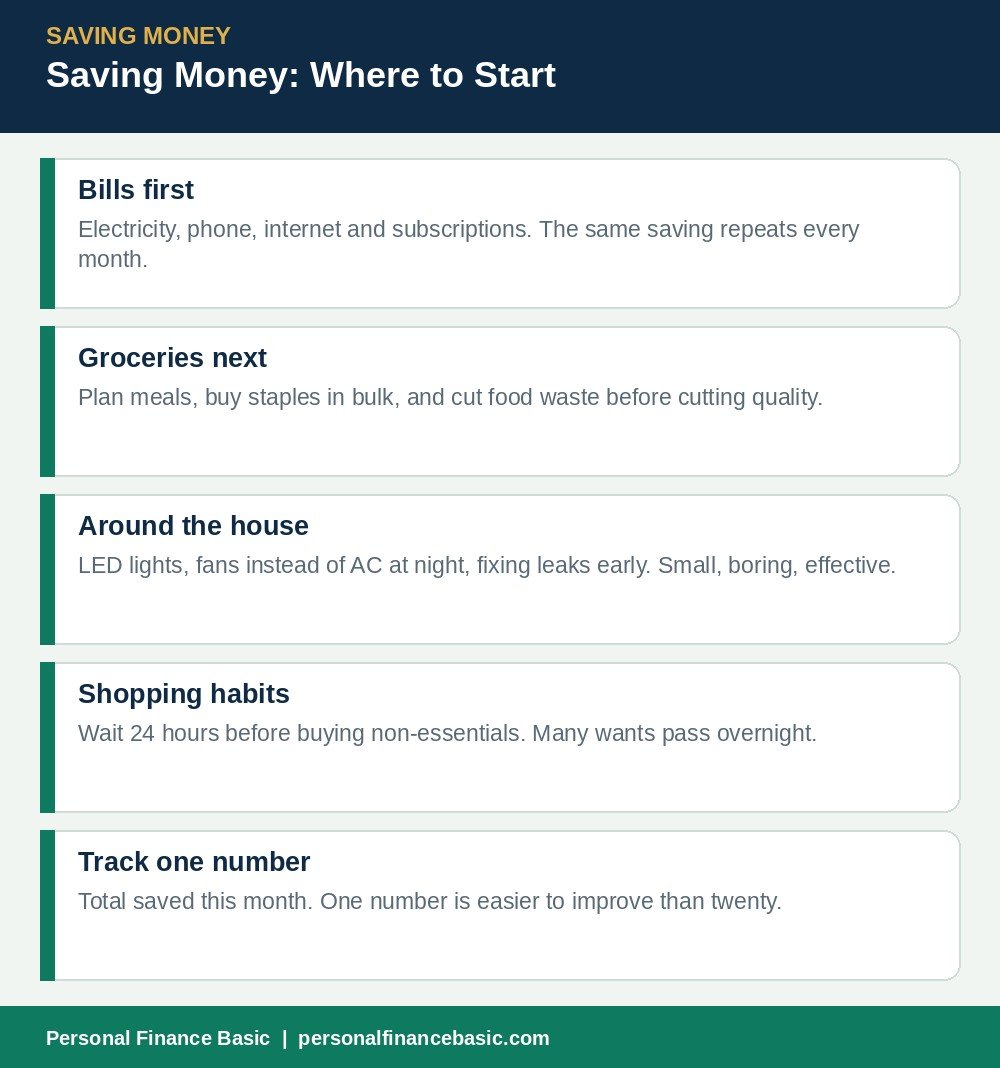
At a glance
I’m not a financial advisor, and this post is general information, not advice for your situation. More in the disclaimer.