

The EMI is the number most borrowers watch. It is not the only number that matters. Over the full life of a loan, the interest you pay can be large, and a small change early on can cut it down. An extra payment, a shorter tenure, or a lower rate can each make a real difference. This guide covers 12 practical ways to do that, in plain terms.
Why interest costs more than you think
Interest is charged on what you still owe. Early in a long loan, a large share of each EMI goes to interest rather than to the principal. So the same loan can end up costing very different amounts, depending on how fast you pay it back. Pay a little off the principal early, and the interest charged in the months after that falls too.
1. Make part-prepayments whenever you can
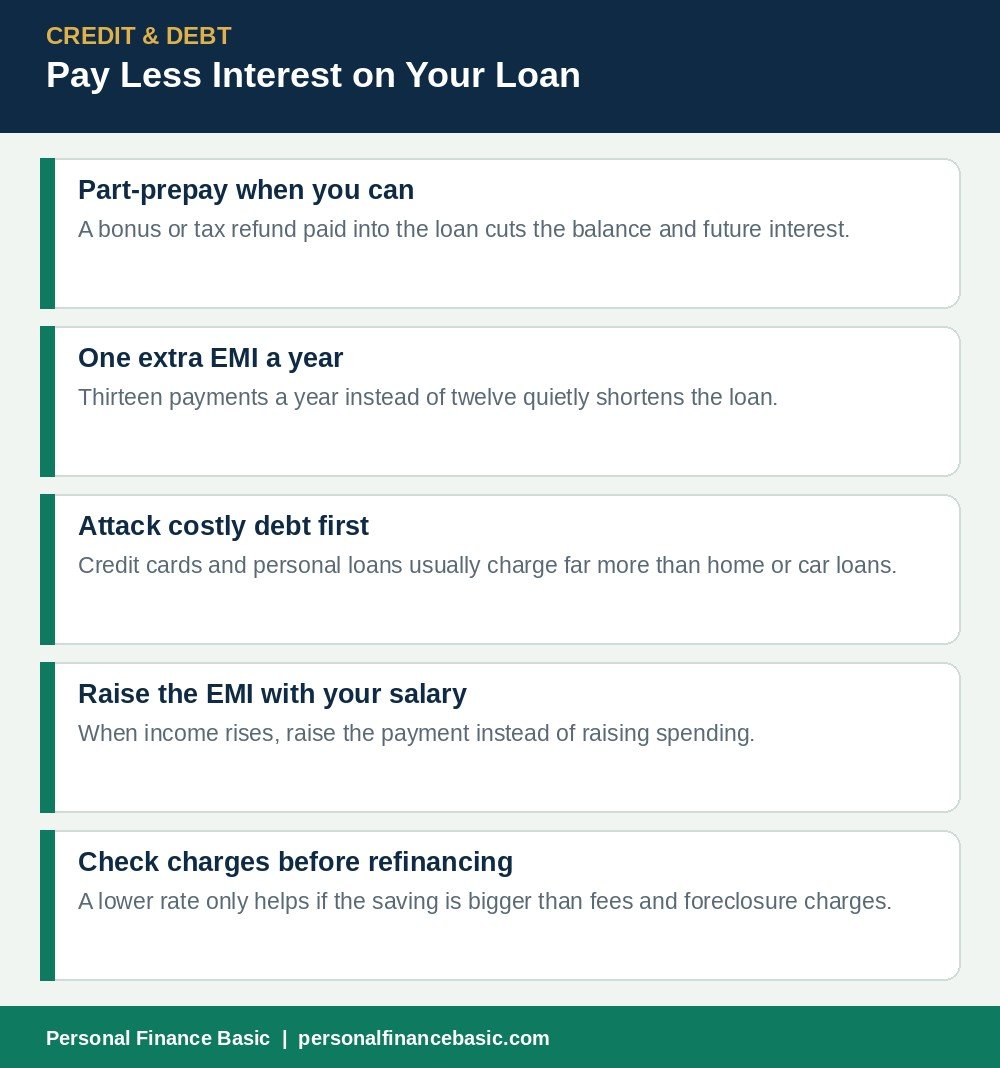
A part-prepayment is an extra payment on top of your EMI, used to bring the principal down. Even ₹10,000 once or twice a year can shorten the loan and reduce total interest. Before you pay, ask your lender how the money will be used. It should cut the principal, rather than simply covering future EMIs. Ask about any charge as well.
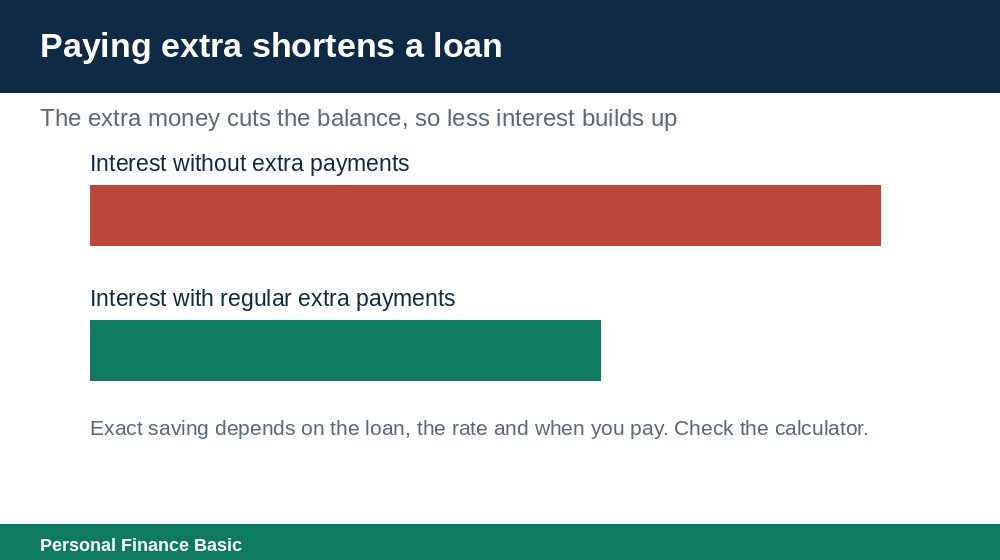
2. Pay one extra EMI every year
One extra EMI a year can feel like a lot at once. A simpler way to get there is to set aside one-twelfth of your EMI each month in a separate account, then pay it once a year. Over a long loan, that habit can take years off the tenure. It works best when the extra payment goes straight to principal.
3. Start with the highest-interest debt
This is the avalanche method. List your debts by interest rate, pay the minimum on all of them, and put every spare rupee towards the most expensive one. In most cases, that saves the most interest. If staying motivated is your main problem, clearing the smallest balance first can still be a sensible choice. See Debt snowball vs. debt avalanche: which should you use? to compare the two approaches.
4. Raise your EMI when your income rises
A pay rise is a good moment to increase the EMI, before your spending grows to match the new income. For example, if your income rises by ₹5,000 a month, you could put ₹2,000 to ₹3,000 of it towards the loan. You will barely notice the change month to month, but the loan will finish sooner.
5. Pick the shortest tenure you can afford
A longer tenure brings the EMI down, but it usually pushes total interest up a lot. A shorter tenure does the opposite. It raises the EMI and cuts total interest. Choose the shortest tenure that still leaves enough for essentials, an emergency fund, and your other obligations. Do not stretch the budget so thin that one unexpected bill pushes you into a new loan.
6. Refinance only if the total saving beats the costs
Moving a loan to a lower rate can help. It only helps, though, if the saving is larger than the processing fee, transfer charges, and any other costs. Compare the total cost of the old loan and the new loan over the same remaining period. A slightly lower EMI spread over a much longer tenure can still cost more in total, so do not judge by the monthly figure alone.
7. Consolidate high-cost debt with care
Consolidation means replacing several expensive debts, such as credit card balances, with one loan at a lower rate. It can make payments simpler and reduce interest. It only works if you stop adding new debt and if the new loan genuinely costs less in total. Without a change in spending, you can end up with the new loan and new card debt on top of it.
8. Pause top-ups and new loans while you repay
A top-up feels easy because your existing lender offers it. It still increases your principal and starts the interest clock again. While you are focused on clearing debt, pause new borrowing unless there is a genuine emergency. If you do need to borrow, compare the full cost first.
9. Ask your lender for a better deal
If you have paid on time, you can ask for a lower rate, a waiver of some charges, or a better deal, especially if another lender is offering one. Be polite and specific about what you want. Get any agreed change in writing before you act on it. If you are struggling, contact the lender early to talk through options, rather than missing payments without saying anything.
10. Check foreclosure and part-payment charges first
Some loans charge a fee for early repayment or for part-prepayment, and the rules can differ by loan type and lender. Before you pay extra, check the charges, the minimum prepayment amount, and any lock-in period. A small fee may still be worth paying if the interest saving is much larger. You should know the figure first, though.
11. Put windfalls towards the loan
Money you were not counting on for monthly expenses, such as a bonus or a tax refund, is well suited to loan reduction. A workable split is to put part towards the loan, part towards your emergency fund, and a small part towards something you enjoy. That way the plan is easier to stick to.
12. Check the loan once a year, not just the EMI
Once a year, look at three figures: the outstanding principal, the interest rate, and the remaining tenure. That review shows whether your extra payments are working, and whether a refinance or a larger prepayment is worth considering. Try the Car Loan Calculator to see how a different down payment, rate, or tenure changes the monthly payment and total interest.
A simple example
Take a loan of ₹5,00,000 with an EMI of ₹10,000. Add ₹2,000 a month towards principal, and you are paying ₹24,000 extra a year. Over several years, that extra amount brings the principal down faster, which reduces the interest charged each month and brings the finish date closer. The exact saving depends on your rate and remaining tenure, so run your own numbers in a calculator rather than relying on this illustration.
At a glance
Frequently asked questions
Is it better to prepay or to invest the money?
It depends on the loan rate, the expected investment return, and how much risk you are comfortable with. Repaying a high-interest loan gives a saving equal to that interest rate. Investment returns are not guaranteed. Many people do both: clear the expensive debt and keep a small emergency fund.
Should I prepay my home loan or my personal loan first?
Usually the higher-interest loan first, because it costs more for each rupee borrowed. Check the rate, the remaining tenure, and any prepayment charges for each loan before you decide.
Will prepayment hurt my credit score?
Paying off a loan on time or early does not normally harm your score. What matters most is a history of on-time payments and sensible use of credit. A closed loan stays on your credit report for a period and shows that you repaid it.
How much extra should I pay?
Pay only what you can afford after essentials and a small emergency cushion. A regular, affordable extra payment is better than a large one-off payment that leaves you short of cash.
What if I cannot afford extra payments right now?
Focus on paying every EMI on time, avoiding new debt, and looking for small savings in your budget. Even ₹500 a month extra, when it becomes possible, is a step in the right direction.
This article is for education only and is not financial advice. Loan terms, charges and eligibility differ by lender, so check your own loan agreement and consider professional advice for your situation.
Comments
One response to “How to Reduce Your Loan: 12 Practical Ways to Pay Less Interest and Become Debt-Free Faster”
[…] Another middle route is to buy a cheaper car now, with cash or a small loan, and save the difference towards a better car later. You get transport when you need it, without a large debt hanging over the next five years. For a longer view on cutting loan costs, read How to Reduce Your Loan. […]