
If you owe money on more than one card or loan, you’ve probably wondered which one to pay first. There are two popular answers, the debt snowball and the debt avalanche, and people argue about them a lot more than they need to.
Here’s how each one works, what the math says, and how to pick.
The quick version
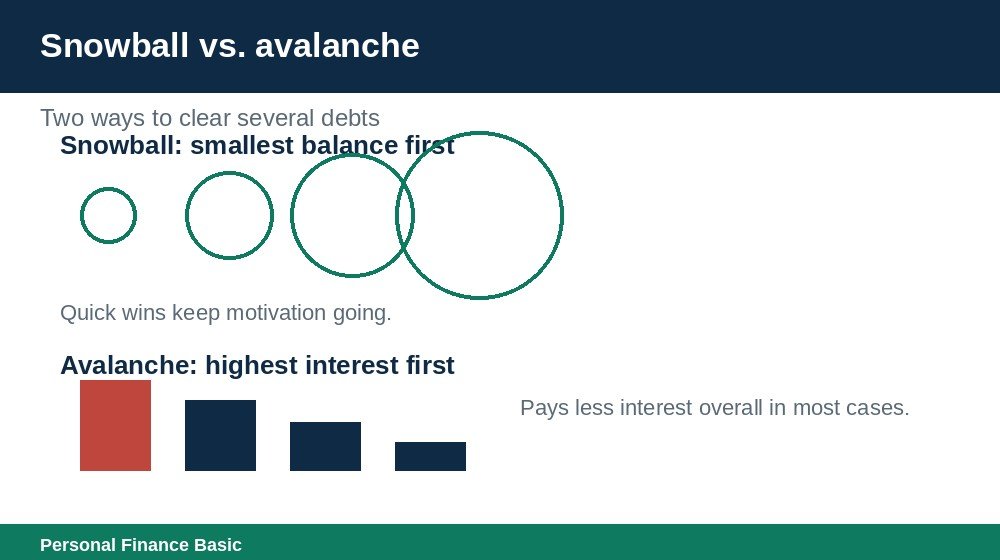
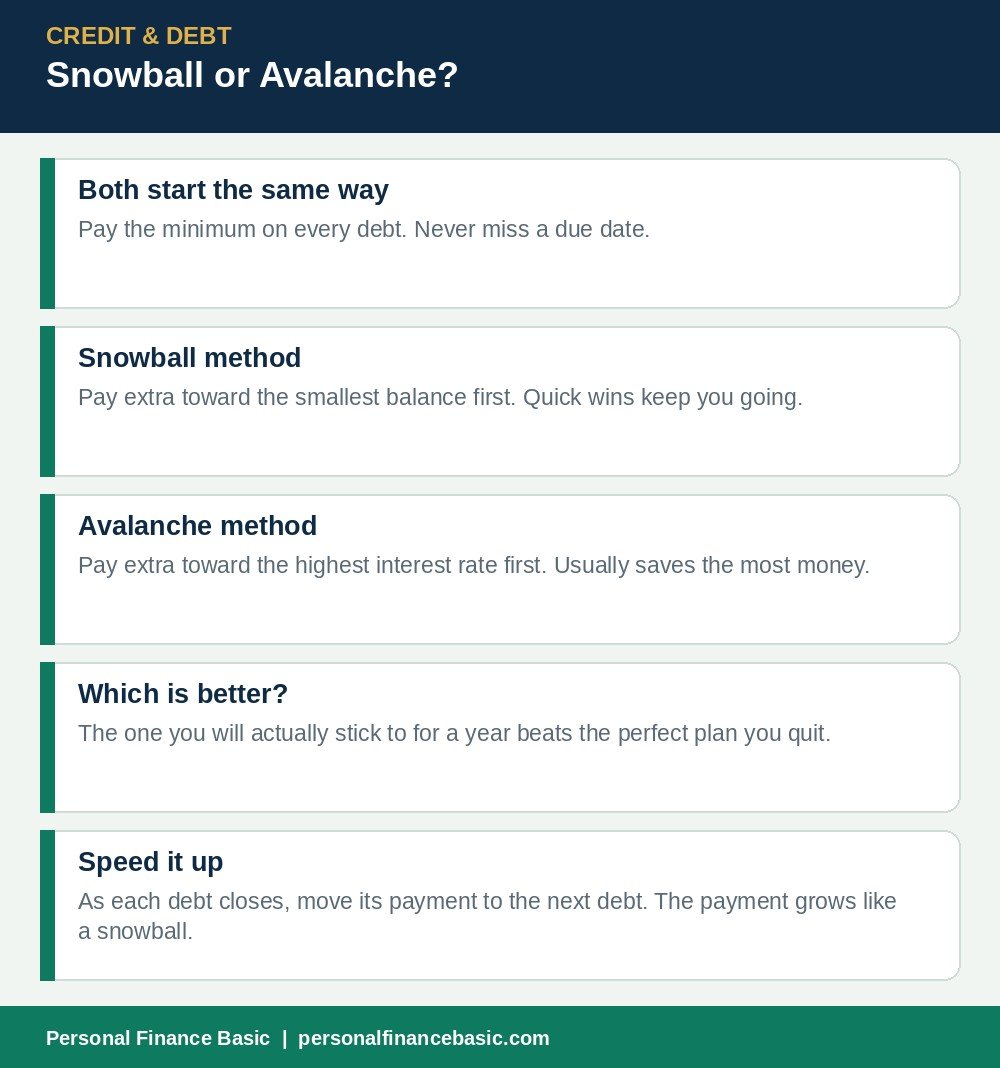
With the snowball, you pay off your smallest balance first. With the avalanche, you pay off the highest interest rate first. In both cases you keep paying the minimum on everything else, and once a debt is gone you roll its payment into the next one.
That rolling-over part is what makes either method work. Each payoff frees up more money for the next debt, so your payments get bigger as you go.
How the debt snowball works
- List your debts from smallest balance to largest. Ignore interest rates.
- Pay the minimum on all of them.
- Put every extra dollar toward the smallest balance.
- When it’s paid off, add that payment to the next smallest debt.
- Repeat until you’re done.
The appeal is speed. You might wipe out a small store card in two or three months, and that early win makes it easier to keep going. Dave Ramsey made this method famous, and a lot of people swear by it for exactly that reason.
How the debt avalanche works
Same steps, different order. You list debts from the highest interest rate to the lowest and attack the top one first.
Because high-interest debt grows fastest, paying it down first means less money goes to interest overall. On paper, the avalanche always costs the same or less than the snowball.
An example with real numbers
Say you have $400 a month for debt (minimums plus extra) and three debts:
| Debt | Balance | Interest rate | Minimum payment |
|---|---|---|---|
| Store card | $800 | 24% | $25 |
| Credit card | $4,500 | 22% | $110 |
| Car loan | $7,000 | 7% | $190 |
Snowball order: store card, then credit card, then car loan. The store card is gone in about four months.
Avalanche order: store card (24%), then credit card (22%), then car loan (7%).
Notice anything? In this case the order is the same, so it doesn’t matter which method you “pick.” That happens more often than people expect. The two methods only split when a small balance has a low rate, or a big balance has a high one.
When they do split, the avalanche usually saves somewhere between a few dollars and a few hundred dollars, depending on the balances and rates. With large credit card balances it can be more. An online debt payoff calculator will show you the exact difference for your own numbers.
Which one should you choose?
I’d look at it this way. If you’ve tried to pay off debt before and lost steam, go with the snowball. Quick wins matter, and a plan you quit halfway saves you nothing.
If you’re the type who stays motivated by seeing the total interest go down, or one of your debts has a painful rate (25%+ credit cards, for example), go with the avalanche.
Some people mix them: knock out one or two tiny balances first for momentum, then switch to highest-rate-first. That’s completely fine. There’s no prize for picking the “pure” version.
Things that matter more than the method
Honestly, the order you pay debts in is less important than these:
- Stop adding new debt. If the cards keep getting used, neither method works.
- Have a small cushion first. Even $500 to $1,000 saved means a flat tire doesn’t go back on the credit card. Here’s how to build an emergency fund without much money.
- Find the extra money. The extra payment is what speeds things up. A simple budget is usually where it comes from.
- Automate the minimums. One missed payment can mean a late fee, a penalty rate, and a hit to your credit score.
What about balance transfers and consolidation?
A 0% balance transfer card or a lower-rate consolidation loan can cut your interest a lot, which helps whichever method you use. Just read the fine print. Balance transfers usually charge a 3% to 5% fee, the 0% rate ends after a set number of months, and it only helps if you don’t run the old card back up.
At a glance
Common questions
Should I pay off debt or save first?
Most people do best with a small emergency fund first, then aggressive debt payoff, then building savings up to three to six months of expenses.
Do student loans and mortgages go on the list?
You can include them, but many people focus on credit cards and personal loans first and keep paying normal payments on low-rate mortgages and federal student loans.
Will paying off debt raise my credit score?
Usually, yes. Lower credit card balances reduce your credit utilization, which is a big part of your score. Keep old cards open after paying them off unless they charge an annual fee you don’t want.
Pick one method this week, write your debts down in that order, and make the first extra payment. That first payment is the hardest one.
I’m not a financial advisor, and this post is general information, not advice for your situation. More in the disclaimer.
Comments
3 responses to “Debt snowball vs. debt avalanche: which should you use?”
[…] main problem, the snowball method — smallest balance first — can still be a good choice. Read Debt snowball vs. debt avalanche: which should you use? to compare […]
[…] This guide is for education only and is not financial advice. Credit scoring rules and lender policies can change, so check the latest information from the credit bureau and your lender. If debt is becoming unmanageable, also read Debt snowball vs. debt avalanche: which should you use? […]
[…] reading: Debt snowball vs. debt avalanche: which should you use? and What Is a Good Credit Score in the […]