Your new credit card arrives with a $2,000 limit. Your friend got $10,000 on the same card. Nobody explains why. It is not random, and it matters more than most people think.
Your limit is the most your issuer will let you owe on that card at one time, and it quietly controls your credit utilization, which is 30% of your FICO score. The average total credit limit in the US was $35,687 as of June 2026, according to Experian, but that average hides a wide range.
Here is what a credit limit is, how issuers decide the number, and what you can do when yours feels too low.
The short answer
A credit limit is the maximum balance your issuer will let you carry on one card. Issuers set it when you open the account, using your credit scores, payment history, income, existing debts and their own rules. You cannot pick the number, but you can grow it with on-time payments.
The quick framework:
- Know your limit and your available credit: limit minus balance.
- Keep your balance under 30% of the limit, and under 10% when you can.
- Pay on time every month, for at least six months, before asking for more.
- Ask for an increase online, with your current income updated.
- If the issuer says no, keep paying on time and ask again in six months.
Quick decision guide:
- New card with a low limit? Use it for one small regular bill and pay it in full.
- Balance near the limit? Pay it down first, because utilization is dragging your score.
- Want a higher limit? Ask after six months of on-time payments.
- Limit cut without warning? Check for missed payments, then call the issuer and ask why.
Step 1: Understand what the limit actually controls
Your credit limit is a ceiling on the balance, not a spending target. If your limit is $5,000 and you owe $1,500, your available credit is $3,500, minus pending charges. Spend past the limit and the issuer can decline the charge.
The limit also sets your utilization, your balance divided by your limit. A $1,500 balance is 30% of a $5,000 limit but 15% of a $10,000 limit. A $1,200 car repair on a $2,000 limit is 60% utilization the day it posts, even if you pay it off two weeks later.
- Best for: a limit you can keep under 30% used in a normal month.
Step 2: Know the five things issuers weigh
Issuers do not publish their exact formulas, but the inputs are consistent across the industry. When you apply, the issuer runs a hard inquiry, reads your credit reports, and looks at the income you state.
First, your credit scores and history: a higher score signals lower risk, and a long record of on-time payments is the strongest single signal. Second, your income: issuers must consider whether you can repay, so stated income sets a ceiling on the limit.
Third, your existing debts: your debt-to-income ratio and how much revolving credit you already have open. Fourth, your history with that issuer: a bank that already holds your accounts often extends higher limits to existing customers. Fifth, the card itself: an entry-level card carries a lower ceiling than a premium card.
Step 3: See how your limit shapes your score
Utilization is the second-largest factor in a FICO score, at 30% of the total. Only payment history weighs more.
| Balance | Limit | Utilization | What it signals |
|---|---|---|---|
| $1,500 | $5,000 | 30% | At the line most experts warn about |
| $1,500 | $7,500 | 20% | Comfortable |
| $1,500 | $10,000 | 15% | Healthy |
| $500 | $5,000 | 10% | Strong |
Example balances.
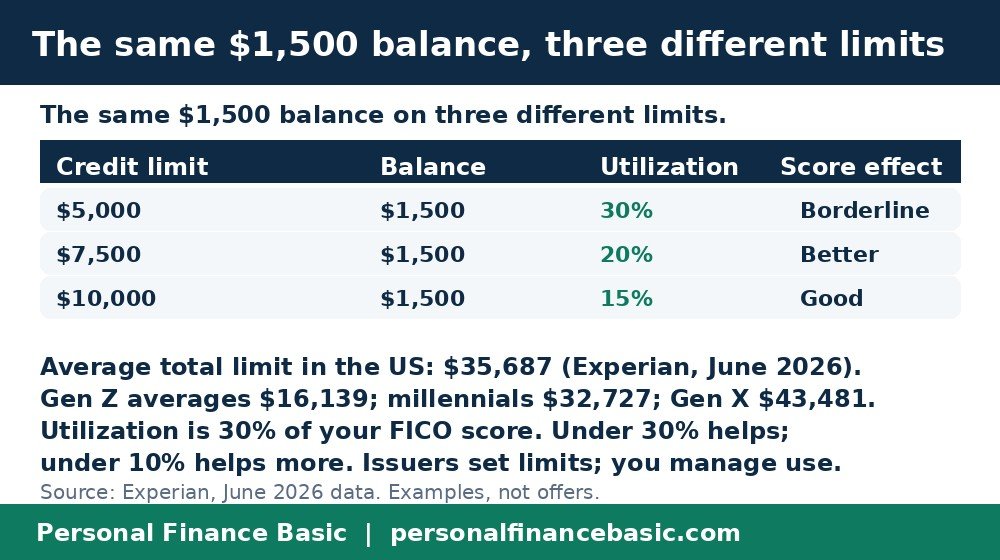
The same $1,500 balance, three different limits.
Two details catch people out. Utilization is measured from the balance on your statement date, not from what you pay by the due date. And a higher limit only helps if spending stays flat.
Step 4: Compare your limit with the average
Experian’s June 2026 data puts the average total credit limit in the US at $35,687, up 2.8% from a year earlier. That is the combined limit across all the cards a person holds:
| Generation | Average total limit | Change from 2025 |
|---|---|---|
| Gen Z (18 to 29) | $16,139 | Up 7.9% |
| Millennials (30 to 45) | $32,727 | Up 6.0% |
| Gen X (46 to 61) | $43,481 | Up 4.3% |
| All consumers | $35,687 | Up 2.8% |
Source: Experian, June 2026.
Younger people have lower limits because they have shorter histories and lower incomes. Limits grow with time, income and a clean payment record. A first card with a $1,000 or $2,000 limit is normal. If yours is far below the average for your age, check for a thin file, a recent missed payment, or high balances elsewhere.
Step 5: Ask for more, and know when limits get cut
Most issuers let you request an increase online or in the app, and many will do a soft pull that does not affect your score. The best time is after six months of on-time payments, with your income updated. A pay rise or a paid-off loan strengthens the case. Ask for a specific number, roughly double your current limit.
If the issuer says no, ask why and when you can try again. The usual answers are a short history, a recent late payment or high balances elsewhere. Fix that issue, wait six months, and ask again. A second card is another route, but it means a hard inquiry and a younger average account age.
Issuers can also lower your limit without you asking, after missed payments, balances near the limit, a falling score, or long inactivity. A cut raises utilization overnight: if your $5,000 limit drops to $2,500 while you owe $1,500, utilization jumps from 30% to 60%.
When a cut happens, call the issuer and ask why. If the reason is inactivity, a small regular charge paid in full can help. If it is missed payments, the fix is time: six to twelve months of clean payments. Pay the balance down first, the fastest way to bring utilization back under control.
Paying down the balance is the only move that helps every time, whatever your issuer says.
At a glance
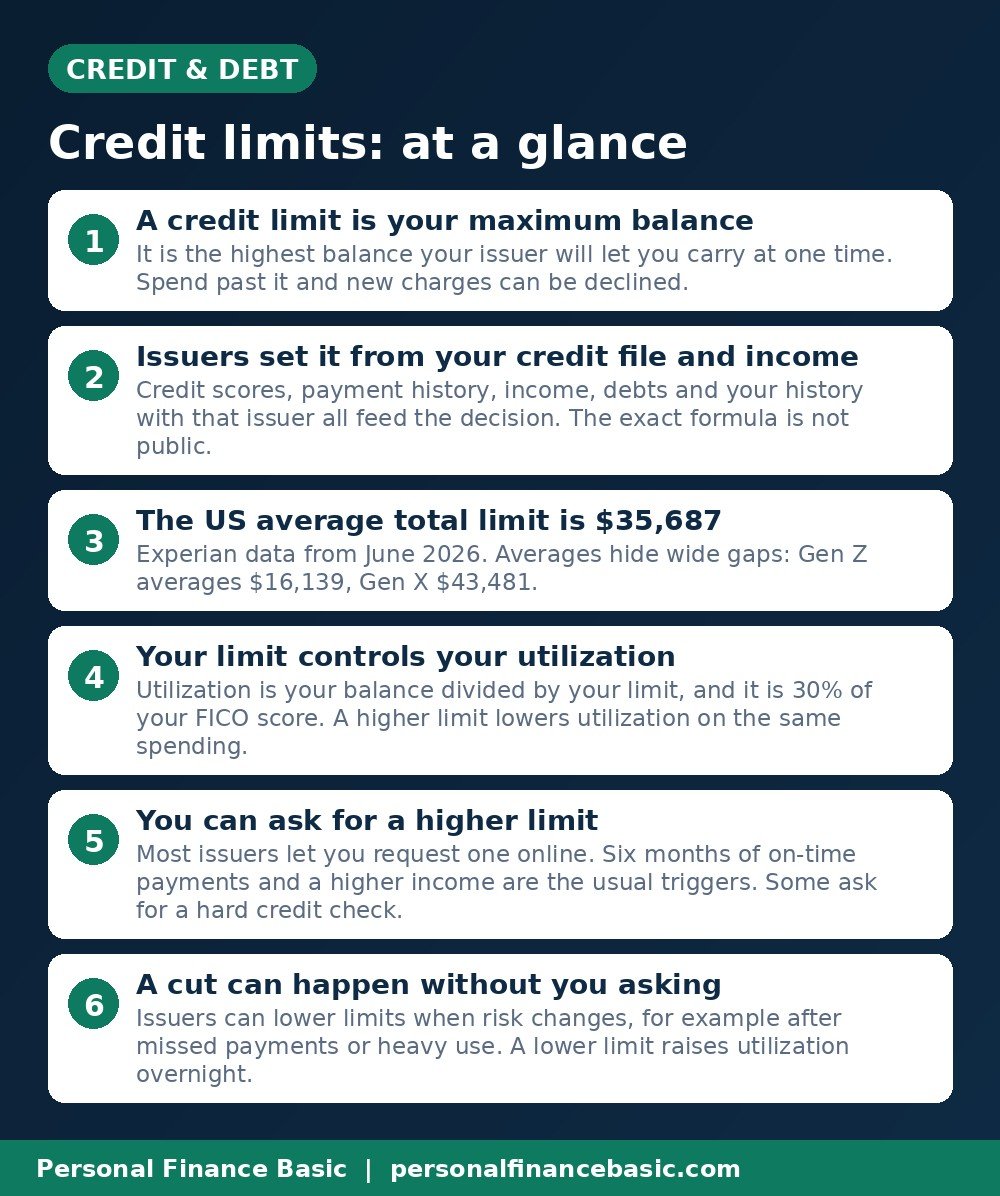
The main points from this guide, in one picture.
Frequently asked questions
What is a credit limit?
It is the maximum balance your card issuer will let you carry on one card. If your limit is $5,000 and you owe $1,500, you have $3,500 of available credit, minus pending charges.
How do issuers decide my credit limit?
They weigh your credit scores and payment history, your income, your existing debts, your history with that issuer, and the type of card. The exact formula is not public.
Does a higher credit limit help my credit score?
It can, by lowering your utilization, which is 30% of your FICO score.
Can I ask for a higher credit limit?
Yes. Most issuers let you request one online or in the app, best after six months of on-time payments. Some use a soft credit check, others a hard one, so ask first.
Can my issuer lower my limit without asking me?
Yes. Issuers can cut limits after missed payments, heavy use, a falling score or long inactivity. A cut raises your utilization at once, so pay the balance down and call the issuer to ask why.
The bottom line: your limit is set by your issuer from your credit file and income, and it shapes your score through utilization. Keep balances under 30%, pay on time for six months, then ask for more.
This post is general education, not financial advice. Credit limits and scoring rules vary by issuer; check your own card terms and credit reports.
Related reading: What Is Credit Utilization and Why Under 30% Matters and How to Improve Your Credit Score in 6 Months