A car is often the second-largest purchase a family makes, after a home. The choice is rarely simple. A loan lets you drive now and pay over time. Saving first means you pay no interest, but you wait. The right answer depends on your income, your savings, and how much you need the car right now.
The mistake many buyers make is to look only at the EMI. The EMI tells you what leaves your account each month. It does not tell you what the car will cost in total, or what happens if your income drops. This guide looks at both routes in plain numbers, so you can compare them properly.
What a car loan really costs
With a loan, you pay a down payment and borrow the rest. You then repay the loan in monthly EMIs, which cover both the amount borrowed and the interest. Interest is charged on the amount you still owe, so a longer loan usually means a much larger interest bill, even if the EMI feels smaller.
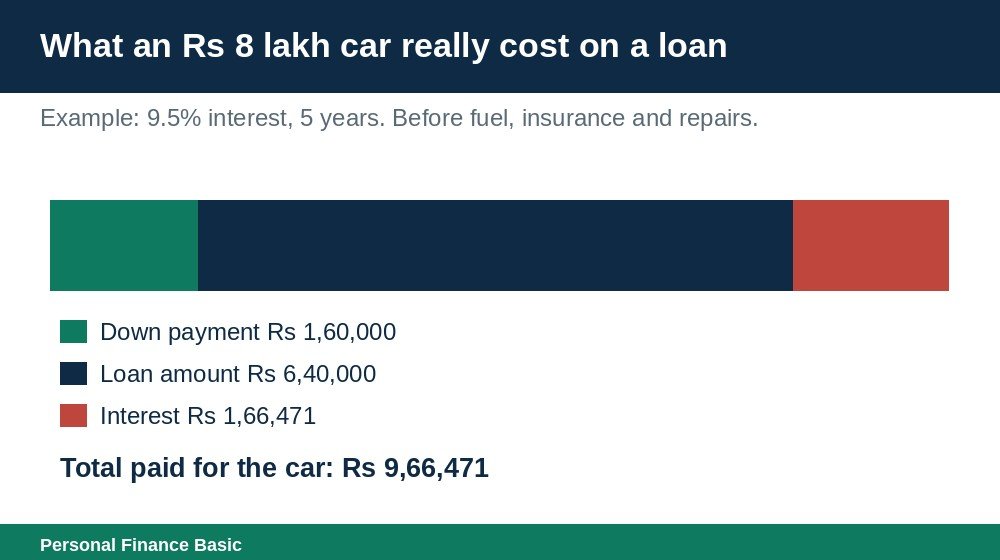
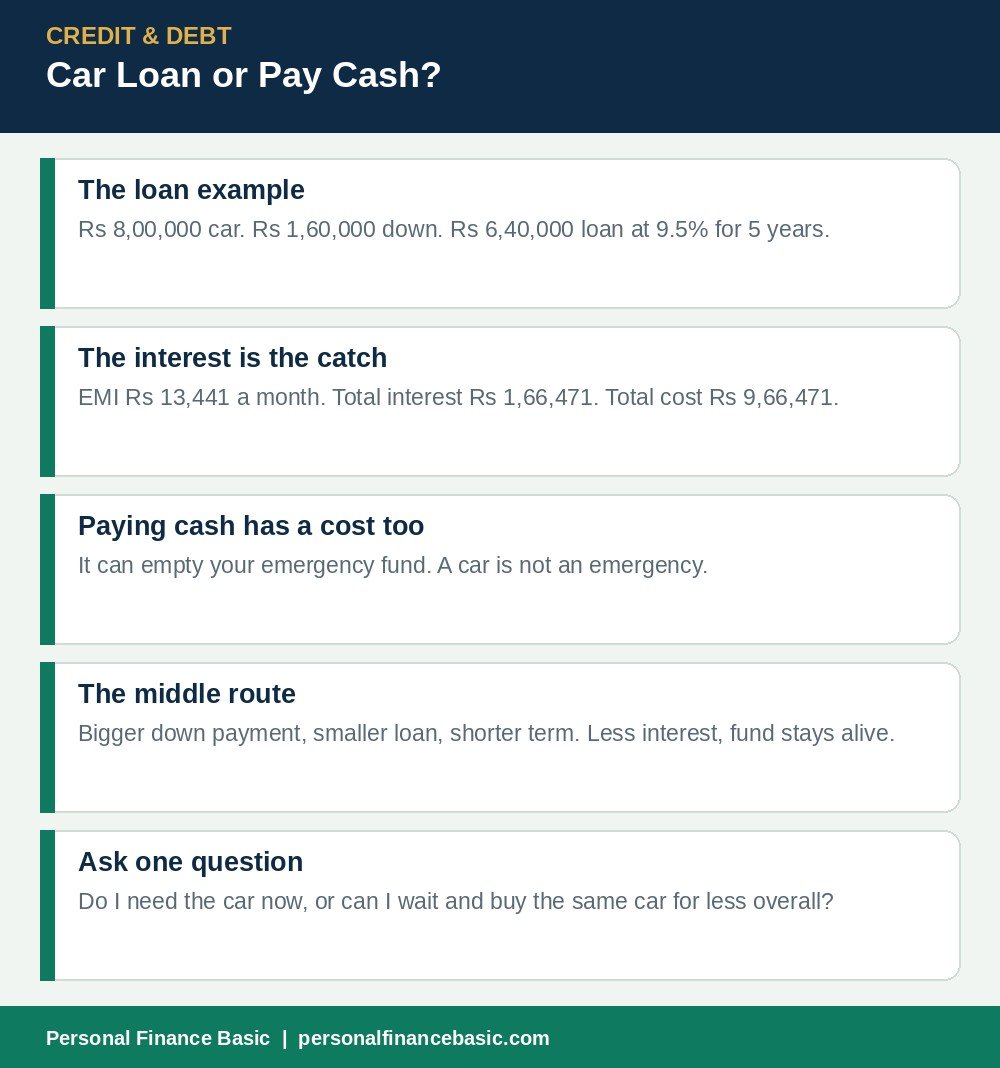
Here is a checked example, using an example rate, not a current offer. The car price is ₹8,00,000. You pay ₹1,60,000 as a down payment and borrow ₹6,40,000 at 9.5% for 5 years, or 60 months. The EMI is ₹13,441 a month. Over 60 months you repay ₹8,06,471, of which ₹1,66,471 is interest. Add the down payment, and the total cost of the car on loan is ₹9,66,471, before insurance, fuel, and maintenance.
That extra ₹1,66,471 is the price of having the car now rather than later. For some people, that price is worth paying. For others, it is money that could have gone to savings, a home deposit, or clearing other debt. You can check your own figures with the car loan calculator.
What paying cash really costs
Paying cash means no EMI and no interest. You own the car outright from day one, and a job loss does not leave you with a car payment to meet. That freedom is the main benefit. The cost is time, and the effect on your savings.
If you have ₹8,00,000 saved and you spend it all on a car, your emergency fund may be gone. A sudden medical bill or a gap in income then becomes a problem, and you may end up borrowing at a higher rate to cover it. A safer rule is to pay cash only if you can still leave a solid emergency fund untouched after the purchase. If the purchase would empty your savings, cash is not the safer choice it first seems.
Saving first also takes time. To reach ₹8,00,000 in 3 years, you would need to put aside roughly ₹20,300 a month in a simple savings pot. That figure shows why most people either wait longer, buy a cheaper car, or take a smaller loan. There is nothing wrong with any of those choices, as long as you make it with open eyes.
Depreciation and running costs
Depreciation means a car loses value over time. A new car is worth less the moment you drive it away, and it keeps losing value each year, even if you look after it well. This happens whether you buy on loan or with cash. It matters for a loan buyer because you may owe more than the car is worth in the early years, if you sell it then.
Running costs exist either way. Insurance, fuel, servicing, tyres, and repairs all add up, and they are on top of the EMI or the purchase price. Before you decide, add a rough monthly figure for these costs to your budget. A car that fits your EMI but leaves no room for fuel and servicing does not really fit your budget.
The middle route
Many buyers find a middle route works best: a larger down payment and a shorter loan. A bigger down payment lowers the amount borrowed, which lowers both the EMI and the total interest. A shorter loan raises the EMI, but it cuts the interest bill and frees you from the loan sooner. If you can manage the higher EMI without strain, a shorter loan is usually cheaper in total.
Another middle route is to buy a cheaper car now, with cash or a small loan, and save the difference towards a better car later. You get transport when you need it, without a large debt hanging over the next five years. For a longer view on cutting loan costs, read How to Reduce Your Loan.
Questions to ask before you decide
Do you need the car now for work or family, or can you wait? If you need it for a daily commute with no good public transport, waiting has a real cost too, in time and lost income. If the car is mainly for weekend trips, waiting is easier to justify.
What does the EMI do to your monthly cash flow? Work it out after rent, food, bills, and other EMIs. If the EMI plus running costs leave you with almost nothing at the end of the month, the loan is too large, even if a lender approves it. Also ask how much interest you will pay in total, not just each month. A small change in tenure or down payment can change that total by tens of thousands of rupees.
Finally, what happens if your income falls for a few months? With a loan, the EMI still has to be paid. With cash, you have no EMI, but you may have little savings left. Keep an emergency fund in both cases, and do not stretch to the most expensive car a lender will allow.
At a glance
Frequently asked questions
Is it always better to buy a car with cash?
Not always. Cash avoids interest, but it can empty your savings. Keep an emergency fund aside first.
Is a longer loan better because the EMI is lower?
The EMI is lower, but total interest is usually higher. Compare the total repaid, not just the EMI.
How much down payment should I make?
As much as you can afford without touching your emergency fund. A larger down payment means a smaller loan.
Should I buy a cheaper car instead?
Often, yes. A cheaper car can mean a smaller loan, lower insurance, and lower running costs.
Does a car loan affect my credit score?
Paying EMIs on time can help build your credit history. Missing EMIs can harm your score and add charges.
Run the numbers for your own car, rate, and tenure before you sign. A short practical check now can save you a large interest bill later.
This article is for education only and is not financial advice. Loan rates, charges, and eligibility vary by lender and change over time. Check the loan terms carefully before you borrow.