Thanksgiving is a week away, and a new survey says the month is already stretching household budgets. On 17 November 2026, NerdWallet published its November Consumer Financial Resilience Index: 41% of Americans say they will have to rely on credit to manage at least some of their November expenses.
That is up from 35% in September and 38% in October, a six-point rise NerdWallet calls statistically significant. Only 66% of Americans have enough cash for an unexpected $1,000 expense, which means a third do not. The overall index score barely moved, at 60.9 out of 100 against 61.6 in October.
Here is what the survey found, and what it means for your money before the holidays.
The short answer
More Americans are leaning on credit to get through an ordinary month, and the cushion behind them is thin. The Harris Poll survey for NerdWallet, 5 to 9 November 2026 among 2,090 US adults, finds 41% relying on credit for November expenses and 34% without cash for a $1,000 emergency.
The quick framework:
- Check your own $1,000 cushion first.
- Set the gift budget in dollars and decide the payment plan first.
- If a balance is already growing, plan the payoff now, not in January.
- Keep everyday spending off the card while the holiday balance is there.
Quick decision guide:
- Have the $1,000 cushion? Spend the holidays from cash.
- Carrying a balance? Make the payoff plan before adding holiday spending to it.
- No cushion? Set a hard gift budget and pay for gifts as you buy them.
The numbers: what NerdWallet found on 17 November
The index measures resilience in five questions. The composite score was nearly flat: 60.9 in November, against 61.6 in October and 61.5 in September. But the individual answers moved: credit reliance rose from 35% in September to 38% in October and 41% in November.
At the same time, 77% say they feel in control of their day-to-day finances, and 77% are confident they can pay all their bills on time this month. People feel in control of the bills in front of them, but a growing share still needs credit to cover them.
The $1,000 buffer splits sharply by income: 81% of households earning $100,000 or more have enough cash, but only 46% of households under $50,000 do. The middle groups sit in between: 66% at $75,000 to $99,999, and 53% at $50,000 to $74,999.
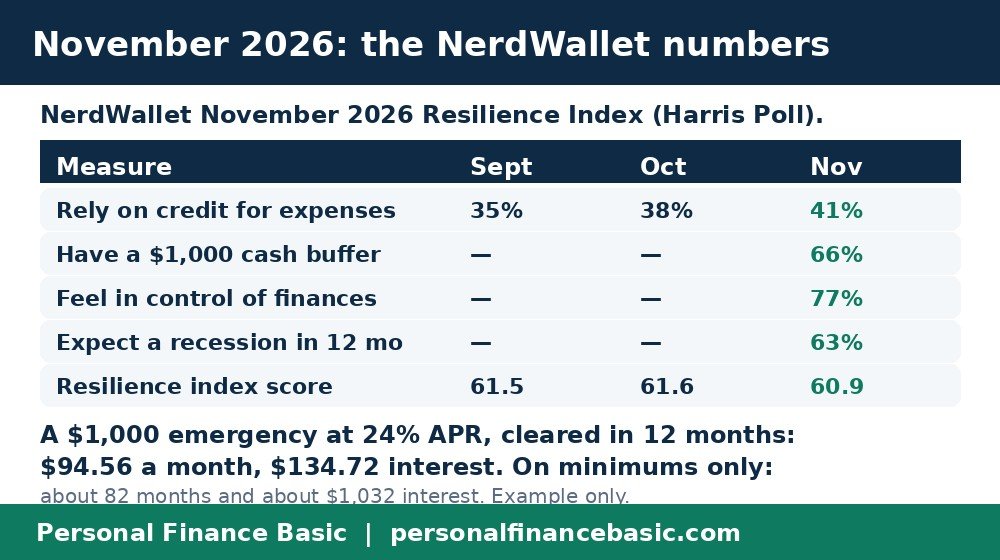
November 2026: the NerdWallet numbers.
One more number: 63% believe the US economy will enter a recession in the next 12 months. That is what respondents believe, not a forecast. The survey’s margin is plus or minus 2.7 points, wider for subgroups.
Who is most exposed
The 41% average hides big gaps. Parents of children under 18 are far more likely to rely on credit: 58%, against 34% of people without minor children. By generation, 57% of millennials and 52% of Gen Zers say they will need credit this month, against 39% of Gen Xers and 21% of baby boomers.
The cash buffer shows the same pattern: boomers are most likely to have $1,000 on hand at 77%, then millennials at 65%, Gen Z at 61% and Gen X at 59%. Men are more likely than women to have the buffer, 73% against 60%.
What it means for holiday spending
November is the month the spending starts. When credit is already covering ordinary expenses, holiday purchases land on the same balance, and the cost runs into the new year. NerdWallet’s Kimberly Palmer puts it plainly: when credit is already helping cover monthly expenses, holiday purchases can affect a household’s budget well into the new year.
That is why the order matters. Decide the gift budget first, in dollars, and decide how each gift gets paid for before you buy it. A $400 gift list paid from cash is a December cost; the same $400 on a card at a 24% example rate, cleared over 12 months, costs about $54 in interest on top.
The $1,000 example: 12 months vs minimum payments
Take a $1,000 emergency with no cash buffer, put on a card at an example 24% annual rate, the same one this site’s payoff calculator uses. Cleared over 12 months, the payment is $94.56 a month, and the total interest is $134.72.
Now pay only the minimum, set here as 2% of the balance with a $25 floor, an illustration; minimums vary by issuer. The same $1,000 takes about 82 months, nearly seven years, and costs about $1,032 in interest, more than the original $1,000. The only thing that changed is the monthly payment.
| How you pay a $1,000 balance* | Monthly payment | Time to clear | Interest paid |
|---|---|---|---|
| Fixed payments over 12 months | $94.56 | 12 months | $134.72 |
| Minimum payments only | Starts at $25 | About 82 months | About $1,032 |
*Example at a 24% annual rate. Minimum-payment rules vary by issuer.
What to do this week
First, check your own cushion. Do you have $1,000 in cash you could reach this week without a card? If yes, protect it: holiday spending comes from the gift budget, not the cushion. If no, the starter emergency fund is the first savings goal.
Second, write the gift list with a dollar amount next to every name. If the total is more than you can pay from cash this month, cut names or amounts now, while it is still a list. Third, if a balance is already growing, set the payoff in writing: a fixed monthly payment, a date it clears, and no new charges on that card until it does.
At a glance
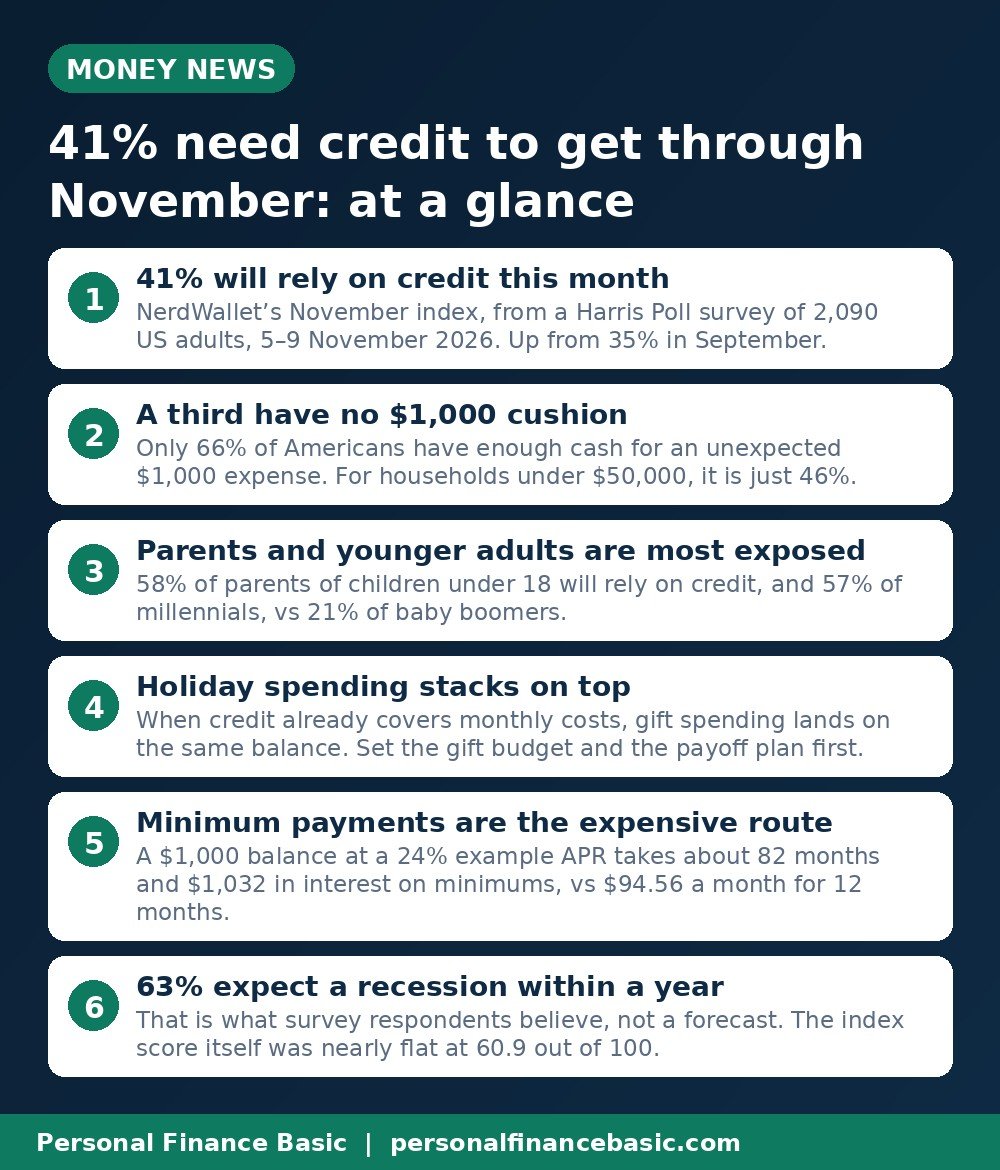
The main points from this guide, in one picture.
Frequently asked questions
What did NerdWallet’s November survey find?
Its November 2026 index found 41% of Americans will rely on credit for at least some November expenses, up from 35% in September. Only 66% have enough cash for an unexpected $1,000 expense. The Harris Poll ran it 5 to 9 November among 2,090 US adults.
Is a recession coming, according to the survey?
The survey does not forecast a recession. It found 63% of respondents believe the US economy will enter one in the next 12 months. That is what people expect, not a prediction.
How much does a $1,000 card balance really cost?
At an example 24% annual rate, clearing $1,000 over 12 months costs $94.56 a month and $134.72 in interest. Paying only minimums takes about 82 months and about $1,032 in interest.
What should I do if I have no $1,000 cushion?
Make the $1,000 starter emergency fund the first savings goal, before holiday extras. Keep it in a separate savings account and build it with a fixed automatic transfer.
The bottom line: 41% of Americans are getting through November on credit, and a third have no $1,000 cushion. If that is your month, the fix is not a bigger credit line. It is a gift budget set in dollars and a payoff plan written down.
This post is general education, not financial advice. Survey figures are from NerdWallet’s November 2026 index, conducted by The Harris Poll. Card examples use an illustrative 24% annual rate.
Related reading: Balance Transfer Cards: How They Work and the Traps and Credit Card Payoff Calculator