Six months is enough time to move a credit score in a real way, if you work on the parts that respond fastest. You cannot erase a missed payment or add years of history in half a year. You can pay on time every month, lower the balances card issuers report, and clean up errors on your reports. Those three moves cover the two biggest parts of a FICO score.
This guide lays out that plan month by month, with a worked example for credit utilization and honest expectations about what changes quickly and what takes longer. No step here requires a paid service or an account you do not need.
What actually moves your score
A FICO score runs from 300 to 850, built from five factors. Payment history counts for 35%, amounts owed for 30%, length of credit history for 15%, and credit mix and new credit for 10% each. Those weights are averages for the general population, but the order holds for most people: paying on time and keeping balances low matter far more than anything else.
Payment history is simple. A payment is usually not reported as late until it is 30 days past due. A payment a few days late can still cost a late fee, but it normally does not reach your credit report. Once it does, at 30 days, it can stay on your report for about seven years, though its effect fades as on-time payments pile up.
Amounts owed is mostly about credit utilization: your card balances divided by your card limits. Owing $2,000 across cards with $10,000 of total limits is 20% utilization. Lower is generally better. Under 30% is a common target, and under 10% scores better still. Length of history, the third factor, rewards old accounts, which is why closing an old card can hurt even when you never use it.
The six-month plan
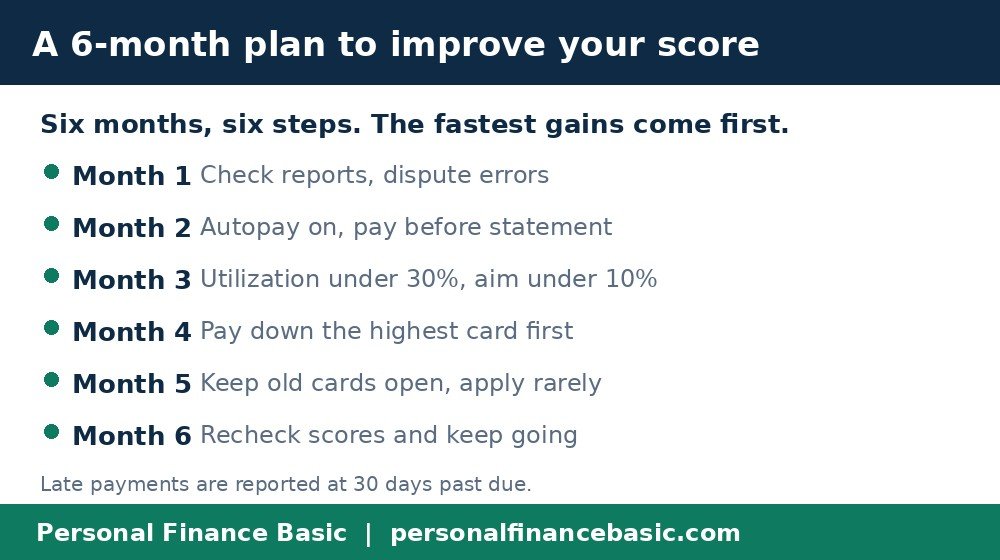
Six steps, one per month. The fastest gains come from the first three.
Month 1 is for checking your starting point. Get your free credit reports from AnnualCreditReport.com, the official site for Equifax, Experian, and TransUnion, and read all three. Look for accounts you do not recognize and balances that look wrong. Dispute any error in writing with the bureau that shows it, and keep copies. A removed error can help in weeks.
Month 2 is for making on-time payments automatic. Set autopay for at least the minimum payment on every card and loan, a few days before the due date so a slow transfer cannot make you late. Autopay does not mean paying only the minimum forever. It means a busy week can never turn into a reported late payment, the single most damaging common mistake.
Month 3 is for utilization. Work out your total card balances and total limits, then pay balances down until utilization is under 30%, or under 10% if you can. Timing matters: issuers usually report the balance on your statement closing date, not the due date. Paying a few days before the statement closes means a lower balance gets reported.
Month 4 is for paying down the most expensive card first. Send extra money to the card with the highest interest rate while paying at least the minimum on the others. This avalanche method saves the most interest. If clearing one small balance would keep you going, paying that one first is also fine.
Month 5 is for leaving things alone. Do not close old cards, even ones you rarely use, because closing a card cuts your total limit and can push utilization up overnight. Do not apply for several new cards at once either: each application can add a hard inquiry.
Month 6 is for checking progress. Pull your reports again and compare your scores with month 1. If utilization fell and every payment was on time, you should see movement.
A worked example: how utilization changes the picture
Take one card with a $4,000 limit and a $2,800 balance: 70% utilization, high enough to drag a score down. Paying $1,600 brings the balance to $1,200, or 30% of the limit. Paying another $800 brings it to $400, or 10%. The same card, the same limit, three very different pictures.
Notice what did not change: you did not need a higher limit or a new card, only a lower reported balance. Utilization can change with the next statement cycle, while payment history needs months of steady behavior.
Do not carry a balance on purpose because someone told you it builds credit. It does not. Using a card for small regular spending and paying it down before the statement closes builds the same record without the interest.
What not to do in these six months
Do not pay a company that promises to remove accurate negative information or to raise your score by a set number of points. Accurate late payments cannot be legitimately erased, and no one can promise a score outcome.
Do not check your score every day: scores update about once a month per account, so monthly checks after statements close are enough.
What to expect, month by month
In the first one or two billing cycles, a lower reported utilization can already show up, and a successful dispute can help early too. By month three or four, a run of on-time payments builds a cleaner recent record, and recent behavior counts more than old behavior.
Recovery from a late payment is slower. Each on-time month weakens its effect, but a score damaged by several missed payments or a collection may need more than six months to recover fully. That is normal: six months of clean behavior is a strong start, not a finish line.
If your score barely moves, check the cause: a high balance on one card can hide progress elsewhere, and an error missed on one bureau’s report can also hold you back.
At a glance
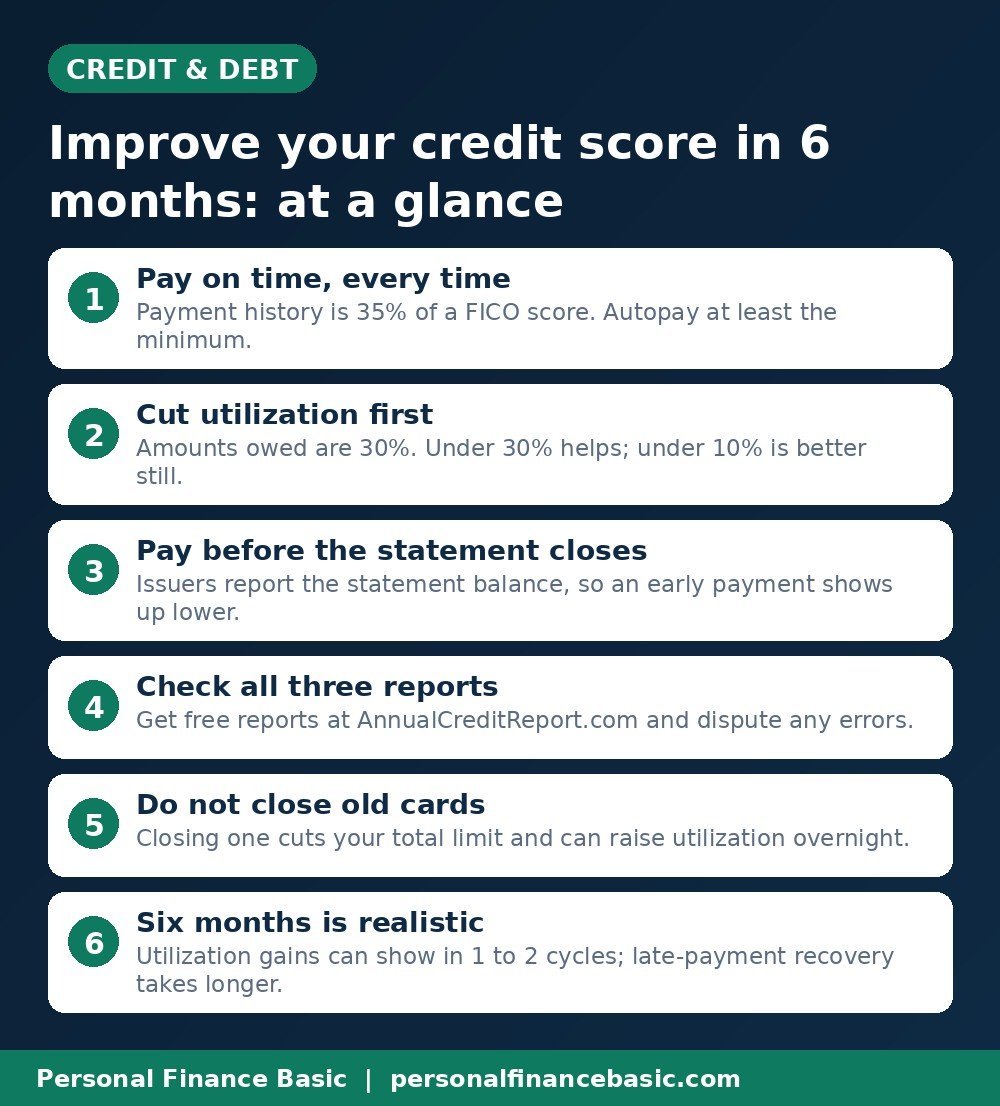
The main points from this guide, in one picture.
Frequently asked questions
How much can my score rise in 6 months?
There is no set number. Cutting utilization from 70% to under 10% can move a score noticeably within one or two cycles, while recovery from missed payments takes longer. Anyone promising a specific point gain is guessing.
Should I pay off a card in full or keep a small balance?
Pay it in full if you can. A zero balance gives 0% utilization on that card, and you pay no interest. Carrying a balance does not build credit faster.
Will checking my own credit hurt my score?
No. Checking your own reports and scores is a soft inquiry and does not affect your score. Only applications for new credit usually create a hard inquiry, with a small, short-lived effect in most cases.
Should I close a card I no longer use?
Usually not during these six months. Closing it lowers your total credit limit, which can raise utilization, and over time it can shorten your credit history. If the card charges an annual fee you cannot justify, close it after your utilization is low.
What if I cannot pay a bill on time?
Contact the lender before the due date. Some will offer a short hardship plan or move a due date. Paying at least the minimum keeps the account current, and paying before 30 days past due keeps a late payment off your report.
This guide is general education, not financial advice. Credit scoring models and lender rules differ, and your results depend on your full credit file. For debts you cannot manage, consider speaking with a nonprofit credit counselor or a qualified financial professional.
Related reading: How to Pay Off Credit Card Debt on a Low Income and What Happens If You Only Pay the Minimum on a Credit Card?