Maya has three credit cards. Her balances add up to $2,400, and her limits add up to $10,000. She is using 24% of her available credit, and that one number quietly shapes her credit score every month.
It matters more than most people expect. Utilization sits inside the “amounts owed” category, which makes up 30% of a FICO score. Only payment history, at 35%, counts for more.
Here is how the number works, how to work out yours, and what to do if it is too high.
The short answer
Credit utilization is your card balances divided by your credit limits, times 100. If you owe $2,400 and your limits total $10,000, your utilization is 24%.
Keep it under 30%, and lower is better. The Consumer Financial Protection Bureau says experts advise using no more than 30% of your total credit limit. Under 10% is better still: Experian data from June 2026 shows people with 800-plus FICO scores averaged just 7% utilization.
Work through it in four moves:
- Work out your overall utilization and your per-card utilization.
- Find the balance your issuer actually reports.
- Pay before your statement closes, when you can.
- Bring the number down with a plan, not a panic.
Quick decision guide:
- Under 10% overall and on each card? You are in the range top scorers sit in. Keep doing what you are doing.
- Between 10% and 30%? Fine, but there is room to gain. Paying down before the statement closes is the fastest fix.
- Over 30%? That is where scores start to feel it. Work the steps below, starting with the card closest to its limit.
- Applying for a loan or a card soon? Aim for under 10% in the month before you apply.
How to work out your number
Take Maya again: Card A has a $1,500 balance on a $5,000 limit, Card B has $600 on a $3,000 limit, and Card C has $300 on a $2,000 limit. Add the balances ($2,400) and the limits ($10,000), divide, and multiply by 100. The answer is 24%.
But the overall number is only half the story. Scoring models also look at each card on its own: Card A sits at 30%, Card B at 20%, Card C at 15%. One card close to its limit can hurt even when the total looks fine.
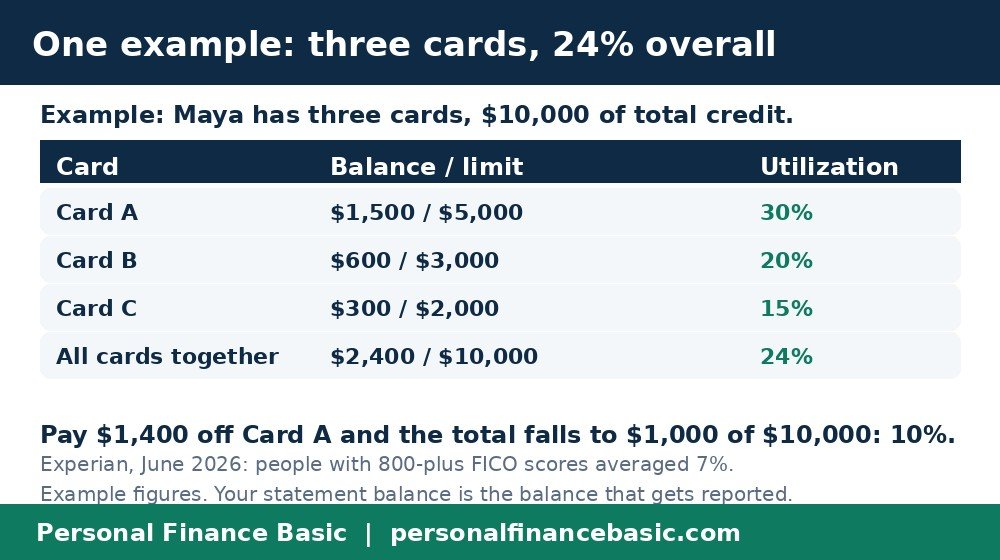
One example: three cards, 24% overall. Paying $1,400 off Card A brings it to 10%.
Now watch Maya pay $1,400 off Card A. Her total falls to $1,000, which is 10% of $10,000, and Card A drops from 30% to 2%. She did not close a card or change her limits. She just moved the one number that matters.
What each level of utilization means
There is no cliff at 30%. FICO’s own guidance says lower is generally better, with no threshold where the score suddenly drops. Think of it as a sliding scale, and use the bands below as a guide.
| Utilization | What it usually means | What to do |
|---|---|---|
| Under 10% | Where the highest scores live | Keep it there; small balances are fine |
| 10% to 29% | Within the common guideline | Good; pay down before big applications |
| 30% to 49% | Your score is likely feeling it | Pay down the highest card first |
| 50% and above | A clear warning sign to lenders | Make a payoff plan this month |
Illustrative bands, based on Experian and CFPB guidance.
- Best for most people: staying under 30% overall and under 30% on each card. It keeps the score steady without much effort.
- Best for the highest scores: under 10%, with a small balance showing on at least one card. A 0% balance on every card gives the scoring model nothing to read.
Step 1: Find the balance that gets reported
The balance that counts is usually the one on your statement closing date, not the balance in your app today. Your issuer reports that statement balance to the bureaus once a month.
That timing catches people out. You can pay in full every month and still show 40% utilization if you spend heavily before the statement closes. Check your statement date, not just your due date.
Step 2: Pay before the statement closes
This is the fastest way to lower the reported number. Pay part of the balance a few days before the statement closing date, and the lower balance is the one the bureaus see.
Say Maya’s statement closes on the 20th. If she pays $1,400 on the 18th, the lower balance is the one the bureaus see. She still pays the rest by the due date, so there is no interest and no late fee. Only the timing changed.
Step 3: Spread balances across cards
Remember that each card is scored on its own. A $2,400 balance on one $2,500-limit card is 96% on that card, even if your other cards are empty. Spread as $800 across three $5,000-limit cards, it is 16% on each.
Spreading a balance is not a substitute for paying it down. It just stops one maxed-out card from dragging your score while you pay it off. Do not open a new card to spread a balance: the application adds a hard inquiry and shortens your average account age.
Step 4: Raise the limit, or lower the balance
Utilization is a fraction, so you can improve it from either side. Paying the balance down is the honest fix, and it also saves interest. Raising a limit works too: the same balance becomes a smaller share of a bigger limit.
Many issuers let you ask for a higher limit online, and some raise it after months of on-time payments. Ask only if you can trust yourself not to spend the extra room. And never close an old card to “clean up”: closing it removes its limit from your total, which pushes your utilization up.
At a glance
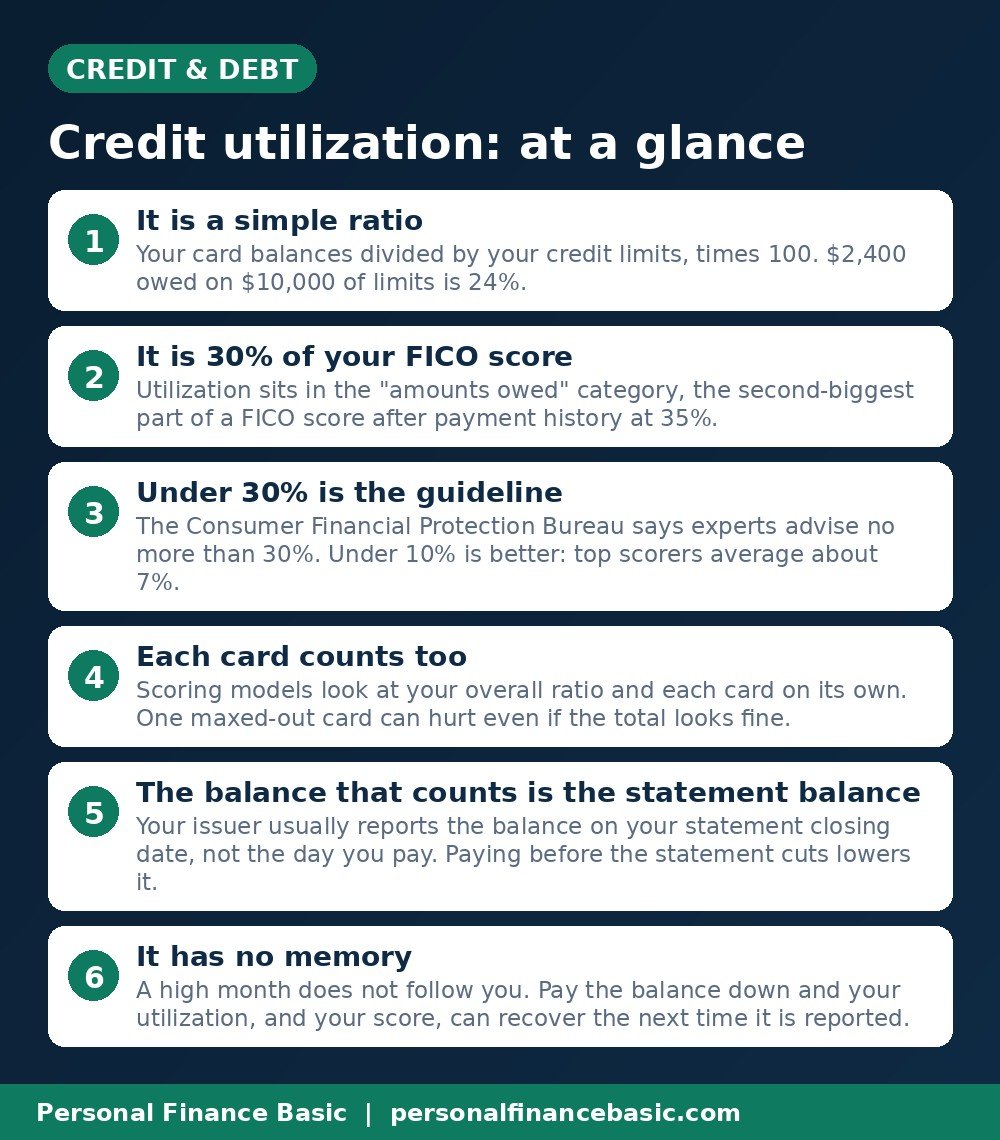
The main points from this guide, in one picture.
Frequently asked questions
Is 30% a hard rule or a guideline?
It is a guideline, not a cliff. The Consumer Financial Protection Bureau says experts advise no more than 30%, but FICO scores utilization on a sliding scale: 29% is not safe and 31% is not suddenly damaged. Lower is better, and under 10% is where the highest scores sit.
Does paying my card in full each month keep utilization at zero?
Not always. Your issuer usually reports the balance on your statement closing date, which can come before your payment. Spend $1,000 during the month and the bureaus see $1,000, even if you pay in full on the due date.
Should I keep a small balance to help my score?
No. Carrying a balance costs interest and does not help your score. What helps is a small reported balance: use the card, let a small balance appear on the statement, then pay it in full by the due date.
How fast does my score recover after I pay down a balance?
Usually within one or two reporting cycles. Utilization has no memory in most scoring models: once a lower balance is reported, the old high number stops counting.
Does utilization apply to loans like a mortgage or a car loan?
No. Utilization only applies to revolving credit, like credit cards and lines of credit. Installment loans are scored differently, on how much you still owe against the original amount.
The bottom line: work out your number, both overall and per card, and aim for under 30%, under 10% if you can. Paying before the statement closes is the fastest fix; paying the balance down is the one that lasts.
This guide is general education, not financial advice. Your card terms and balances decide what applies to you.
Related reading: How to Improve Your Credit Score in 6 Months and How to Read Your Credit Card Statement