A credit card can be a useful tool or an expensive trap, and the difference often comes down to picking the right type for where you are now. If you have no credit history or a low score, most standard cards will turn you down. A secured credit card was built for exactly this situation.
It works like a normal credit card, with one big difference: you put down a cash deposit first. That deposit protects the card issuer, which is why they approve people with little or no credit history. An unsecured card, the type most people picture, needs no deposit but asks for a stronger credit record instead.
What a secured credit card is
A secured credit card is a real credit card backed by a cash deposit you pay up front. The deposit acts as collateral: if you stop paying, the issuer can use it to cover what you owe. That safety net is why these cards are open to people with no credit score or a low one.
You apply and pay a deposit, typically $200 to $500, though some cards accept as little as $49 and others allow up to $2,500. Your credit limit usually matches your deposit: put down $300 and you can spend up to $300.
The deposit is not a payment. It sits with the issuer while the account is open, and you still owe your monthly bill. If you pay in full each month, you pay no interest. The deposit comes back to you when the issuer upgrades you to an unsecured card, or when you close the account with the balance paid in full.
A secured card is not a prepaid card. The Consumer Financial Protection Bureau notes that a secured card reports your payments to the three major credit bureaus, Equifax, Experian, and TransUnion, so on-time payments build your history. Most prepaid cards do not report at all, so they do nothing for your score.
What an unsecured credit card is
An unsecured credit card is the standard card most people carry. There is no deposit. The issuer sets your credit limit from your credit history and income, and lends to you on trust. Because the issuer takes more risk, the approval bar is higher.
Most unsecured cards ask for at least fair credit, usually a FICO score around 580 or higher, and the better cards ask for good credit, around 670 or higher. A first unsecured card might start at $500 or $1,000, while a long, clean history can bring $10,000 or more.
Unsecured cards often come with perks secured cards rarely offer, such as cash back or travel points. The average APR across all credit card accounts was 20.94% in the second quarter of 2026, according to Federal Reserve data, and secured cards often sit at the higher end of that range, sometimes 25% to 30% or more. The rate only matters if you carry a balance. Pay in full and the APR costs you nothing.
Secured vs unsecured, side by side
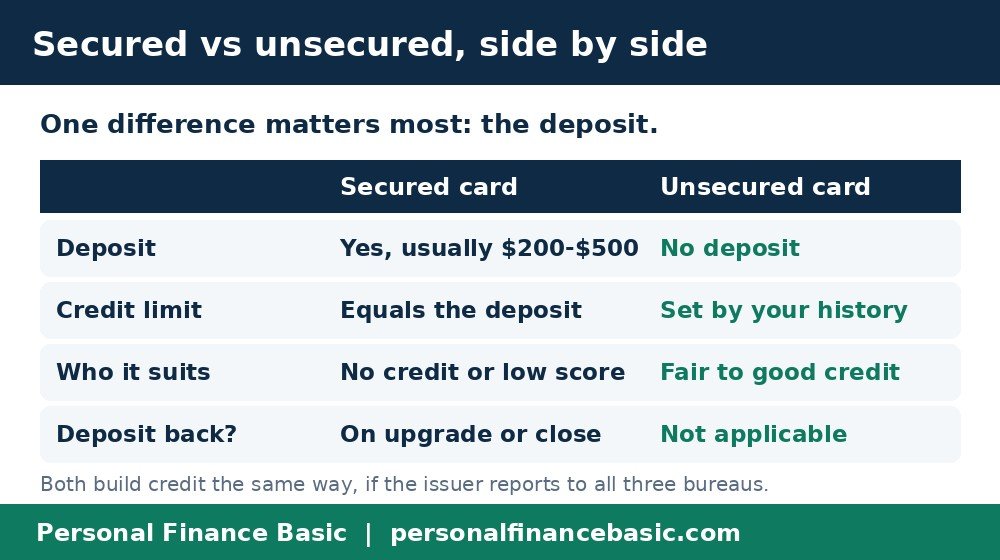
One difference matters most: the deposit. Everything else follows from it.
The trade is clear. A secured card asks for cash up front and gives you a small limit, but it opens the door when nothing else will. An unsecured card asks for nothing up front but wants proof you can handle credit already. Both build your history the same way, one on-time payment at a time.
Which one should you choose?
Choose a secured card if you have no credit history, a score below about 580, or a recent rejection. It also fits if you are rebuilding after bankruptcy, collections, or a long run of missed payments. The deposit is the price of entry, and for most people it is $200 to $500.
Choose an unsecured card if your score is already fair or better and you have steady income. If you can qualify for a card with no annual fee and no deposit, take it. There is no reason to tie up your cash when the issuer will lend to you on trust.
If you are in between, apply for the unsecured card first. Too many applications in a short time can nick your score, so apply for one card, wait for the answer, and only then look at a secured card if the answer is no.
How to use a secured card to build credit
Getting the card is the easy part. Using it well is what builds your score. Keep your balance low: scoring models look at how much of your limit you use, and staying under 30% helps. On a $300 limit that means under $90. On a $500 limit, under $150.
Pay on time, every month, without exception. Payment history is the biggest factor in your FICO score, about 35% of it. Set up automatic payments for at least the minimum, and pay the full statement balance whenever you can.
Use it for small, regular spending you would buy anyway, such as gas or groceries, and pay it off. That steady pattern is exactly what a thin credit file needs.
Check that the card reports to all three bureaus before you apply. Most do, but a card that reports to only one builds your history more slowly. The issuer’s terms should say so plainly.
How to graduate to an unsecured card
Most issuers review secured accounts after 6 to 12 months of on-time payments. If your record looks good, they may refund your deposit and move you to an unsecured card with a higher limit. Some issuers do this automatically. Others ask you to request a review.
If your issuer does not offer an upgrade path, do not worry. After 6 to 12 months of good payments your score will have moved, and you can apply for an unsecured card elsewhere. Keep the secured card open: a longer account history helps your score, and closing it returns the deposit only if the balance is paid in full.
At a glance
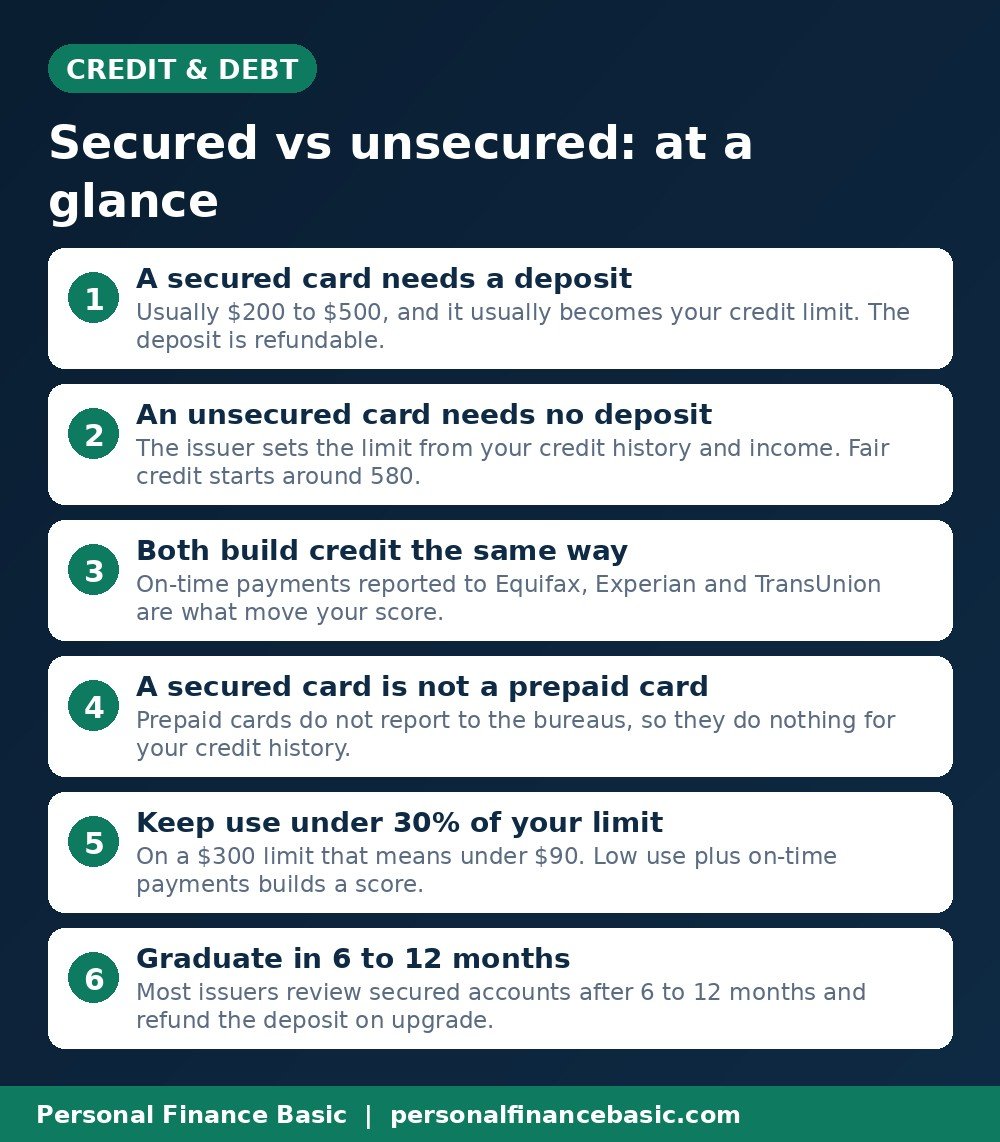
The main points from this guide, in one picture.
Frequently asked questions
Is a secured credit card the same as a prepaid card?
No. A secured card is a real credit card that reports your payments to the bureaus, so it builds your credit history. A prepaid card uses your own loaded money, and most prepaid cards do not report, so they do nothing for your score.
How much deposit do I need for a secured card?
Most cards ask for $200 to $500, and the deposit usually becomes your credit limit. Some accept as little as $49, and some let you deposit up to $2,500.
Will a secured card hurt my credit score?
Applying causes a small, short-lived dip, as with any card application. After that, on-time payments and low use of your limit are what build your score.
When do I get my deposit back?
Usually when the issuer upgrades you to an unsecured card, which often happens after 6 to 12 months of on-time payments. You also get it back if you close the account with the balance paid in full.
Can I get an unsecured card with no credit history?
It is very hard. Most unsecured cards ask for at least fair credit, around 580 or higher. With no history, a secured card is the normal first step, and 6 to 12 months of good use is often enough to qualify for an unsecured card after that.
This guide is general education, not financial advice. Card terms and approval rules vary by issuer, so read the terms of any card before you apply. Consider speaking with a qualified financial adviser about your own situation.
Related reading: How to Improve Your Credit Score in 6 Months and Does Checking Your Own Credit Score Hurt It?