Selling online in the US starts with a choice that looks simple and is not: where does your store live? The platform you pick sets what you pay each month, what it takes from each sale, and how much traffic you have to find yourself.
This guide compares the main options for a beginner in the US: what each one charges per month, what it takes from a sale, and who it suits. No platform wins on every measure, and the cheapest to start is rarely the cheapest per sale.
The two kinds of platform
Your own store (Shopify, WooCommerce, BigCommerce, Wix, Squarespace): you pay a monthly fee or hosting costs, you get full control of your shopfront, and you bring your own traffic.
A marketplace (Amazon, Etsy, eBay): no monthly fee is required to start, and millions of shoppers are already searching there — but you pay a bigger cut of every sale and follow their rules.
Many sellers start on a marketplace to get first sales, then add their own store once they know what sells. That sequence is often the cheapest way to learn.
The main platforms, compared
| Platform | Starting cost | Main per-sale fees | Best for |
|---|---|---|---|
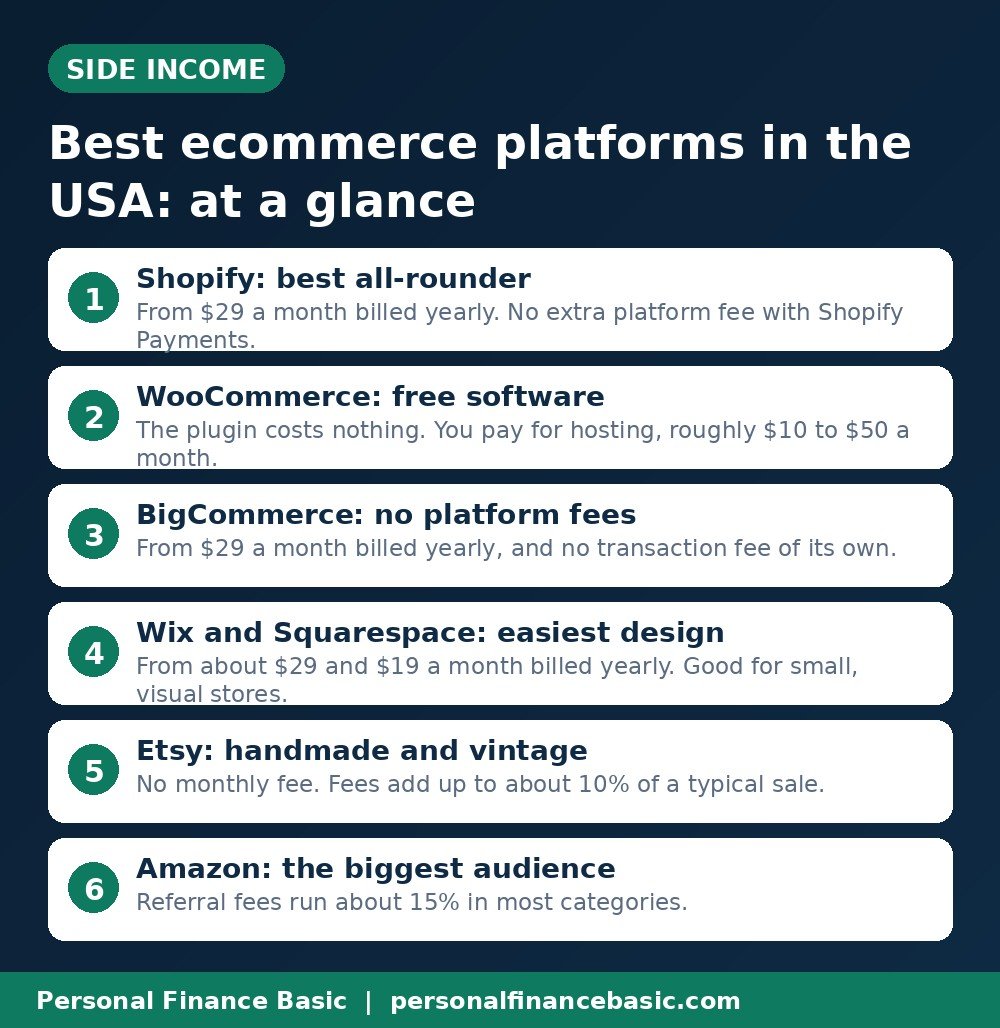
| Shopify | $29/mo billed yearly ($39 monthly) | 2.9% + 30¢ card processing with Shopify Payments | Most beginners who want their own store |
| WooCommerce | Free software; hosting extra | Card processing, about 2.9% + 30¢ | WordPress users who want full control |
| BigCommerce | $29/mo billed yearly ($39 monthly) | Card processing; no platform transaction fee | Growing stores that sell a lot |
| Wix | $29/mo billed yearly (Core plan) | Card processing; no platform transaction fee | Small stores where design matters |
| Squarespace | $19/mo billed yearly (Basic) | 2% store fee on Basic; 0% on Core and above, plus processing | Visual brands, artists, photographers |
| Etsy | No monthly fee | $0.20 per listing, 6.5% transaction fee, 3% + $0.25 processing | Handmade, vintage and craft items |
| Amazon | $0 (Individual) or $39.99/mo (Professional) | Referral fee, 15% in most categories; Individual adds $0.99 per item | Products that people already search for |
Shopify: the default choice for your own store
Shopify is the platform most new US sellers end up on, because it handles hosting, security, checkout and payments in one place. The Basic plan costs $29 a month when billed yearly ($39 month-to-month). With Shopify Payments, card processing costs 2.9% + 30¢ on the Basic plan. Use a third-party payment provider instead and Shopify adds a 1% transaction fee on top.
Choose Shopify if you want your own store, plan to grow, and would rather pay a predictable monthly fee than manage software. Its app store covers most add-ons, and its checkout is trusted by shoppers.
WooCommerce: free software, real running costs
WooCommerce is a free plugin that turns a WordPress site into a store. The software costs nothing and the running costs are hosting, a domain, a payment processor and any paid extensions. Hosting for a small store usually runs $5 to $25 a month, and card processing is about 2.9% + 30¢, similar to Shopify’s.
Choose WooCommerce if you already run a WordPress site, are comfortable updating plugins and backups, and want full control without a platform monthly fee. It suits sellers who like to own every part of the setup.
BigCommerce: built to avoid platform fees
BigCommerce works like Shopify, hosted store, monthly plan, but it charges no transaction fee of its own. The Standard plan costs $29 a month billed yearly ($39 monthly). You still pay card processing, but you keep more of each sale than on a plan that adds a platform fee.
Choose BigCommerce if you expect decent sales volume and want to keep the per-sale cut as low as possible without running your own software.
Wix and Squarespace: the design-first options
Wix (Core, $29 a month billed yearly) and Squarespace (Basic, $19 a month billed yearly, with a 2% store fee; Core removes it) are website builders first and stores second. Both include hosting and design tools, and both handle checkout, but neither is built for large catalogues or complex shipping.
Choose one of these if your store is small, the look of the site is part of the product, for example art, photography or a personal brand, and you do not need deep ecommerce features yet.
Etsy: where handmade and vintage buyers already shop
Etsy charges no monthly fee. You pay $0.20 to list an item for four months, a 6.5% transaction fee on the sale price including shipping, and 3% + $0.25 for payment processing. On a $40 sale, that adds up to about $4.25 before any advertising.
Choose Etsy if you make or design what you sell, or sell vintage, and you want buyers from day one without building traffic yourself. The trade-off is that Etsy, not you, owns the customer relationship.
Amazon: the biggest shop window, the biggest cut
Amazon offers two plans: Individual, with no monthly fee but $0.99 charged per item sold, and Professional at $39.99 a month. Either way you pay a referral fee, 15% in most categories. On a $40 sale that is $6.40 on Professional and $6.99 on Individual, before fulfilment fees if Amazon stores and ships for you.
Choose Amazon if your product is the kind people type into a search bar, and your margin can survive giving up roughly a sixth of the price. It is the largest audience in US ecommerce, and the most expensive per sale.
What a $40 sale actually costs
Monthly fees get the attention, but per-sale fees decide what you keep. On the same $40 sale with free shipping and no advertising, the fees come out very differently by channel:
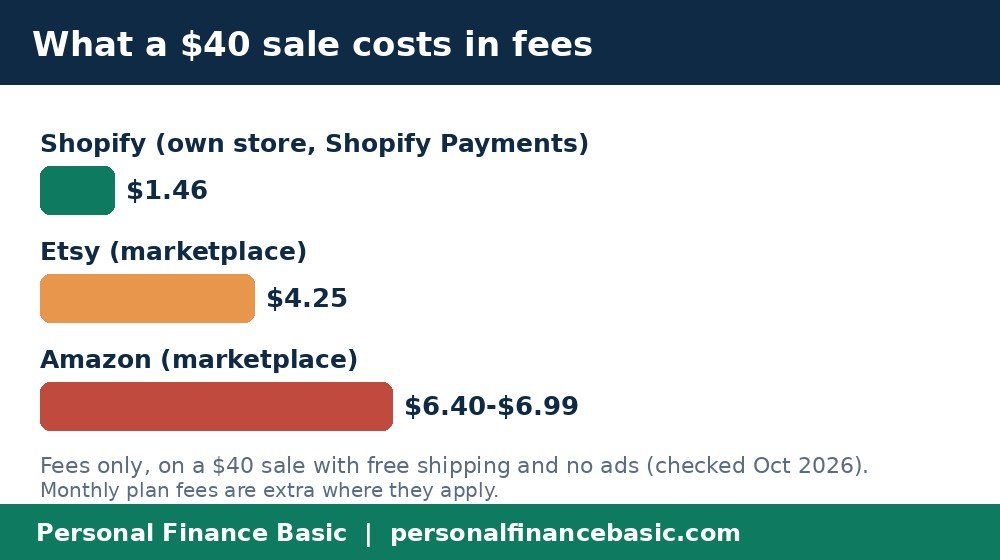
The pattern is simple. Your own store is cheapest per sale and most expensive in effort. A marketplace is free to stand still and expensive per order. Neither is wrong; they charge for different things.
How to pick, based on your situation
- You make things by hand: start on Etsy. The audience is there and there is no monthly bill while you learn.
- You have a product and plan to build a brand: Shopify, or BigCommerce if you expect volume early. Budget the monthly fee into your prices from the start.
- You already have a WordPress site or blog: WooCommerce adds a store to what you own, at the price of doing your own upkeep.
- Your product is visual and your range is small: Wix or Squarespace will get a good-looking store live fastest.
- Your margin is healthy and people search for your product by name or type: Amazon’s referral fee buys the largest stream of ready buyers in the country.
Whichever you choose, run the fee maths on your own prices before listing anything. A platform that costs 10 to 15% per sale needs a different price than one that costs 3%. If you are still at the idea stage, our guide to earning your first income online covers the no-stock ways to start, and these side income ideas show how selling fits alongside other options.
At a glance
Frequently asked questions
What is the cheapest ecommerce platform in the USA?
To start, a marketplace like Etsy, which has no monthly fee. Per sale, your own store is cheapest: on Shopify with its own payments, a $40 sale costs about $1.46 in processing, against about $4.25 on Etsy and $6.40 to $6.99 on Amazon, before any monthly plan fees.
Is Shopify worth it for a beginner?
It is worth it if you are selling regularly, because the monthly fee buys hosting, checkout, security and support in one place. If you expect only a few sales while you test an idea, a marketplace with no monthly fee is the cheaper way to learn.
How much does Amazon take from a sale?
A referral fee of 15% in most categories, plus either $0.99 per item on the Individual plan or $39.99 a month on the Professional plan. If Amazon stores and ships the item for you, fulfilment fees are added on top.
Can I sell on more than one platform?
Yes, and many sellers do. A common pattern is a marketplace for discovery and an own store for repeat buyers. Just keep stock levels in step across both, and check each platform’s rules about directing buyers elsewhere.
Do I need a business licence to sell online in the US?
It depends on your state, your city and what you sell. Many states require a seller’s permit for collecting sales tax, and some products have their own rules. Check your state’s requirements before your first sale; this guide is education, not legal or tax advice.
This article is general education, not financial, tax or legal advice. Platform prices and fees were checked in November 2026 and change often; confirm current pricing on each platform’s own site before you commit.