A bank account is the starting point for almost everything else in personal finance. Your paycheck needs somewhere to land, your bills need somewhere to be paid from, and your savings need a safe place to sit. Opening your first account is simpler than most people expect: about 30 minutes, and four documents.
This guide covers which account to open first, how to choose a bank, what to bring, and what happens after the account is open.
Checking, savings, or both?
A checking account is for money that moves. Your paycheck goes in, and rent, bills and daily spending come out. It usually comes with a debit card and a way to pay online. A savings account is for money that stays put. It earns a small amount of interest, and it holds your emergency fund and goals.
Most people open both at the same time. The checking account handles daily life, and the savings account holds money you do not want to spend by accident. Keeping them at the same bank makes it easy to move money between them.
You do not need both on day one. If you only need somewhere for your paycheck and bills, a checking account alone is enough to start. You can add a savings account later.
How to choose a bank
Start with the fees. The three to check are the monthly account fee, ATM fees and overdraft fees. Many checking accounts charge a monthly fee of $5 to $15, but most waive it if you set up direct deposit or keep a minimum balance. Ask exactly what waives the fee.
Next, check how you will use the account. If you use cash, look for branches and ATMs near your home and work, and ask whether the bank charges for using another bank’s ATM. If you rarely use cash, an online bank can work well, since it usually has lower fees. Either way, check that the bank has a mobile app for checking your balance, depositing a check and moving money.
Also ask about the minimum opening deposit. Many accounts open with $25 to $100, and some need no deposit at all. If the bank asks for more than you have, that is the wrong account for now.
What to bring
Banks have to verify who you are before they open an account. The list below is what most banks ask for. Bring the originals, not photos on your phone.
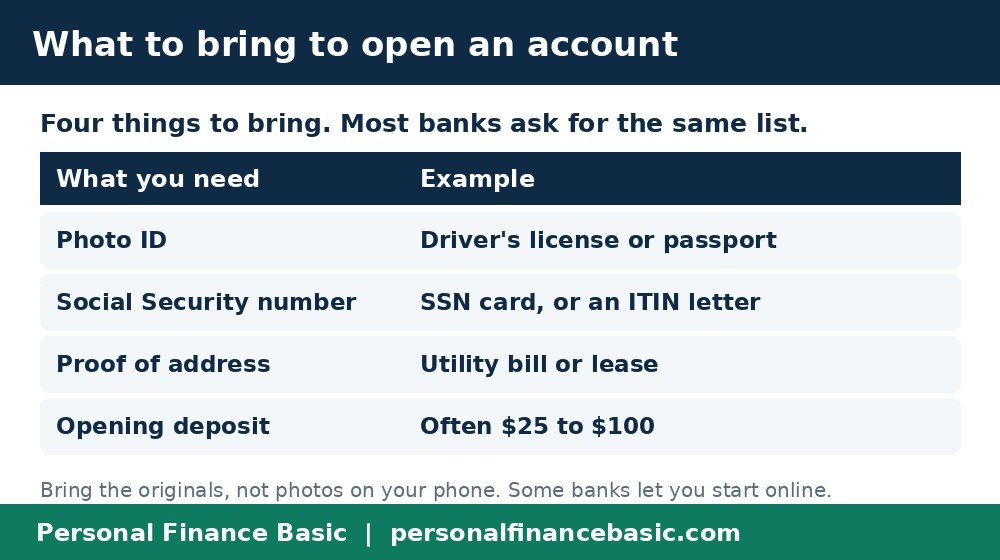
Four things to bring. Most banks ask for the same list.
First, a government-issued photo ID, such as a driver’s license, state ID card or passport. Second, your Social Security number; you may need the card itself, or just the number. If you do not have a Social Security number, many banks accept an Individual Taxpayer Identification Number, or ITIN, instead. Third, proof of your address, such as a utility bill or a lease. Fourth, money for the opening deposit, if the account needs one.
If you are under 18, a parent or guardian usually has to open the account with you, and the bank will ask for their ID too. Some banks offer accounts made for teenagers, with a debit card and limits set by the parent.
Opening the account, step by step
You can open most accounts in a branch or online. In a branch, the steps are: show your ID and documents, choose the account type, fill in your details, make the opening deposit, and sign the account agreement. The debit card usually arrives by mail within 7 to 10 business days.
Online, the steps are the same, but you upload photos of your documents and the bank checks them. Some banks open the account the same day. Others ask you to visit a branch to finish the check.
Read the account agreement before you sign it. It states the fees, the minimum balance, and what happens if the account goes below zero. The important parts are the monthly fee and how to avoid it, and the overdraft fee. If anything is unclear, ask.
At the end, ask for the account number, the routing number, and how to set up online banking. The routing number is the nine-digit number that identifies your bank, and you need it for direct deposit and bill payments.
Your money is insured to $250,000
Money in a bank account is covered by the Federal Deposit Insurance Corporation, or FDIC. If an FDIC-insured bank fails, the FDIC returns your money, up to $250,000 per depositor, per bank, for each ownership type. A joint account is covered separately.
Check that the bank is FDIC-insured before you open the account. Most banks display the FDIC logo on their website and in their branches. Credit unions have the same cover through the NCUA, also to $250,000.
The insurance covers your deposits if the bank fails. It does not cover investment losses, or money lost to a scam where you sent the money yourself. Keep your login details private, and never share a code a bank texts you.
Your first month with the account
Set up direct deposit first, so your paycheck goes straight into the account. Your employer will ask for the routing number and the account number, and the first deposit usually takes one or two pay cycles to start. Direct deposit often waives the monthly fee.
Turn on balance alerts, so your phone tells you when money comes in and when the balance drops below a level you choose. Set the low-balance alert at $100.
Learn the app. Check that you can see recent transactions, deposit a check by taking a photo of it, and move money to savings. Try a small transfer to savings in the first week, so the habit is set up before you need it.
Keep a small cushion in checking, around $100 to $200 above your planned spending, so a bill that arrives early does not push the account below zero. An overdraft fee is often $30 or more, and one fee can wipe out a month of careful saving.
At a glance
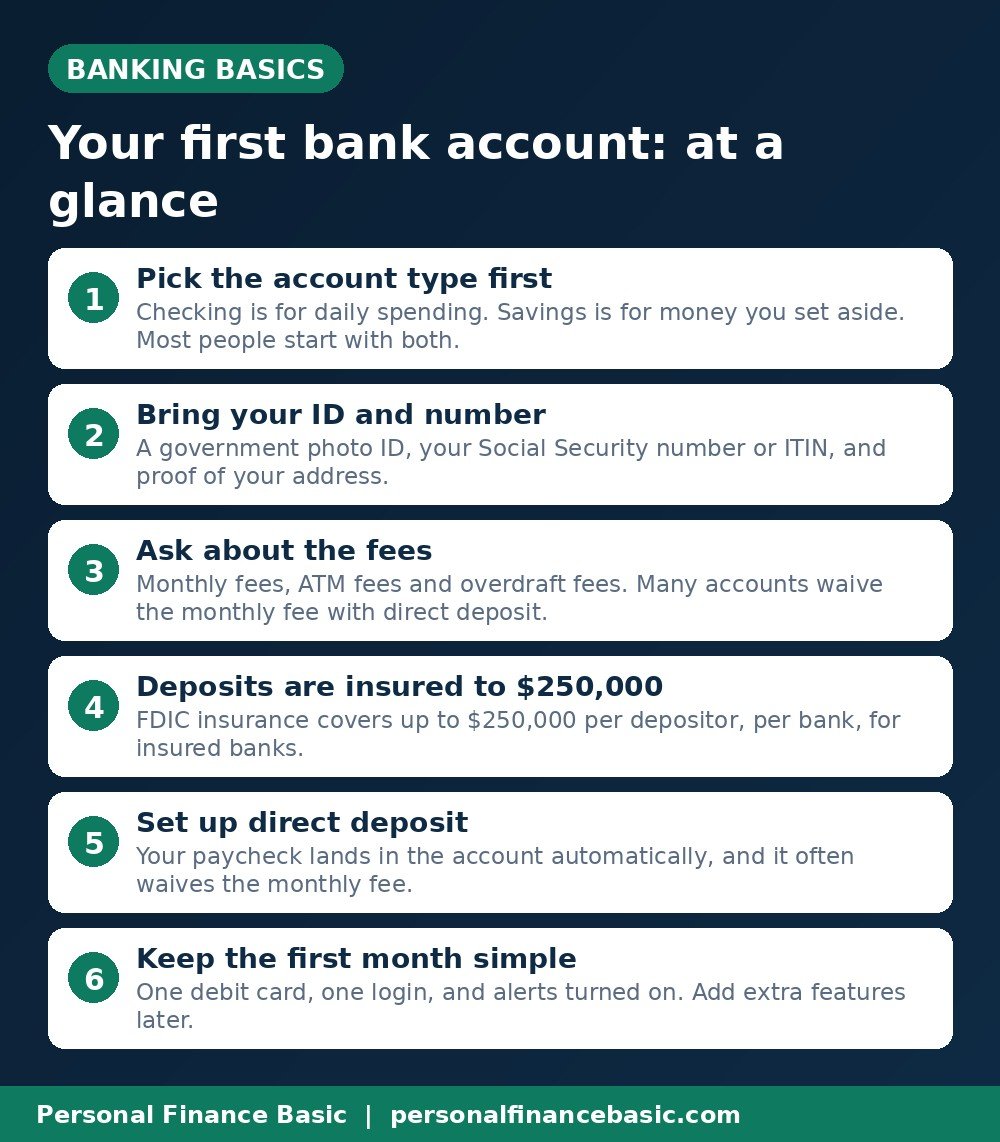
The main points from this guide, in one picture.
Frequently asked questions
What do I need to open my first bank account?
A government photo ID, your Social Security number or ITIN, proof of your address, and money for the opening deposit if the account needs one. Most accounts open with $25 to $100.
Can I open a bank account without a Social Security number?
Many banks accept an ITIN instead of a Social Security number, and a passport is usually accepted as the photo ID. Rules differ by bank, so call ahead and ask what documents they accept.
How much money do I need to open an account?
Many checking accounts open with $25 to $100, and some online accounts open with no deposit. Ask the bank what the minimum is before you apply, and pick an account that fits what you have.
Is my money safe in a bank account?
Yes, if the bank is FDIC-insured. The FDIC covers up to $250,000 per depositor, per bank, for each ownership type. Credit unions have the same cover through the NCUA.
How long does it take to open an account?
About 30 minutes in a branch, and often the same day online. Your debit card usually arrives within 7 to 10 business days. Direct deposit can take one or two pay cycles to start.
This guide is general education, not financial advice. Account terms and fees differ by bank, so check the account agreement for the account you open. Consider speaking with a qualified financial adviser about your own situation.
Related reading: Checking vs Savings Account: What Is the Difference? and What Is FDIC Insurance and Why It Matters