You picked up freelance work, sold a few things online, or earned tips through a delivery app. No tax was taken out. So do you pay tax on side income in the US?
Yes. The IRS taxes almost all income, and side income is no exception. This guide covers what counts, the two taxes, the forms, and how to set money aside.
What counts as side income?
Side income is money you earn outside your main job: freelance writing, design, tutoring, pet sitting, delivery driving, and task work. Money from selling things online, renting a spare room, and cash tips counts too.
The IRS has no separate side hustle category. If you aim to make a profit, it treats the work as a business, even if small and part time. If you do it mainly for fun, it may be a hobby. Both kinds of income are taxable, but the rules for costs differ.
Selling your own used things for less than you paid is usually not taxable. A jacket bought for $80 and sold for $25 is a loss, and a loss on a personal item is not taxed. Buying items to resell for a profit is business income.
The short answer: yes, you pay tax
All income is taxable unless the law says otherwise, and no law exempts side income. Cash, tips, small amounts, and app payments all count. The amount matters for which forms you receive, but not for whether the income is taxable.
No form does not mean no tax. A client may pay $500 and never send a form, and a buyer may pay in cash. You still report the income.
The two taxes on side income
Most side earners face two federal taxes. The first is income tax: side income is added to your other income and taxed at your rate after the standard deduction and any credits.
The second is self-employment tax, the one that catches beginners by surprise. An employer pays half of your Social Security and Medicare taxes and takes the other half from your pay. When you work for yourself, you pay both halves: 15.3 percent in total, 12.4 percent for Social Security and 2.9 percent for Medicare.
Self-employment tax starts once net earnings reach $400 in a year. Net earnings means side income minus business costs. You pay 15.3 percent on 92.35 percent of net earnings. The Social Security part applies only up to $184,500 of combined wages and self-employment income in 2026. The Medicare part has no cap.
Worked example, labelled as an assumption, not a promise: on $5,000 of net side earnings, take 92.35 percent ($4,617.50), apply 15.3 percent, and the self-employment tax is about $706. Income tax is charged on top, at your own rate. That is why many side earners set aside 25 to 30 percent of each payment.
What forms should you expect?
The form depends on how you were paid. A business client reports payments for services on Form 1099-NEC: $600 or more for payments made in 2025, and $2,000 or more for payments made in 2026, under the One Big Beautiful Bill Act passed in 2025. Income below the threshold is still taxable.
Payment apps and marketplaces report on Form 1099-K. Under the federal rule restored in 2025, they send one when payments pass $20,000 and more than 200 transactions in a year. Some states set lower limits. The form reports gross payments, not profit, so fees, shipping, and the cost of what you sold still come off first.
Tips and cash pay usually come with no form. Keep a daily note of cash and tips, with the date and amount.
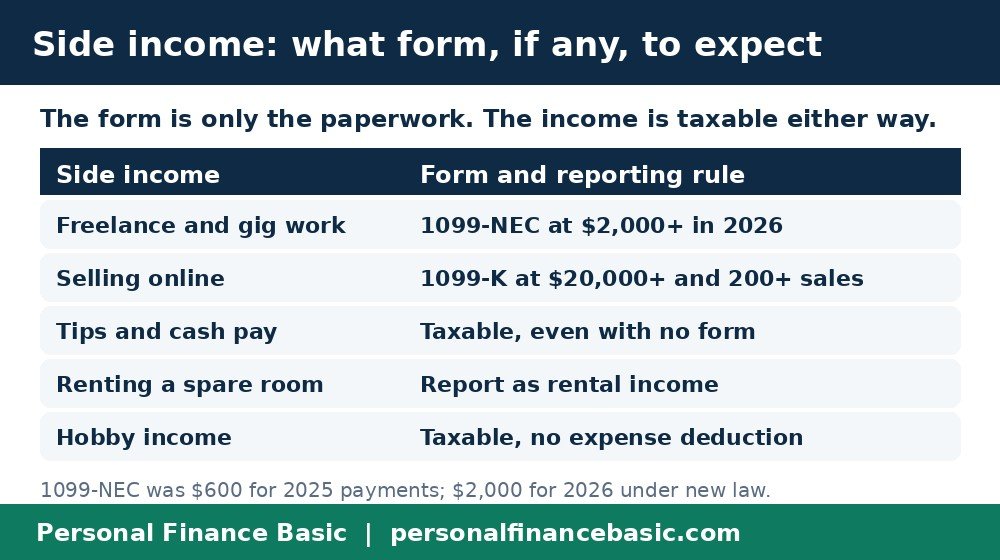
Side income: what form, if any, to expect. The form is only the paperwork. The income is taxable either way.
Hobby or business: why the label matters
The IRS weighs nine factors, including your records, the time you spend, and whether you have made a profit before. No single factor decides it. An activity is presumed to be run for profit if it made a profit in three or more of the last five tax years.
If it is a business, you report income and costs on Schedule C, pay self-employment tax on net earnings of $400 or more through Schedule SE, and deduct ordinary costs such as supplies, fees, shipping, and mileage.
If it is a hobby, you still report the income, on Schedule 1, line 8j. But hobby costs cannot be deducted, so hobby income is taxed in full. Hobby income carries no self-employment tax, because a hobby is not a trade or business.
Paying during the year: quarterly estimated tax
The US tax system is pay as you go. Employees pay through withholding. Side earners have no withholding, so the IRS generally expects quarterly estimated payments, made with Form 1040-ES, if you expect to owe $1,000 or more when you file. They cover income tax and self-employment tax together.
For 2026 income, the due dates are 15 April, 15 June, and 15 September 2026, and 15 January 2027. If you file by 31 January 2027 and pay the rest, you do not need to make the January payment. Missing a payment can bring an underpayment penalty.
How much to set aside from each payment
Open a separate savings account for tax money, and move a share of each side payment into it on the day it arrives. A common starting point is 25 to 30 percent, which covers self-employment tax plus a modest income tax rate.
On an $800 payment, 25 percent is $200 and 30 percent is $240. Money set aside on the day you are paid is money you will not spend by mistake.
Keep records from the first payment
List each payment with the date, who paid, and the amount. Keep receipts for costs and copies of any 1099 forms. If a form shows more than you received, ask the payer to correct it.
At a glance
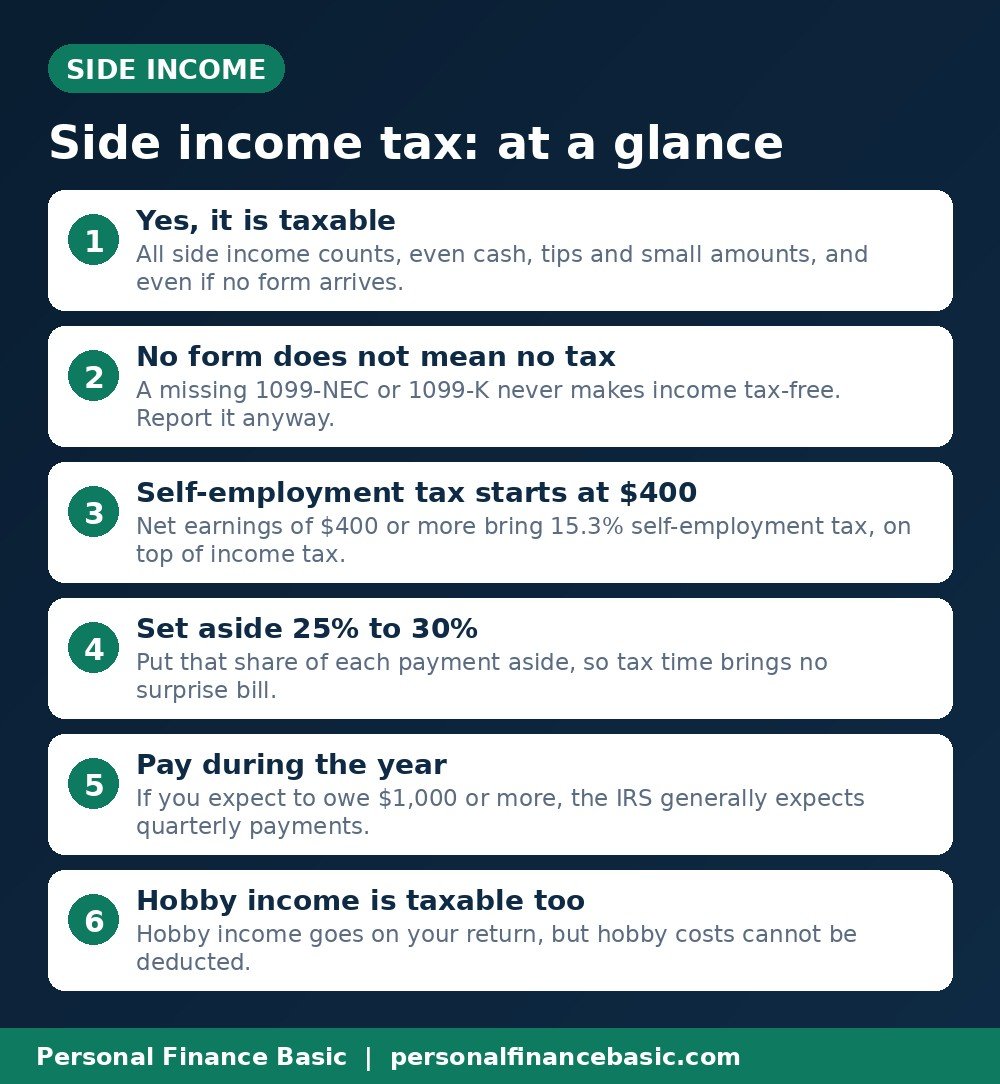
The main points from this guide, in one picture.
Frequently asked questions
Do I pay tax on side income if I earn less than $600?
Yes. The $600 figure was a reporting threshold for 2025 payments, not a tax-free limit. All side income is taxable, even $50, even with no form.
What is self-employment tax, and when does it start?
It is the Social Security and Medicare tax for the self-employed, at 15.3 percent on 92.35 percent of net earnings. It starts at $400 of net earnings in a year, and you work it out on Schedule SE.
Do I need to pay tax four times a year?
If you expect to owe $1,000 or more, the IRS generally expects quarterly payments, due 15 April, 15 June, 15 September, and 15 January. If you expect to owe less, you can usually settle up when you file.
Is hobby income taxable?
Yes. Hobby income goes on Schedule 1, line 8j, and is taxed in full, because hobby costs cannot be deducted. It carries no self-employment tax.
What if I never receive a 1099 form?
Report the income anyway. Keep your own record of payments, and use it to fill in your return.
This guide is general education, not tax advice. Tax rules change, and the right amounts depend on your income, costs, and state. Check IRS.gov or speak with a qualified tax professional. The worked examples are illustrations based on stated assumptions, not promises of what you will owe.
Related reading: 10 Side Hustles You Can Start With No Money in the US and How to Sell Things You Own Online: A Beginner Plan