On 10 November 2026, the Internal Revenue Service reminded taxpayers of a tax break that many people have never been able to use. If you take the standard deduction instead of itemizing, you can now deduct up to $1,000 in cash donations to charity on your tax return. Married couples filing jointly can deduct up to $2,000.
The rule comes from the Working Families Tax Cuts law, and the IRS says it is permanent. It applies to donations made during 2026, so it will show up on the tax returns filed in the 2027 filing season. There is still time to use it, because only gifts made before 31 December 2026 count.
Who qualifies
The deduction is only for people who do not itemize. Each year, you either take the standard deduction, a flat amount set by the IRS, or you itemize, adding up specific expenses. About 90 percent of filers take the standard deduction, according to the Tax Policy Center, so this rule reaches most taxpayers.
For 2026, the standard deduction is $16,100 for single filers and $32,200 for married couples filing jointly. If you take the standard deduction, you can now add the charitable deduction on top of it. The two amounts do not cancel each other out. You keep the full standard deduction and add up to $1,000, or $2,000 for a married couple filing jointly, for qualifying cash gifts.
If you itemize, this new rule does not apply to you. Itemizers deduct donations under the normal rules, although those changed too: starting in 2026, only the part of your donations above 0.5 percent of your adjusted gross income is deductible.
What counts, and what does not
Only qualifying cash contributions count. Cash includes checks and card payments, not just paper money. The gift must go to a qualified charitable organization that is eligible to receive tax-deductible contributions. You can check whether an organization qualifies with the IRS tax-exempt organization search tool.
Noncash gifts do not qualify for this deduction. A bag of clothes, household goods, or a used car given to charity does not count, even if the charity is qualified. The IRS is clear on this point, so do not count noncash gifts toward the $1,000.
Two other types of gift are also excluded. Cash given to a supporting organization does not qualify, and neither does cash given to set up or maintain a donor-advised fund. Gifts of stock or other property do not count either, because they are not cash.
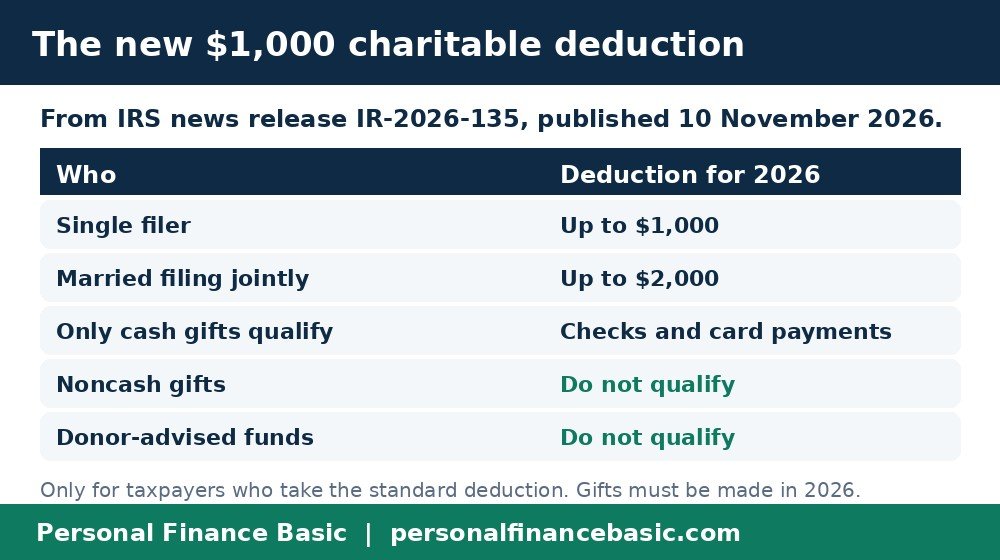
The new $1,000 charitable deduction, from IRS news release IR-2026-135.
How much is it worth?
A deduction is not a refund. It lowers your taxable income, and the tax you save depends on your bracket. A married couple in the 12 percent bracket who gives $2,000 in cash saves about $240 in federal income tax. The same gift in the 22 percent bracket saves about $440. These are simple illustrations, not a promise. Your actual result depends on your income and the rest of your return.
Here is how the cap works in practice. A single filer who gives $800 in cash to a qualified charity during 2026 and takes the standard deduction can deduct the full $800. If the same person gives $1,500, only $1,000 of it is deductible under this rule. The extra $500 does not carry over, and it does not become deductible by itemizing unless the total itemized deductions beat the standard deduction.
For a married couple filing jointly, the $2,000 cap is a joint cap. It is not $1,000 for each spouse on top of a shared limit, and it is not $2,000 each. The couple’s combined qualifying cash gifts are deductible up to $2,000 in total.
What to do before 31 December
The deduction only covers gifts made during 2026, so the timing matters. If you planned to give anyway, giving before the year ends means the gift counts on your 2026 return. A gift made on 2 January 2027 belongs to the 2027 tax year instead.
Keep records of every gift. The IRS asks for receipts, canceled checks, bank records, or a written communication from the charity showing its name, the date, and the amount. For any single gift of $250 or more, you need a written acknowledgment from the charity to claim the deduction. Keep those papers with your tax records for the year, and hold on to them until after you file.
Check that the charity qualifies before you give, not after. A quick check on the IRS search tool takes a minute. The IRS also notes that more eligibility rules, contribution limits, and recordkeeping rules may apply, and it points readers to Publication 6196 for the full detail.
Why this rule is new
Standard-deduction filers have not had a charitable deduction since the temporary pandemic-era rule ended. That rule allowed up to $300 for 2020 and 2021, and then it expired. The new rule is higher, $1,000 instead of $300, and permanent rather than a one-year measure. The IRS chief executive, Frank J. Bisignano, said in the release that making the provision permanent should encourage giving now and in the future.
The timing is useful for anyone planning year-end giving. November and December are the months when many people give the most, and this year those gifts can lower a tax bill for the first time in years, as long as they are cash gifts to qualified charities and the giver takes the standard deduction.
At a glance
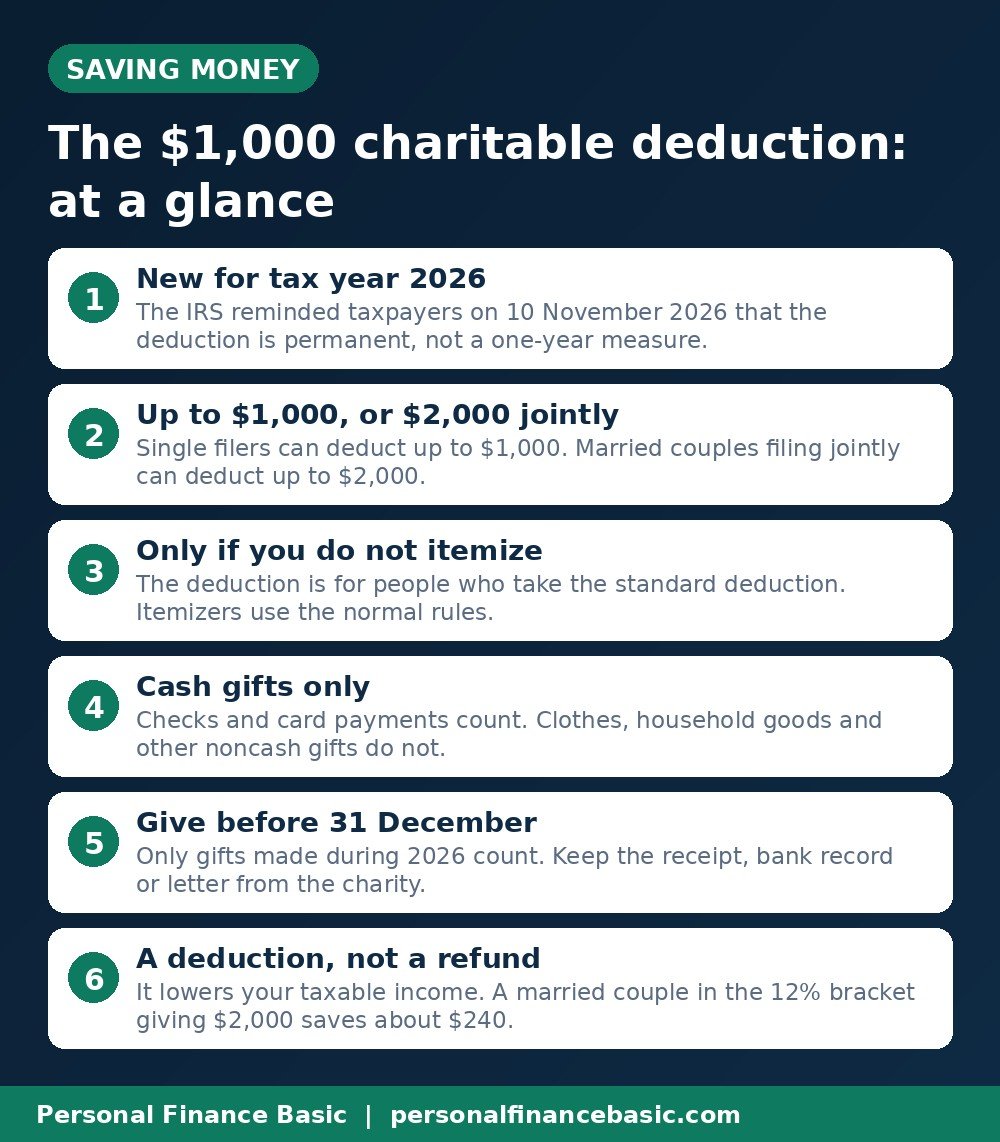
The main points from this guide, in one picture.
Frequently asked questions
Can I deduct donations if I take the standard deduction?
Yes, starting with tax year 2026. The IRS said on 10 November 2026 that people who take the standard deduction can deduct up to $1,000 in qualifying cash donations, or $2,000 for married couples filing jointly. The gift must be made during 2026.
Do gifts of clothes or household goods count?
No. Only cash contributions count for this deduction, including checks and card payments. Noncash gifts such as clothes, furniture, or vehicles do not qualify, and neither do gifts to donor-advised funds.
How much tax will I actually save?
It depends on your tax bracket, because a deduction lowers your taxable income rather than giving you money back. A married couple in the 12 percent bracket giving $2,000 saves about $240. Your own result depends on your income and the rest of your return.
What records do I need to keep?
Keep a receipt, canceled check, bank record, or a written note from the charity showing its name, the date, and the amount. For a single gift of $250 or more, you need a written acknowledgment from the charity.
This guide is general education, not tax advice. Tax rules are detailed and change over time, so check the current rules on IRS.gov and consider speaking with a qualified tax adviser about your own return before you act.
Related reading: IRS Just Set Your 2027 Tax Numbers: New Standard Deduction and Brackets Explained and How to Budget When Your Income Changes Every Month