On 12 November 2026, the Internal Revenue Service announced the retirement plan limits for 2027 in news release IR-2026-136 and Notice 2026-66. The headline number is the 401(k) limit: it rises to $25,500, up $1,000 from $24,500 in 2026. The IRA limit, by contrast, does not move at all. It stays at $7,500.
The IRS published the 2027 tax numbers on 5 November, but that release did not cover retirement accounts. The figures below are the official IRS numbers, not a forecast. Open enrollment is running at many workplaces right now, so the choices you make this month set your 2027 payroll deductions.
What changed for 2027
The $25,500 limit covers what you contribute from your own pay to a 401(k), a 403(b), a governmental 457 plan, or the federal Thrift Savings Plan. It does not include any money your employer adds. An employer match sits on top of your $25,500, up to a separate total limit below.
Workers age 50 and older can contribute more. The catch-up amount rises from $8,000 to $8,500 in 2027, taking the total to $34,000. You qualify if you turn 50 by 31 December 2027. Workers who turn 60, 61, 62 or 63 during 2027 get a higher catch-up of $11,750 instead, up from $11,250, for a total of $37,250. This replaces the age-50 catch-up for those four years; it does not stack on top of it.
Two other limits moved as well. SIMPLE plans, the retirement plans many small employers offer, rise from $17,000 to $17,500. The total annual additions limit for defined contribution plans, which counts your contributions plus your employer’s contributions together, rises from $72,000 to $75,000.
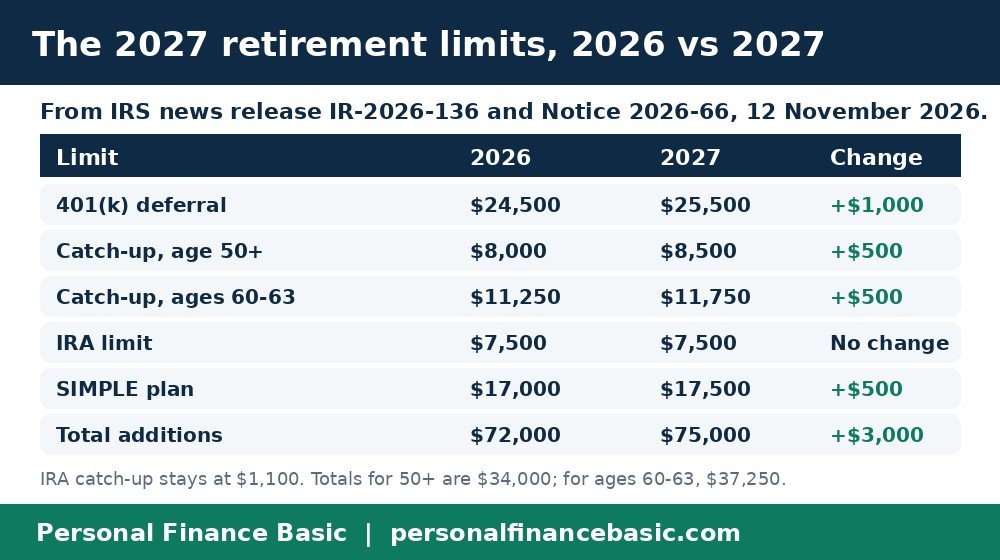
The 2027 retirement limits, compared with 2026. Source: IRS news release IR-2026-136 and Notice 2026-66.
What stayed the same
The IRA limit is unchanged. For 2027, you can put $7,500 in total into your traditional and Roth IRAs combined, the same as in 2026. The IRA catch-up for people 50 and older is also unchanged at $1,100, so the total for savers 50 and older is $8,600. The $7,500 limit covers all of your IRAs together, not each one. If you put $4,000 into a traditional IRA, you can put at most $3,500 into a Roth IRA in the same year. It rose from $7,000 to $7,500 in 2026, and inflation since then was not enough to push it to the next step.
When the new limits take effect
These are 2027 limits. They apply to paychecks dated in calendar year 2027. A higher election you set during open enrollment takes effect with your first January paycheck. It does not change what you can put in during the rest of 2026. The 2026 limits still govern the rest of this year: $24,500 for 401(k) deferrals, with an $8,000 catch-up at age 50 and older and $11,250 at ages 60 to 63. Check your first pay stub of January 2027 to confirm the higher deduction is there.
IRAs work on a different clock. You can make IRA contributions for 2027 from 1 January 2027 until the tax filing deadline in April 2028. A 401(k) has no such extension. Its contributions must come out of paychecks dated in 2027, so the election you set now is the one that counts.
What the extra $1,000 looks like per paycheck
An extra $1,000 a year sounds large as one number. Split across the year, it is about $83 more per month, or $1,000 divided by 12. If you are paid every two weeks, it is about $38.46 per paycheck, or $1,000 divided by 26 pay periods. These are plain arithmetic, not a recommendation. Whether the higher amount fits your budget depends on your pay, your rent, and your other costs.
To reach the new maximum, divide $25,500 by your number of pay periods and set your election to that amount. Avoid reaching the limit too early in the year: if you hit $25,500 in October, your contributions stop, and some employers only match the pay periods in which you contribute.
The income ranges that also moved
The IRS also raised the income ranges that decide who can use an IRA. For a single filer covered by a workplace plan, the traditional IRA deduction phases out between $83,000 and $93,000 of modified adjusted gross income in 2027, up from $81,000 to $91,000 in 2026. Inside that range, only part of your contribution is deductible. Above $93,000, none of it is.
For a Roth IRA, the phase-out range for single filers rises to $158,000 to $173,000 in 2027, up from $153,000 to $168,000 in 2026. Below $158,000 you can make the full contribution. Between $158,000 and $173,000 you can make a partial contribution. At $173,000 or more, you cannot contribute directly to a Roth IRA at all. One more threshold also rose: if your prior-year wages were above $155,000, up from $150,000, any catch-up contribution must go into a Roth account.
What to do during open enrollment
Start with the number that matters most. If your employer offers a 401(k) match, contribute at least enough to get the full match. The match is money your employer adds to your account, and it does not count against your $25,500 limit.
Next, look at your current election. If you contribute a fixed dollar amount per paycheck, that amount will carry into 2027 unless you change it. The limit went up, but your election did not move with it. To use the new limit, you have to raise the election yourself. If you contribute a percentage of pay, check what it works out to at your 2027 pay.
Finally, remember what did not change. Your IRA limit is still $7,500, and your 2026 tax return still uses the 2026 numbers. The 2027 standard deduction and tax brackets apply to income earned in 2027, on the return you file in early 2028.
At a glance
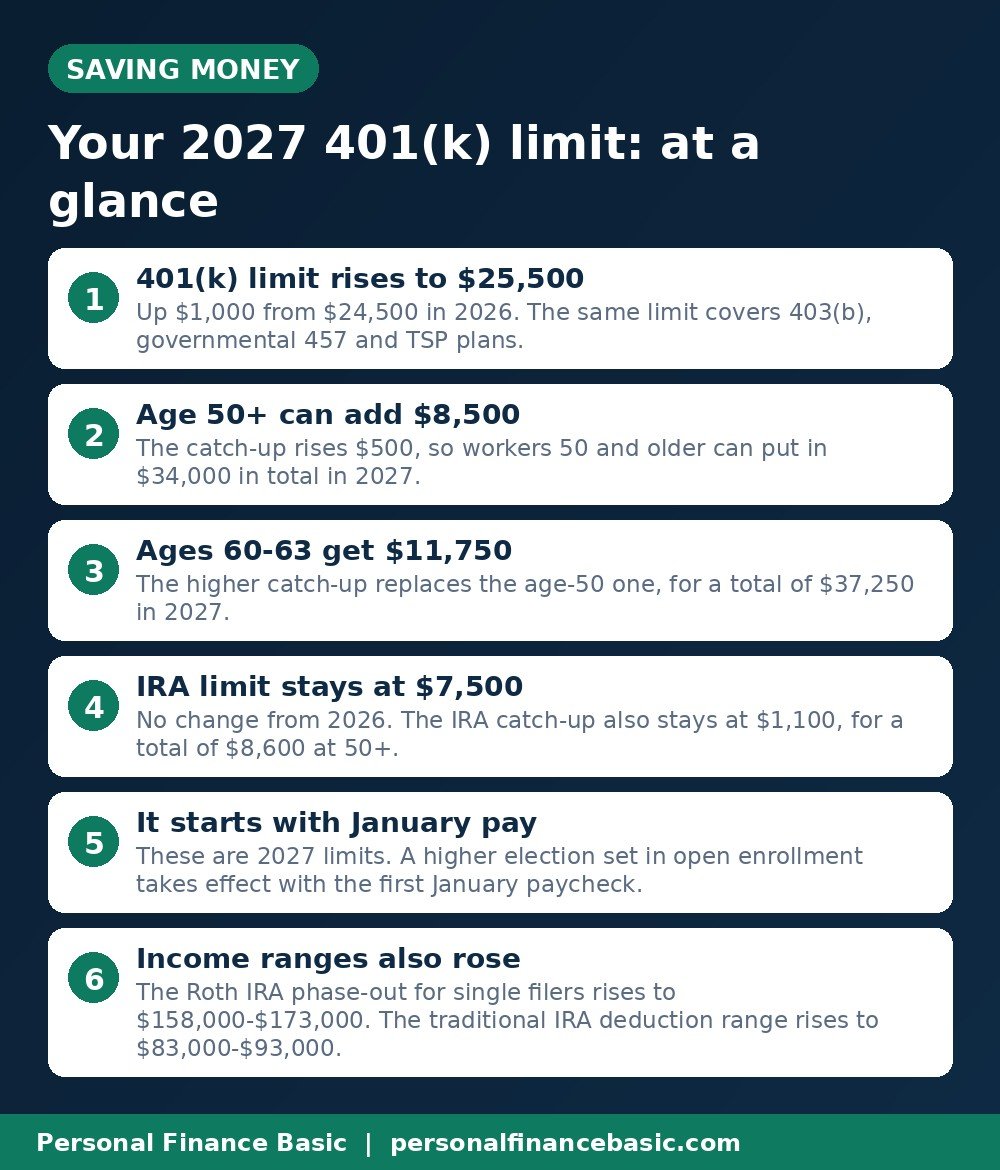
The main points from this guide, in one picture.
Frequently asked questions
When do the 2027 401(k) limits start?
They apply to paychecks dated in 2027. A higher election set during open enrollment takes effect with your first January paycheck.
Does the higher limit change what I can put in during 2026?
No. The 2026 limit of $24,500 still governs contributions from 2026 paychecks.
How much can I put into an IRA in 2027?
Up to $7,500 in total across all your IRAs, the same as in 2026. If you are 50 or older, you can add a $1,100 catch-up, for a total of $8,600.
What if I turn 60 in 2027?
You get the higher catch-up of $11,750 instead of $8,500, for a total of $37,250.
Do I need to do anything now?
Raise your 401(k) election during open enrollment, and check your first January pay stub.
This guide is general education, not financial or tax advice. Retirement plan rules are detailed and change over time. The right amounts depend on your income, your employer plan, and your goals. Consider speaking with a qualified tax professional about your own situation.
Related reading: IRS Just Set Your 2027 Tax Numbers: New Standard Deduction and Brackets, Explained and Traditional IRA vs Roth IRA: What Is the Difference?