

A Systematic Investment Plan, or SIP, is a way to put a fixed amount of money into a mutual fund every month. You do not need a large sum to begin. You choose an amount, pick a date, and the money goes in on that date each month. Over time, small regular payments can add up to a useful sum, though the value will move up and down with the market.
Many people start with ₹500 a month because it feels manageable. It is less than the cost of a few takeaway meals, and it does not leave a big hole in a monthly budget. For a first-time investor, a small start also makes it easier to learn how investing feels when markets fall, without risking a large amount.
What a SIP does
When you invest through a SIP, you buy units of a mutual fund. The price of a unit changes each day. When prices are low, your ₹500 buys more units. When prices are high, it buys fewer units. This spread over time is one reason people prefer a monthly plan to trying to guess the right day to invest a lump sum.
A SIP is a habit, more than a single decision. You set it up once, and it keeps going until you stop it or change it. That regularity matters because most people do not invest well when they have to decide again each month.
Why ₹500 is a common starting point
Many funds allow SIPs starting at ₹500, and some start lower. It varies by fund, so check the fund’s minimum before you apply. If ₹500 is too much for your budget right now, a smaller amount is still a start. If ₹500 feels easy after a few months, you can raise it later. The amount matters less than keeping the plan going.
Do not borrow money to fund a SIP, and do not use money you need for rent, food, or an EMI due that month. A SIP works best with money you can leave alone for a few years.
Before you start
Clear high-interest card debt first if you have any. Card interest is usually far higher than any return you might get from a fund, so paying that debt down first often saves more money than investing would earn. At the same time, keep some emergency money aside in a savings account, so a sudden bill does not force you to stop the SIP or sell units at a bad time. Our guide on how to build an emergency fund explains a simple way to begin.
Pick one goal and a time period. A goal could be a course fee in five years, a house deposit in ten years, or retirement in twenty years. The time period matters because equity funds, which invest mainly in shares, can fall sharply in a short period. They are better suited to longer goals, where there is time to recover from a fall.
How to start, step by step
First, complete KYC, which is the basic identity check used for investing in India. You will usually need your PAN and your bank details. This is a one-time step, and it is done online in most cases. Next, decide the monthly date. A date just after your salary comes in works well, because the money leaves before you spend it.
Then choose a broad fund category. Beginners often look at index funds, large-cap funds, hybrid funds, and ELSS funds, but they work in different ways. An index fund follows a market index, such as a group of large listed companies, and does not try to pick winners. A large-cap fund invests mainly in large, well-known companies. A hybrid fund mixes shares with debt, such as bonds, which can soften falls but may also limit gains. ELSS is a type of equity fund that offers tax saving under the old tax regime, with a lock-in period of three years. That lock-in means you cannot take the money out before three years are up, so check the rules that apply to you.
Start the SIP through the fund house or a regulated platform. Read the fund details, check the minimum amount and any exit load, which is a charge for taking money out early, and then set up auto-debit from your bank account. Auto-debit removes the need to remember each month. Once it is running, review it once or twice a year. Check whether your goal or income has changed, and whether the fund is still doing what you need. You do not need to check it every day. When your income rises, try to raise the SIP by a small amount. Even ₹500 extra a month, kept going for years, can make a real difference.
A hypothetical example
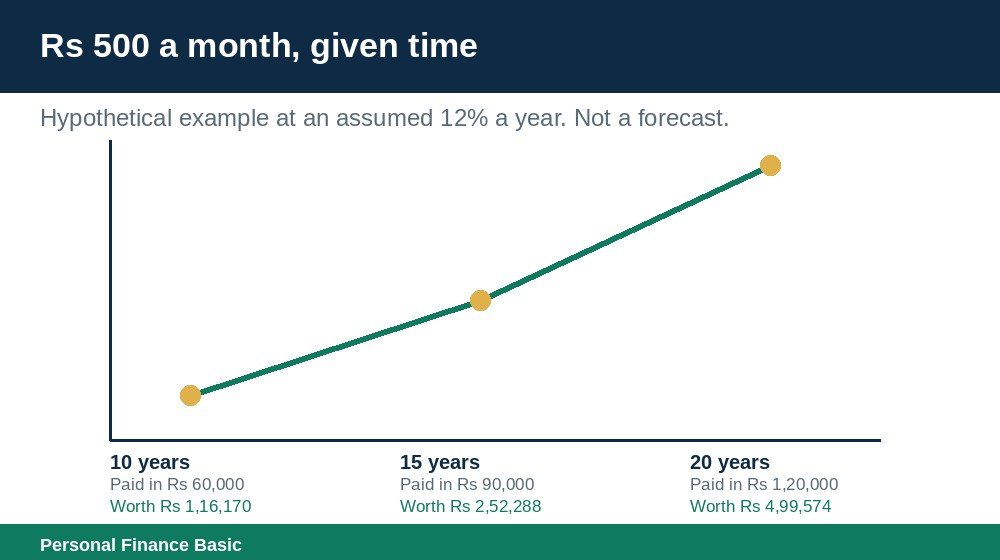
The figures below are a hypothetical example at an assumed 12% a year. This is an assumption, not a forecast, and actual returns will differ. They show how time, more than the monthly amount alone, shapes the result.
| Time | Invested | Estimated value |
|---|---|---|
| 10 years | ₹60,000 | ₹1,16,170 |
| 15 years | ₹90,000 | ₹2,52,288 |
| 20 years | ₹1,20,000 | ₹4,99,574 |
In each case the monthly payment is ₹500. The invested total grows in a straight line, but the estimated value grows faster over time, because returns also earn returns in later years. That is why starting early, even with a small amount, can matter more than waiting until you can afford a large amount. Try your own numbers with the mutual fund calculator.
The risks to keep in mind
A SIP is market-linked, so its value goes up and down. Returns are not guaranteed. In a bad year, your investment may be worth less than what you put in, even if you invested every month. Short periods are risky for equity funds, because a fall near the time you need the money leaves little time to recover. If your goal is less than three years away, a safer option, such as a savings account or a short-term debt fund, may suit you better. Read the fund documents before you invest, and do not put all your savings into one fund.
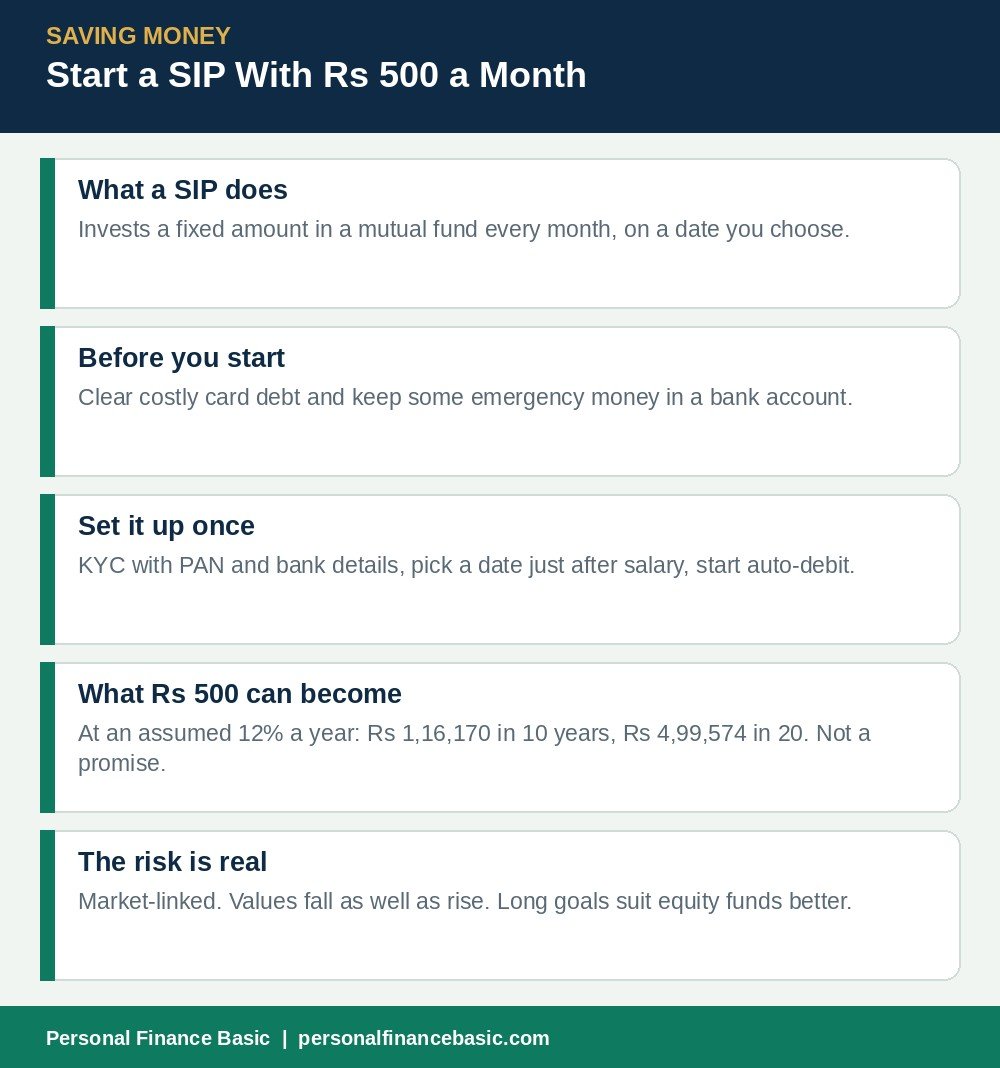
At a glance
Frequently asked questions
Can I start a SIP with less than ₹500?
Some funds allow a lower minimum. Check the fund’s minimum amount before you apply, as it varies by fund.
Can I stop or pause a SIP?
Yes, in most cases you can stop, pause, or change the amount. Check the fund’s rules and any exit load first.
Is a SIP safe?
No investment in shares is fully safe. A SIP spreads your money over time, but the value can still fall.
Do I need a demat account?
No, you do not need a demat account for a regular mutual fund SIP. KYC, PAN, and bank details are usually enough.
When should I increase my SIP?
When your income rises and your monthly budget still has room, after essentials and emergency savings are covered.
Start small, keep the date steady, and let time do most of the work. If ₹500 is what you can afford this month, that is a good place to begin.
This article is for education only and is not financial advice. Mutual fund investments are subject to market risks. Read all scheme-related documents carefully before investing.


Comments
One response to “How to Start a SIP with ₹500 a Month”
[…] see realistic side income ideas for beginners in India. And once extra income starts coming in, a SIP with ₹500 a month is one simple place to put a small part of it […]