
Seeing a CIBIL score of 0 can be confusing. It sounds like the lowest possible score, but it is not. A score of 0 usually means you do not have enough credit history for a score to be worked out yet. This guide explains what 0 means, how it differs from -1 and from a low score, and how lenders decide how much you can borrow when you are new to credit.
What does a CIBIL score of 0 mean?
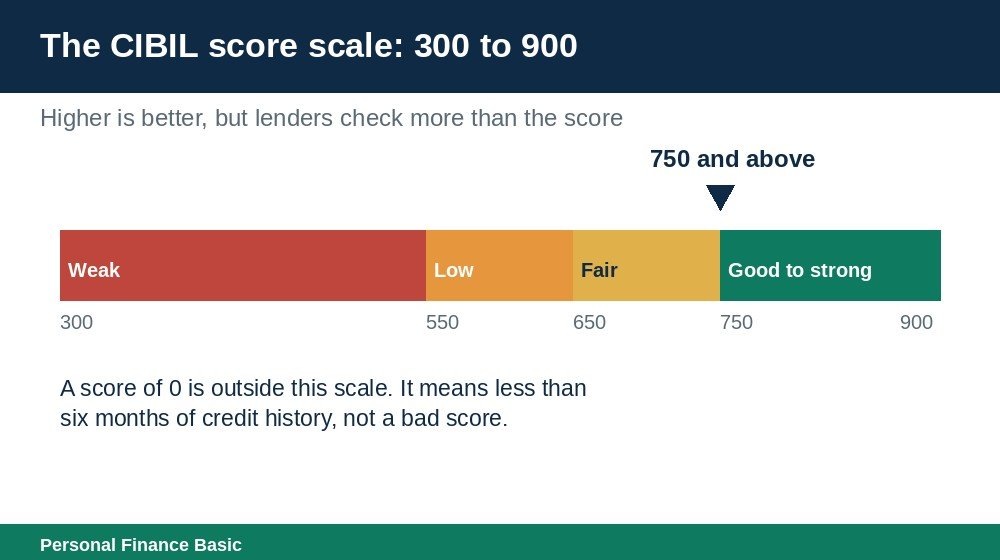
CIBIL scores in India range from 300 to 900. A score of 0 means your credit history is less than six months old, so it is marked NA, which stands for Not Applicable. A score of -1, shown as NH, means you have no credit history at all. Neither one is a bad score in the usual sense. Both mean lenders cannot yet see a track record of borrowing and repayment.
0 vs -1 vs a low score
| Score shown | What it means | How lenders see it |
|---|---|---|
| 0 (NA) | Credit history less than 6 months old | Too little history to judge yet |
| -1 (NH) | No credit history at all | No track record to judge |
| Low score, e.g. below 600 | A history exists, but with late payments or defaults | Higher risk, based on past behaviour |
The difference matters. A low score points to problems in the past. A score of 0 or -1 points to a lack of information, which is why lenders look at other evidence instead.
Can you be rejected just for having no credit history?
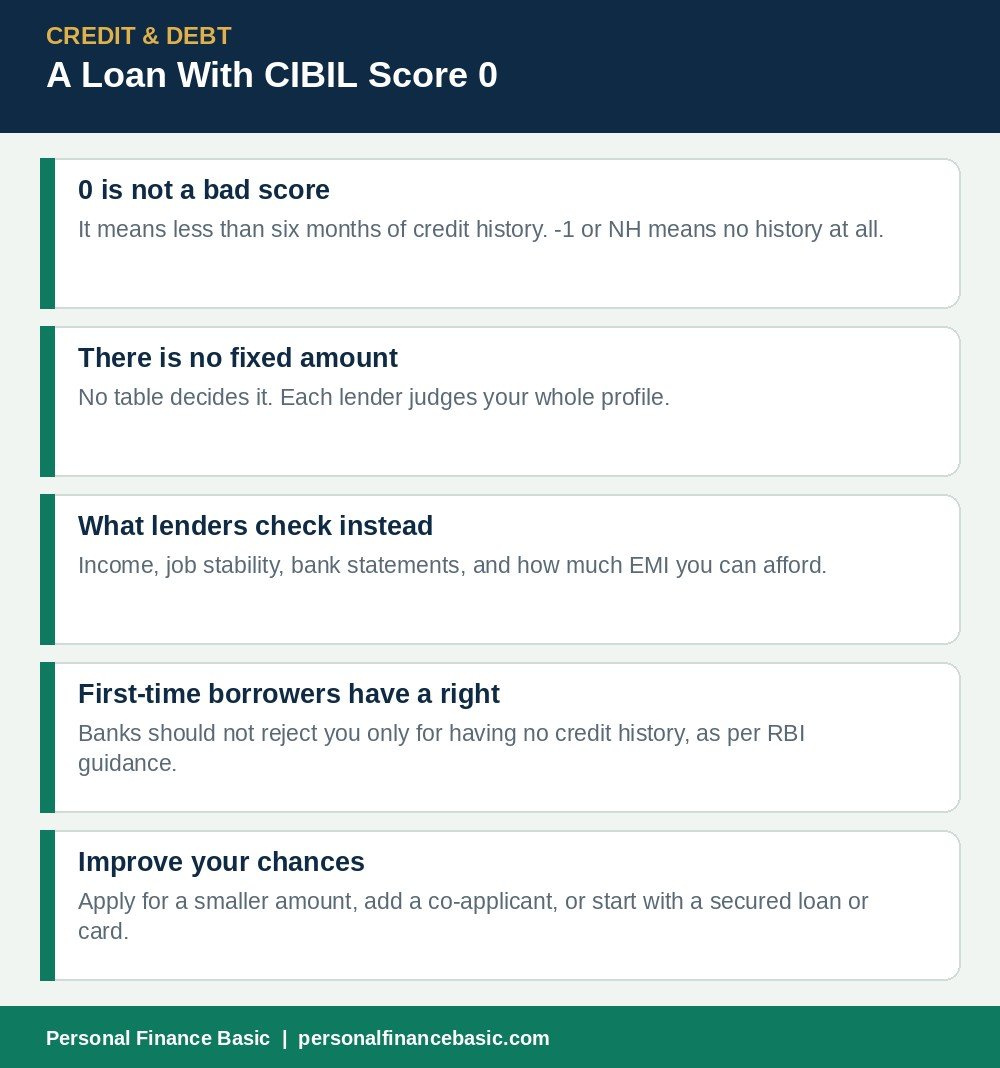
According to the position reported in 2025 from India’s Finance Ministry and the Reserve Bank of India, first-time borrowers should not be rejected solely because they have no credit history, and the RBI has not prescribed any minimum credit score. That does not mean approval is guaranteed. Lenders still carry out their own checks. They look at your income, employment, bank statements, and ability to repay, and they can decline an application for other reasons.
So, how much loan can you get with CIBIL 0?
There is no fixed loan amount for a CIBIL score of 0, and any website that promises one for everyone should be treated with suspicion. The amount depends on several factors taken together: your income and how stable it is, your job or business, your existing EMIs, your relationship with the bank, the type of loan, and whether you have a co-applicant with a good credit history.
How lenders judge what you can afford: EMI and FOIR
Lenders look at how much of your monthly income would go towards EMIs. This is often described as FOIR, the Fixed Obligation to Income Ratio. For example, if you earn ₹50,000 a month and already pay ₹10,000 in EMIs, 20% of your income is already committed. A lender will be cautious about adding a large new EMI on top of that, even if the headline loan amount looks affordable. That is why two people with CIBIL 0 can be offered very different amounts. Their incomes and existing obligations differ.
Try the Car Loan Calculator with your own numbers to see how the loan amount, rate, and tenure change the monthly EMI. That EMI, compared with your income, is what a lender will focus on.
Which loan types are easier or harder with no history?
Secured loans are usually easier to consider, because the lender holds security. Examples are a gold loan, a loan against a fixed deposit, or a loan against property. A secured credit card, backed by a deposit, can also be a way to start building history. Large unsecured personal loans and high-limit credit cards are harder to get at first, or smaller at first, because the lender has no security and no repayment record to rely on. Applying with a co-applicant who has a stable income and a good score can strengthen an application, but the co-applicant is also responsible for repayment if you do not pay.
Documents lenders usually ask for
Expect to be asked for identity and address proof, such as Aadhaar or PAN, and income proof, such as salary slips, bank statements, or income tax returns for self-employed applicants. You may also need employment or business proof, such as an offer letter, business registration, or recent statements, plus details of existing loans, EMIs, and credit cards, if any. For secured loans, bring documents for the security, such as the fixed deposit receipt or property papers.
Steps to improve your chances
Apply for an amount whose EMI fits comfortably within your income, after essentials and existing EMIs. Keep your bank account healthy, with regular income credits and no frequent overdrafts or bounced cheques. Start building history with a secured card or a small loan, and pay on time, in full. Consider a co-applicant only if both of you understand the responsibility involved. And avoid applying to many lenders at once, because multiple applications in a short period can look risky.
For the longer-term plan, read How to Increase Your CIBIL Score: A Step-by-Step Beginner Guide, which includes a realistic six-month action plan.
Beware of no CIBIL, no income proof loan scams
Be cautious of anyone offering a loan without a CIBIL check and without income proof, especially if they ask you to pay a fee in advance. Genuine lenders check repayment capacity, and advance-fee demands are a classic warning sign of fraud. Never share your OTP, passwords, or full card details with someone offering such a loan, and never pay a processing fee to a personal account before approval.
At a glance
Frequently asked questions
Is CIBIL 0 a bad score?
No. It means there is not enough credit history yet, less than six months, not that you have borrowed badly. It is different from a low score, which reflects past repayment problems.
Can I get a loan with CIBIL 0?
Possibly, depending on your income, stability, existing EMIs, the loan type, and the lender’s own checks. Secured loans and applications with a strong co-applicant are often more realistic starting points.
How much loan will I definitely get?
No one can promise a fixed amount for CIBIL 0. The amount is decided case by case, mainly on income and EMI affordability, so be wary of any guaranteed figure.
How do I move from 0 to a real score?
Build a record. Use a secured card or a small loan, pay on time and in full, keep utilisation low, and give it time, typically several months of consistent behaviour.
Does the RBI set a minimum CIBIL score for loans?
No. The RBI has not prescribed a minimum credit score. Individual lenders set their own criteria and still carry out their own due diligence.
This article is for education only and is not financial advice. Loan eligibility, amounts, rates and documents differ by lender, so check directly with the lender and consider professional advice for your situation.
Comments
2 responses to “How Much Loan Can I Get If My CIBIL Score Is 0?”
[…] at income, employment stability, existing EMIs and bank statements. If you are new to credit, read How Much Loan Can I Get If My CIBIL Score Is 0? — a score of 0 is not a bad score, it simply means there is not enough history […]
[…] read How to Increase Your CIBIL Score. If you are new to credit and have little or no history, read How Much Loan Can I Get If My CIBIL Score Is 0? to understand what a score of 0 […]