Put $1,000 in an account that pays 5% a year, and after one year you have $1,050. Leave it alone for a second year and you earn 5% on $1,050, not on $1,000. That extra $2.50 is compound interest.
It sounds small. Over ten years, that same $1,000 at 5% grows to $1,628.89, while simple interest would only reach $1,500. This guide explains how it works, with numbers you can check, and how to use it in your own saving.
What compound interest means
Compound interest is interest calculated on your balance, not just on the money you first put in. Each time interest is added, your balance grows, and the next round of interest is calculated on the bigger balance.
Banks and investment accounts usually compound yearly, monthly, or daily. The more often interest is added, the faster the balance grows. What matters most is the rate and the time.
The same idea works in reverse. Credit card balances compound too, which is why a balance paid only at the minimum can take years to clear. Compounding helps you when you save and hurts you when you owe.
Simple interest vs compound interest
Simple interest only ever pays on the original amount. Put $1,000 in at 5% simple interest and you earn $50 every year. After ten years you have $1,500: your $1,000 plus ten payments of $50.
Compound interest pays on the running balance. Year one is the same: $50 on $1,000, giving $1,050. Year two pays 5% on $1,050, which is $52.50, giving $1,102.50. Year three pays 5% on $1,102.50, which is $55.13, giving $1,157.63.
By year ten the balance is $1,628.89, $128.89 more than simple interest gives. The gap then grows: $653.30 after 20 years and $1,821.94 after 30 years.
The formula, in plain English
The formula is A = P(1 + r/n) raised to the power of nt. Each letter stands for one thing: A is the final amount, P is the amount you start with, r is the annual rate as a decimal, n is how many times a year interest is added, and t is the number of years.
For $1,000 at 5% compounded once a year for 10 years: P is 1,000, r is 0.05, n is 1, and t is 10. The math is 1,000 times 1.05 to the power of 10, which is $1,628.89. Compounded monthly, n is 12, and the same money reaches $1,647.01.
You do not need to work the formula by hand. Free calculators do it in seconds, and the site’s mutual fund calculator shows the same kind of growth for regular monthly investing. The formula shows what drives the result: the starting amount, the rate, how often interest is added, and above all, time.
The numbers over time
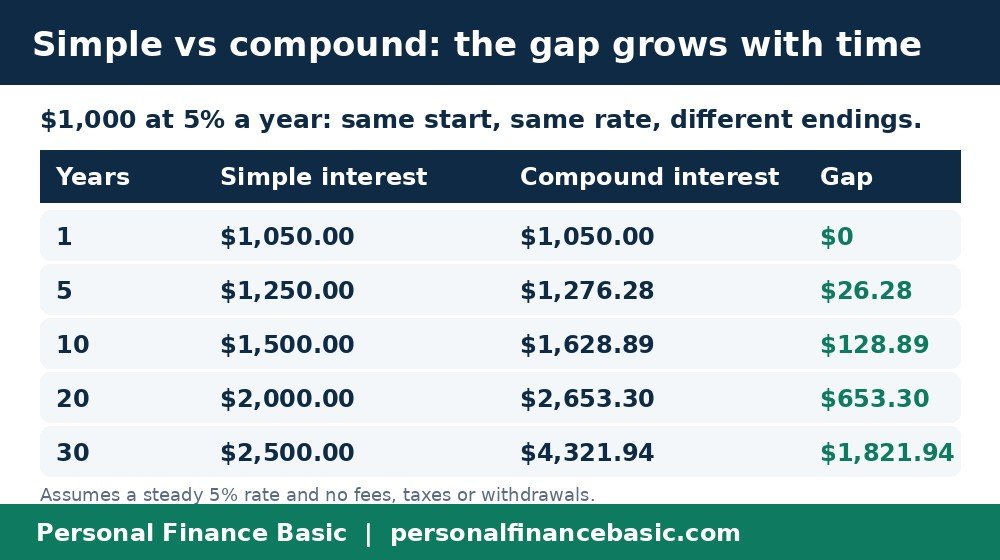
Simple vs compound interest on $1,000 at 5% a year. The gap starts at zero and grows with time.
In year one there is no gap at all. By year five it is $26.28. By year ten it is $128.89. Then the gap starts to run: $653.30 by year 20 and $1,821.94 by year 30.
The rate stays at 5% and nobody adds a dollar. The growth comes only from interest being added to the balance and then earning interest itself. That is why the first ten years look slow and the later years look fast.
These numbers assume a steady 5% rate with no fees, no taxes and no withdrawals. Real accounts do not pay a fixed rate forever, and returns move up and down. Treat the figures as a way to see the pattern, not as a promise.
What happens when you add money every month
Most people do not start with a lump sum. They save a little from each paycheck, and compounding works on those deposits too. Take $100 a month at a steady 7% annual return, compounded monthly: after ten years you have put in $12,000 and the balance is about $17,308. The extra $5,308 is growth on your deposits and on the growth itself.
Keep going and the numbers widen. After 20 years of $100 a month you have put in $24,000 and the balance is about $52,093. After 30 years you have put in $36,000 and the balance is about $121,997. By year 30 the growth is most of the balance.
These are illustrations, not predictions. A steady 7% return for 30 years is an assumption, not something any investment guarantees. Real returns vary, some years are negative, and fees and taxes take a cut. The point is the shape: regular deposits plus time plus compounding build far more than the deposits.
Where you see compound interest
Savings accounts pay compound interest, usually monthly, on whatever balance you hold. A high-yield savings account pays a higher rate than a regular one. Retirement accounts like a 401(k) or a Roth IRA grow the same way when the money inside earns returns that stay invested.
It also shows up in loans. A mortgage or a car loan charges interest on a shrinking balance as you pay it down. A credit card is different: unpaid interest is added to the balance and then charged interest itself. That is why carrying a card balance is so costly and why paying more than the minimum makes such a difference.
Compounding helps you when you are the one earning the interest, and it hurts you when you are the one paying it. Saving early and paying down costly debt early are the same move in opposite directions.
How to put it to work
Start with what you have, even if it is $25 or $50 a month. The amount matters less than the start date. A dollar saved at 25 has decades to compound. The same dollar saved at 45 has half the time.
Add money on a schedule and leave it alone. An automatic transfer on payday removes the decision. Taking money out resets the clock, so keep this money separate from the cash you spend.
Watch the fees. A fund that charges 1% a year instead of 0.1% keeps a bigger slice of your growth every year, and that slice compounds too. Low fees, steady deposits, and time are the things you can control.
At a glance
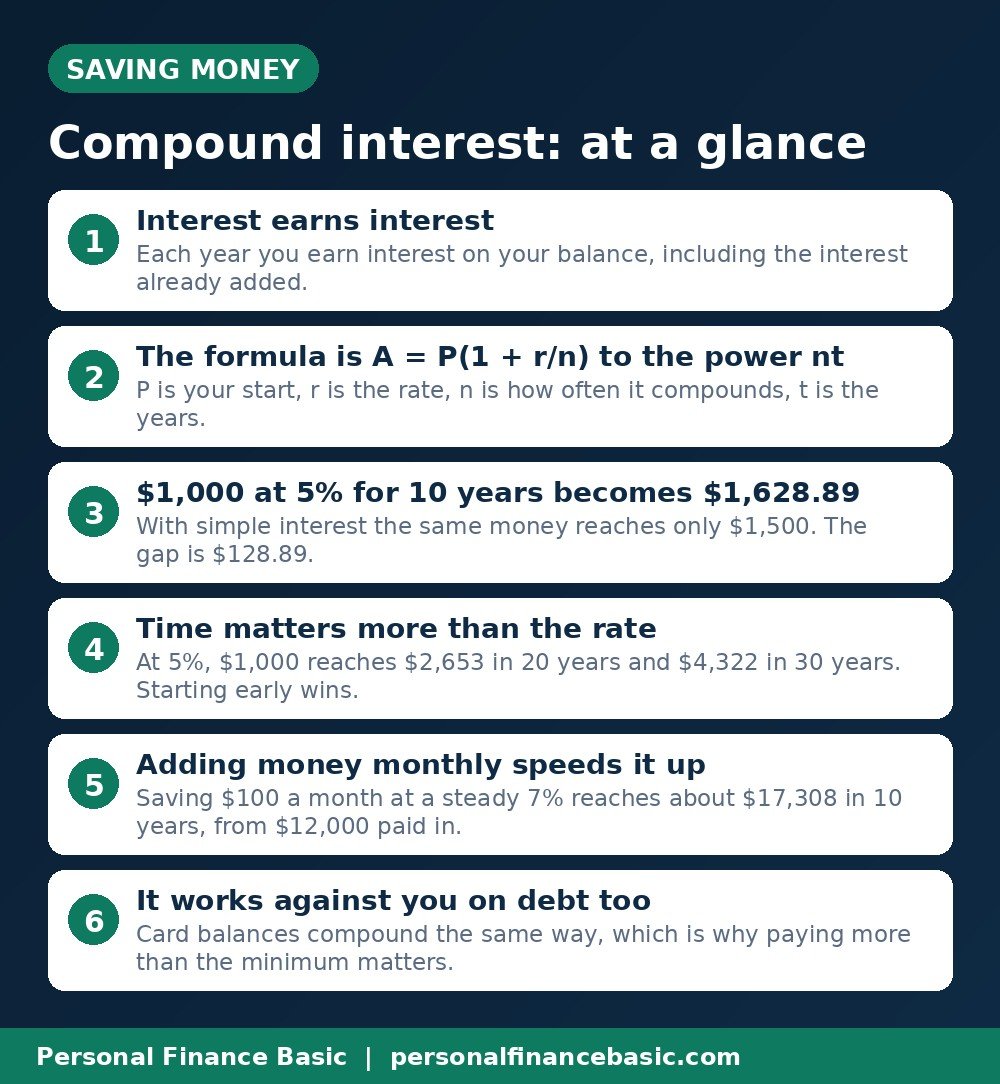
The main points from this guide, in one picture.
Frequently asked questions
What is compound interest in simple words?
It is interest earned on your balance, including the interest already added to it. Each time interest is added, your balance grows, so the next round is calculated on a bigger number.
How is compound interest different from simple interest?
Simple interest only pays on the original amount, so $1,000 at 5% earns $50 every year. Compound interest pays on the running balance, so the yearly amount grows: $50 in year one, $52.50 in year two, and so on.
How much will $1,000 grow at 5% in 10 years?
Compounded once a year, $1,000 at 5% becomes $1,628.89 after 10 years. With simple interest it would only reach $1,500. Compounded monthly it reaches $1,647.01.
Does compound interest work with monthly deposits?
Yes. Saving $100 a month at a steady 7% annual return, compounded monthly, reaches about $17,308 after 10 years, from $12,000 paid in. That is an illustration, not a promise.
Can compound interest work against me?
Yes. Credit card debt compounds the same way: unpaid interest is added to your balance and then charged interest itself. That is why paying more than the minimum makes such a difference.
This guide is general education, not financial advice. The right amounts depend on your income, costs, and goals. Consider speaking with a qualified financial adviser about your own situation.
Related reading: What Is an Index Fund? A Beginner Explanation and How to Start Investing With $100 a Month