Your first paycheck from a new job usually arrives as a paper check. You take it to the bank, wait for it to clear, and hope the money is there before rent is due.
About 93% of US workers are paid by direct deposit, according to Nacha, the organization that governs the ACH network. Your employer sends your pay straight to your bank or credit union, and it is there on payday.
Here is what direct deposit is, what you need to set it up, and how long it takes before the first electronic paycheck lands.
The short answer
Direct deposit is an electronic payment that moves your wages from your employer’s bank account to yours through the ACH network, the same network that handles most bill payments and bank-to-bank transfers in the US.
To set it up, you give your employer two numbers, your bank’s nine-digit routing number and your account number, then fill in a short authorization form, usually in your employer’s payroll portal or with HR.
The setup has four moves:
- Find your routing number and account number.
- Fill in the authorization form and choose your accounts.
- Wait while your employer runs a prenote, a $0 test deposit.
- Check the first real deposit on payday.
Quick decision guide:
- Starting a new job? Hand in the form during onboarding. Your first paychecks may still be paper checks.
- Switching banks? Keep the old account open until the first deposit lands.
- Want to save without thinking? Split the deposit: part to checking, part to savings.
- Paid by a government agency or the IRS? The same idea applies, through that agency’s own form or portal.
How direct deposit actually moves your money
When payday comes, your employer sends a payment file to its bank. The bank passes it through the ACH network, and your bank posts the money to your account. The instructions usually go out a business day or two before payday.
Some banks post the money as soon as they get that advance notice. That is what “early direct deposit” means: your pay shows up up to two days before payday. Your bank may post on payday itself, and that is normal.
The network does not run on weekends or federal holidays. If payday falls on a holiday, the deposit usually arrives the business day before.
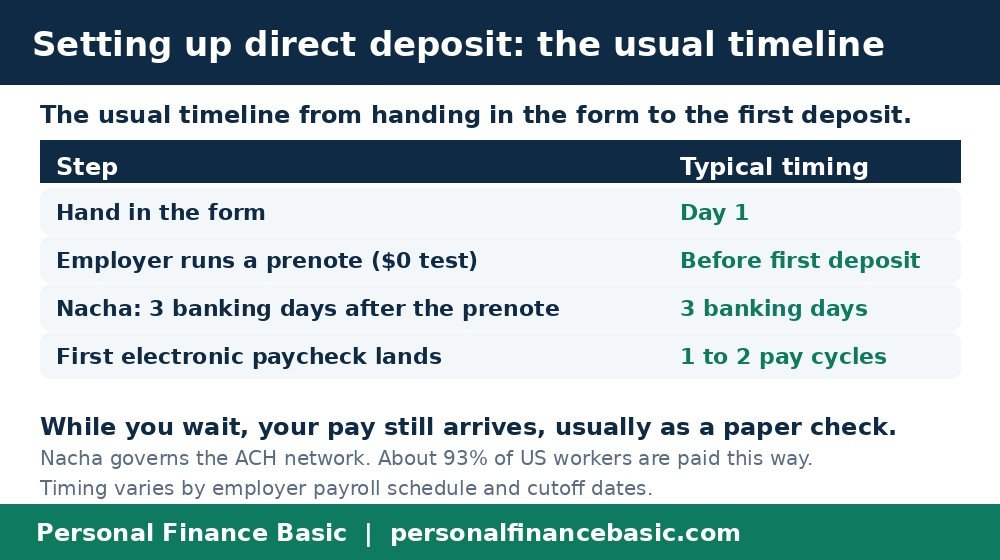
The usual timeline from handing in the form to the first electronic paycheck.
Step 1: Find your routing and account numbers
You need two numbers. The routing number is nine digits and identifies your bank. The account number identifies your account. Both are printed at the bottom of your checks: routing on the left, account in the middle.
No checks? Both numbers are in your bank’s app or online banking, usually under account details. You can also call your bank and ask. Never share these numbers by email or text with someone you do not know.
Step 2: Fill in the form and choose your accounts
Most employers use an online payroll portal. You enter the routing number, the account number, the account type (checking or savings) and the amount to send there. Some employers still use a paper form, and some ask for a voided check as backup: a check with “VOID” written across it, so it cannot be cashed but still shows your numbers.
This is also where splitting comes in. Many employers let you send your pay to more than one account. A common split is the full paycheck to checking, plus a fixed amount like $100 to savings. The split happens before the money reaches you, which is why it works so well for saving.
- Best for most people: the full paycheck to checking, with a fixed amount split to savings. Savings happens on its own.
- Best for shared bills: split the pay between a joint account for bills and a personal account. Both people see the bill money land on time.
- Not for: an account you cannot check. Always confirm the first deposit lands where you expect it.
Step 3: Wait for the prenote, then one to two pay cycles
After you hand in the form, most employers run a prenote first: a $0 test transaction to check that your routing and account numbers are right. Nacha’s rules require at least three banking days between the prenote and the first real deposit.
In practice, the wait is longer. Most employers build in extra time, and payroll cutoff dates matter too. Hand your form in just after a payroll cutoff and your request rolls into the next cycle. That is why the first electronic paycheck usually arrives one to two full pay cycles after you enroll.
While you wait, your pay still arrives, usually as a paper check for the paychecks that fall in the gap.
| Way to get paid | Speed | Risk | Effort |
|---|---|---|---|
| Direct deposit | On payday, sometimes early | Very low; no check to lose | One form, once |
| Paper check | After a trip to the bank, plus clearing time | Can be lost or stolen | Every payday |
Step 4: Check the first deposit, then keep an eye on it
On the first payday after the wait, check your account. Confirm the amount matches your pay stub and that it landed in the right account. If nothing arrived after two full pay cycles, call payroll. A mistyped account number is the usual cause.
After that, direct deposit mostly runs itself. Check your pay stub each payday anyway. It takes a minute, and it catches a wrong withholding or a missing hour.
What to do when things change
Switching banks is the most common change. Set up direct deposit at the new bank first, keep the old account open, and wait until one full paycheck lands in the new account before you close the old one. Closing too early can send a paycheck to a closed account.
Changing jobs means a new form for the new employer. Your old direct deposit stops on its own, and your final paycheck may come as a paper check.
At a glance
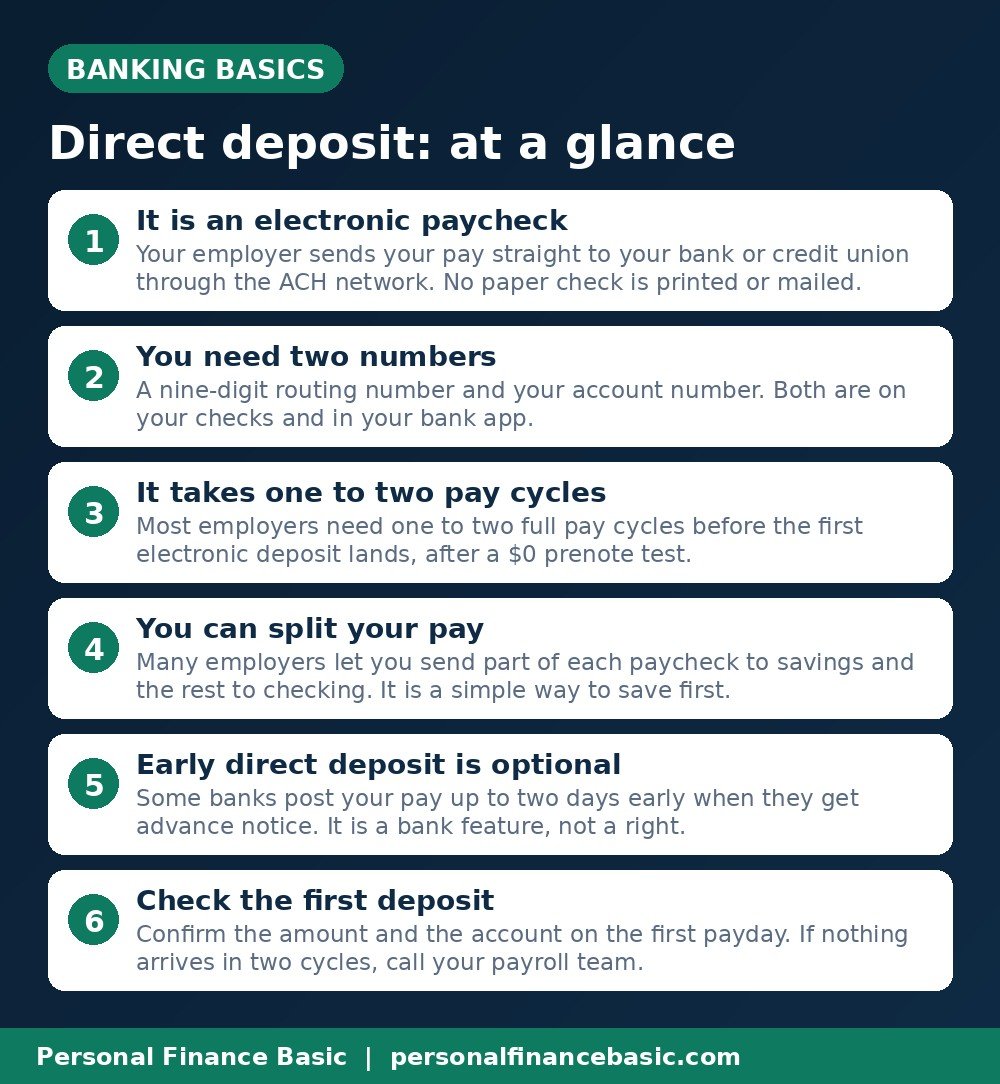
The main points from this guide, in one picture.
Frequently asked questions
How long does it take to set up direct deposit?
Usually one to two full pay cycles. Your employer runs a $0 prenote test first, and Nacha’s rules require at least three banking days after the prenote before the first real deposit.
Is direct deposit safe?
Yes. It is the standard way most American workers are paid, and it removes the risk of a lost or stolen paper check.
Can I split my paycheck between two accounts?
Most employers allow it. Send a fixed amount or a percentage to savings and the rest to checking. The split happens on payday, which makes it an easy way to save without thinking.
What is early direct deposit?
Some banks post your pay up to two days before the official payday, when they get advance notice from your employer. If your bank does not offer it, your pay arrives on payday, which is normal.
What happens if I close the account my pay goes to?
The deposit bounces back to your employer. Set up direct deposit at the new account first and keep the old one open until a full paycheck lands there. If a paycheck bounces, call payroll right away so they can reissue it.
The bottom line: direct deposit takes one form and about ten minutes. Hand it in early, expect one or two paper checks while the prenote clears, and check the first deposit carefully.
This guide is general education, not financial advice. Your employer’s payroll schedule and your bank’s terms decide the exact timing for you.
Related reading: How to Open Your First Bank Account in the US and How to Automate Your Savings on Payday