
Your paycheck lands, the bills go out, and by the end of the month the money is gone. You are not sure where it went, and you are not sure it will be different next month.
That is normal. Most people never sit down with their own numbers, so small leaks run for months: a forgotten subscription, a food delivery habit, a fee you never noticed. Each one is small. Together they add up to real money.
A monthly money review fixes that in 30 minutes. Here is the exact routine, minute by minute.
The short answer
A monthly money review is a 30-minute check of what came in, what went out, and what needs to change next month. Do it monthly, on the same day.
The quick framework:
- Gather your statements and pay stubs (6 minutes).
- Compare what you spent to what you planned (10 minutes).
- Find the leaks: subscriptions, fees, extras (6 minutes).
- Move money: cancel the leak, feed the goal (4 minutes).
- Set one money goal for next month (4 minutes).
Quick decision guide:
- Never reviewed your money before? Start with the 10-minute check-in below, then work up to the full 30.
- Money tight every month? Spend most of your 30 minutes on step 3, the leaks.
- Already on track? Use the review to push extra money toward your next goal.
- Income changes every month? Review the day after your biggest payday, not on a fixed date.
Step 1: Gather everything in 6 minutes
Open your bank and card statements for the month that just ended, plus your pay stubs. If it takes longer than 6 minutes to find them, your money lives in too many places, and that is your first fix.
Write down three numbers: what came in, what went out, and what is left. Do not judge them yet.
Keep a simple note for this: a notebook, a spreadsheet, or a notes app. The tool matters less than the habit.
- Best for: anyone who has never looked at a full month of spending in one place.
- Not for: fixing a crisis today. A review finds the pattern; an emergency needs action first.
Step 2: Compare what you spent to what you planned
Go through your budget categories one by one and compare the plan to the real number. A gap of $20 or more in a category is worth a look.
Most months, two or three categories hold the whole story. One is usually the surprise, and the rest are close to plan.
Do not rewrite your whole budget here. You are finding the gaps; the fixes come in step 4.
Here is a worked example. Maya earns $3,000 a month after tax and plans $900 for wants. Last month she spent $1,077 on wants, $177 over plan: $87 in forgotten subscriptions, $45 over her dining budget, and $45 in delivery fees.
- Best for: spotting the one or two categories that blow your budget every month.
- Not for: judging yourself. The numbers are information, not a grade.
Step 3: Find the leaks
Leaks are spending that gives you nothing back: forgotten subscriptions, bank fees, food delivery, and apps you stopped using but kept paying for.
Check your subscriptions first. The small ones are the easiest to miss: $9.99 here, $14.99 there. Add them up. Maya found $87 a month, which is $1,044 a year.
Then check fees: overdraft, ATM and late fees. One $35 overdraft fee a month is $420 a year, and a single phone call or settings change often stops them.
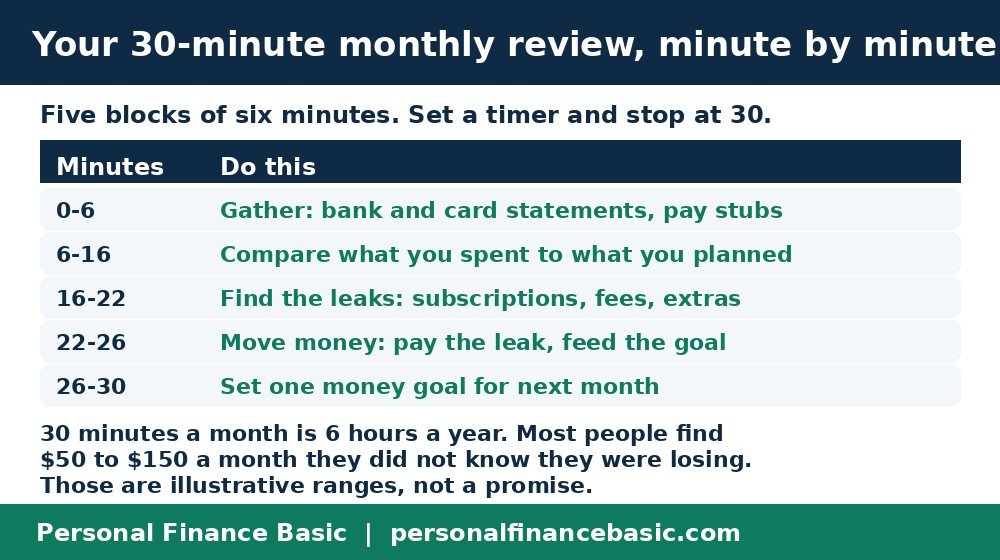
Five blocks of six minutes. Set a timer and stop at 30.
- Best for: months when money feels tight but you cannot say why.
- Not for: cutting things you actually enjoy and use. A leak is spending with no value, not spending on fun.
Step 4: Move the money the same day
A review that ends with no action changes nothing. Cancel the subscription, call about the fee, then move the saved amount to your goal the same day.
Maya cancelled $87 of subscriptions and moved that $87 to her emergency fund the same afternoon. She also set a $45 weekly dining limit. Her $132 a month in leaks becomes $1,584 a year toward her goal, if she keeps it up for 12 months.
Do the transfer now, while the numbers are in front of you. Tomorrow the urgency fades and the money stays where it was.
- Best for: turning a finding into a real saving the same day.
- Not for: moving money you still need for bills due this week. Check the due dates first.
Step 5: Set one goal for next month
Pick one goal, and only one: save $100 extra, pay $150 more on the card, or cut one category by $50. A small goal you keep beats a big goal you drop after two weeks.
Write it down next to the three numbers from step 1. Next month’s review starts by checking whether you hit it.
If your income changes every month, set the goal as a percentage: save 5% of what came in, whatever that number is.
- Best for: keeping momentum without a complicated plan.
- Not for: fixing everything at once. One goal a month is the speed that sticks.
Which review style fits you?
Not every month needs the full 30 minutes. Pick the style that matches your month, and stick with it.
| Review style | Time per month | Hours a year | What it catches |
|---|---|---|---|
| 10-minute check-in | 10 minutes | 2 hours | Big surprises only |
| 30-minute review | 30 minutes | 6 hours | Leaks, fees, overspend |
| 60-minute deep dive | 60 minutes | 12 hours | Everything, plus goals and rates |
Hours a year are computed from the monthly time. The 30-minute review is the best trade for most people.
The 10-minute check-in works when money is simple and stable. The 60-minute deep dive fits a big month, like a job change or a move, when you also want to check your rates and goals.
At a glance
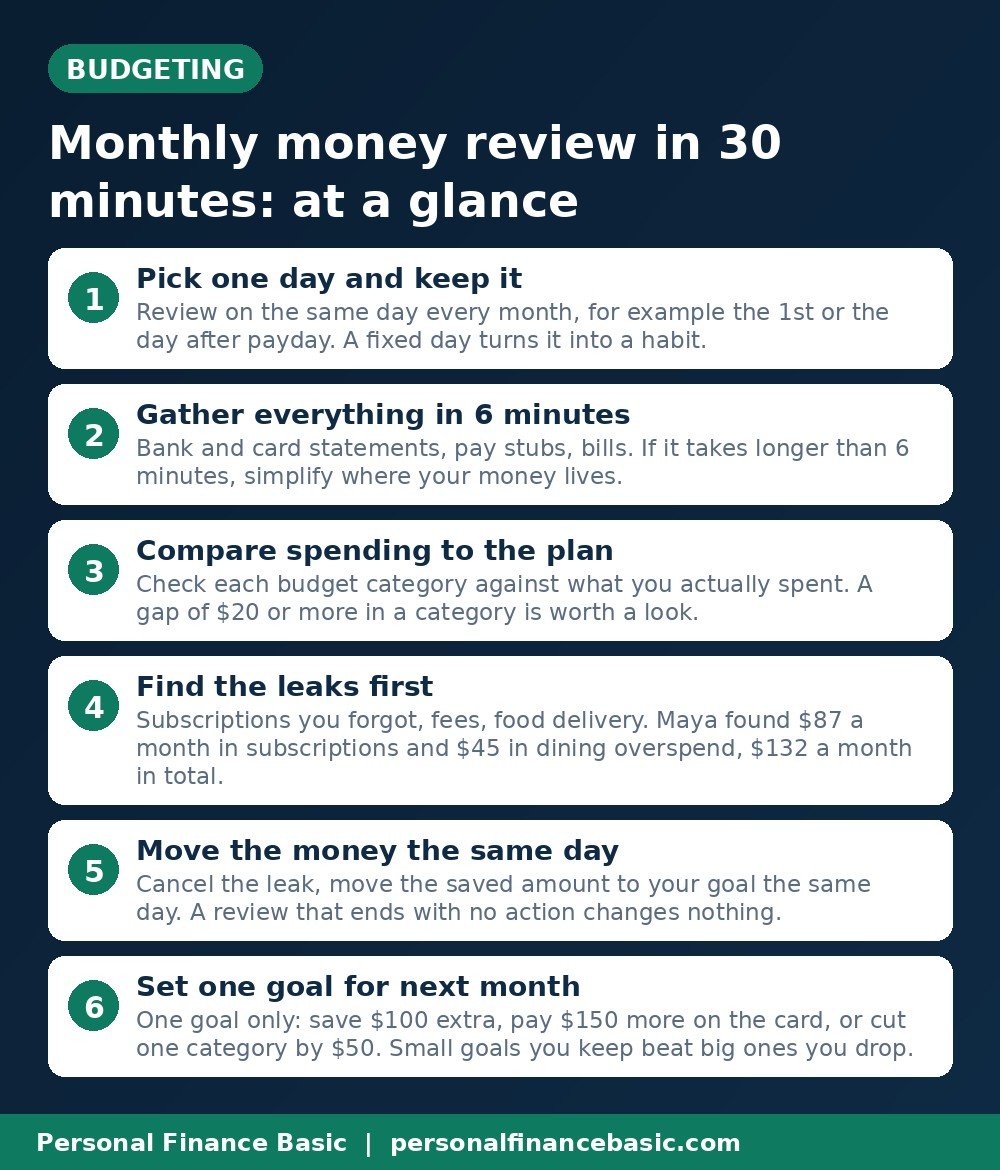
The main points from this guide, in one picture.
Frequently asked questions
How often should I do a money review?
Once a month is enough for most people. A weekly check helps if your income changes every month.
What if I do not have a budget yet?
Do the review anyway. Steps 1 and 2 give you the real numbers, and those become your first budget. Start with the 50/30/20 split, then adjust it to fit your life.
What is the best day to do the review?
The 1st of the month, or the day after your main payday. Pick one day, put it on your calendar, and keep it.
Do I need an app or a spreadsheet?
No. A notebook works fine. An app or spreadsheet helps if you like charts and automatic totals, but use whatever you will actually open.
What if I find a big problem, like debt growing every month?
Do not try to fix it inside the 30 minutes. Note it, finish the review, and set one action for the week, like calling the lender. A review finds the problem; a separate plan fixes it.
The verdict
A monthly money review takes 30 minutes and pays for itself the first time you find a forgotten subscription or a fee you can stop. Pick a day, set a timer, and run the five steps.
Start this month. If you want a simple frame for the numbers you find, read our guide to the 50/30/20 rule with US examples, and if you want the savings to happen on its own, read how to automate your savings on payday.
This post is general education, not financial advice. Your numbers are your own; use the review to understand them, and talk to a qualified professional before making big money decisions.