
Open enrollment is here, and your employer is offering a health plan with a high deductible. Next to it sit three little letters: HSA. Most people skip past it.
That skip can cost real money. A health savings account, or HSA, is the only common account with a triple tax break: money goes in tax-free, grows tax-free, and comes out tax-free for medical costs. For 2026 you can put in up to $4,400 for self-only coverage or $8,750 for family.
Here is how it works, who can open one, and how to use it.
The short answer
An HSA is a savings account that pairs with a high-deductible health plan (HDHP). You put money in before tax, spend it on qualified medical costs, and keep what is left. The money is yours, it rolls over every year, and it follows you when you change jobs.
The quick framework:
- Check your plan qualifies.
- Open the HSA through your employer or a bank.
- Decide how much to put in each paycheck.
- Pay medical bills from it, and keep receipts.
- Invest the balance once it passes your yearly medical costs.
Quick decision guide:
- Young and healthy with a high-deductible plan? An HSA is often a good fit: you pay little in care.
- Frequent doctor visits or prescriptions? A low-deductible plan may cost less overall. Compare total yearly cost, not just the premium.
- Already have an FSA? You cannot usually have both at once. Compare them below.
- Over 55? You can add a $1,000 catch-up each year, on top of the normal limit.
Step 1: Check you qualify
You can only contribute to an HSA if you are covered by a qualifying high-deductible health plan. For 2026, the deductible must be at least $1,700 for self-only or $3,400 for family coverage, and the out-of-pocket maximum cannot pass $8,500 or $17,000.
Your plan documents will say whether it is HSA-eligible. A regular low-deductible plan does not qualify, and neither does a plan where someone else claims you as a dependent.
Medicare blocks new contributions. Once you enroll, you can still spend what is in your HSA, but you cannot add more.
- Best for: people whose employer offers an HDHP, or who buy one on the marketplace.
- Not for: anyone on a low-deductible plan, on Medicare, or claimed as a dependent.
Step 2: Open the account
Most employers open the HSA for you when you pick the HDHP, and contributions come straight out of your paycheck before tax, skipping Social Security and Medicare tax too.
If your employer does not offer one, open an HSA yourself at a bank or a brokerage. Your own contributions are tax-deductible when you file, though they do not get the payroll-tax saving.
Check the fees before you pick a provider: some charge monthly, some charge to invest, some charge nothing.
- Best for: employees whose employer offers an HDHP with payroll contributions.
- Not for: anyone who wants to open one without a qualifying plan. The plan comes first.
Step 3: Decide how much to put in
For 2026, the IRS lets you contribute up to $4,400 for self-only coverage and $8,750 for family coverage. For 2027, those rise to $4,500 and $9,000, plus $1,000 at 55 or older.
Here is a worked example. Maya is 30, single, and puts $200 a month into her HSA, $2,400 a year. In the 22% federal bracket, that saves about $528 in federal income tax ($2,400 x 22%). From her paycheck it also skips about $184 in Social Security and Medicare tax ($2,400 x 7.65%). Her $2,400 of savings really costs about $1,688. These figures are illustrative.
Start with your expected medical costs for the year: prescriptions, a dentist visit, glasses. Cover that first.
- Best for: anyone who can put in at least enough to cover their yearly medical costs.
- Not for: money you need for rent or bills. An HSA is for medical costs and long-term saving, not this month’s spending.
Step 4: Spend it right, and keep your receipts
You can spend HSA money tax-free on qualified medical costs: doctor visits, prescriptions, dental work, glasses, and many over-the-counter items.
Keep every receipt. You can pay yourself back from the HSA years later for a medical bill you paid today, as long as it happened after the HSA was opened. Many people pay small bills from checking and let the HSA grow.
Do not spend it on anything else before 65. A non-medical withdrawal before 65 is taxed as income plus a 20% penalty. After 65, it is taxed as income, like a traditional retirement account, with no penalty.
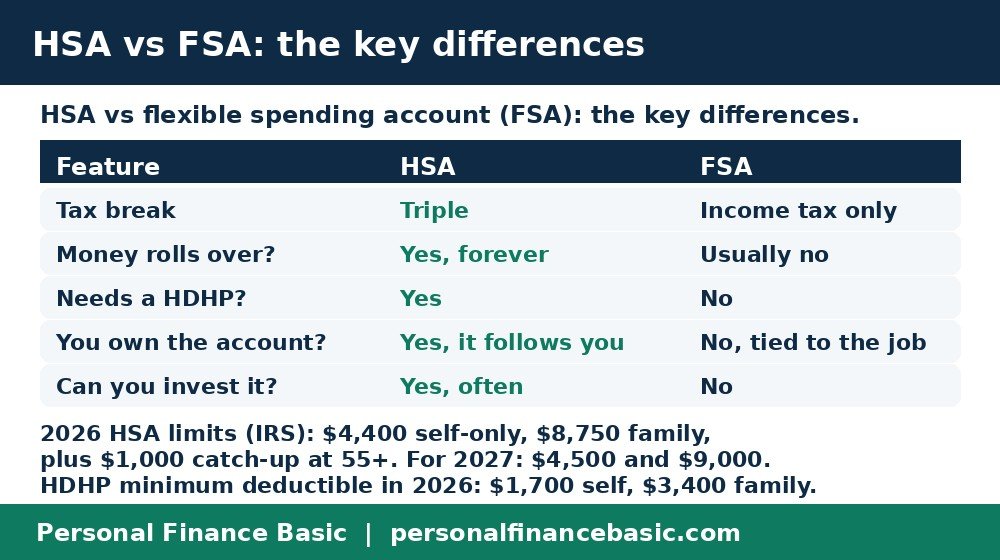
HSA vs FSA: the key differences.
- Best for: paying medical costs with tax-free dollars.
- Not for: everyday spending. Non-medical withdrawals before 65 cost you tax plus a 20% penalty.
Step 5: Invest the balance once it grows
Most providers let you invest once your balance passes $1,000. Keep one year of expected medical costs in cash, and invest the rest like any long-term saving.
This is where the HSA becomes more than a medical wallet. Money grows tax-free, and if you spend it on medical costs, it is never taxed at all. Healthy savers can build a five-figure balance over a decade.
One warning: the balance can fall as well as rise, so do not invest money you will need for a doctor visit next month.
- Best for: long-term savers with a cash cushion for this year’s medical costs.
- Not for: money you expect to spend on care in the next few months.
HSA vs FSA: which one fits?
An FSA, or flexible spending account, is the other workplace medical account. It also uses pre-tax money, but the rules are very different. The biggest difference is the rollover: an HSA balance never expires, while an FSA balance is usually lost at year-end.
| Question | HSA | FSA |
|---|---|---|
| Money rolls over? | Yes, forever | Usually no |
| Needs a high-deductible plan? | Yes | No |
| You keep it if you change jobs? | Yes | No |
| Can you invest the balance? | Yes | No |
| Tax break | Triple: in, growth, out | Contributions only |
An HSA wins on flexibility and long-term value. An FSA wins if your plan is not a high-deductible one.
At a glance
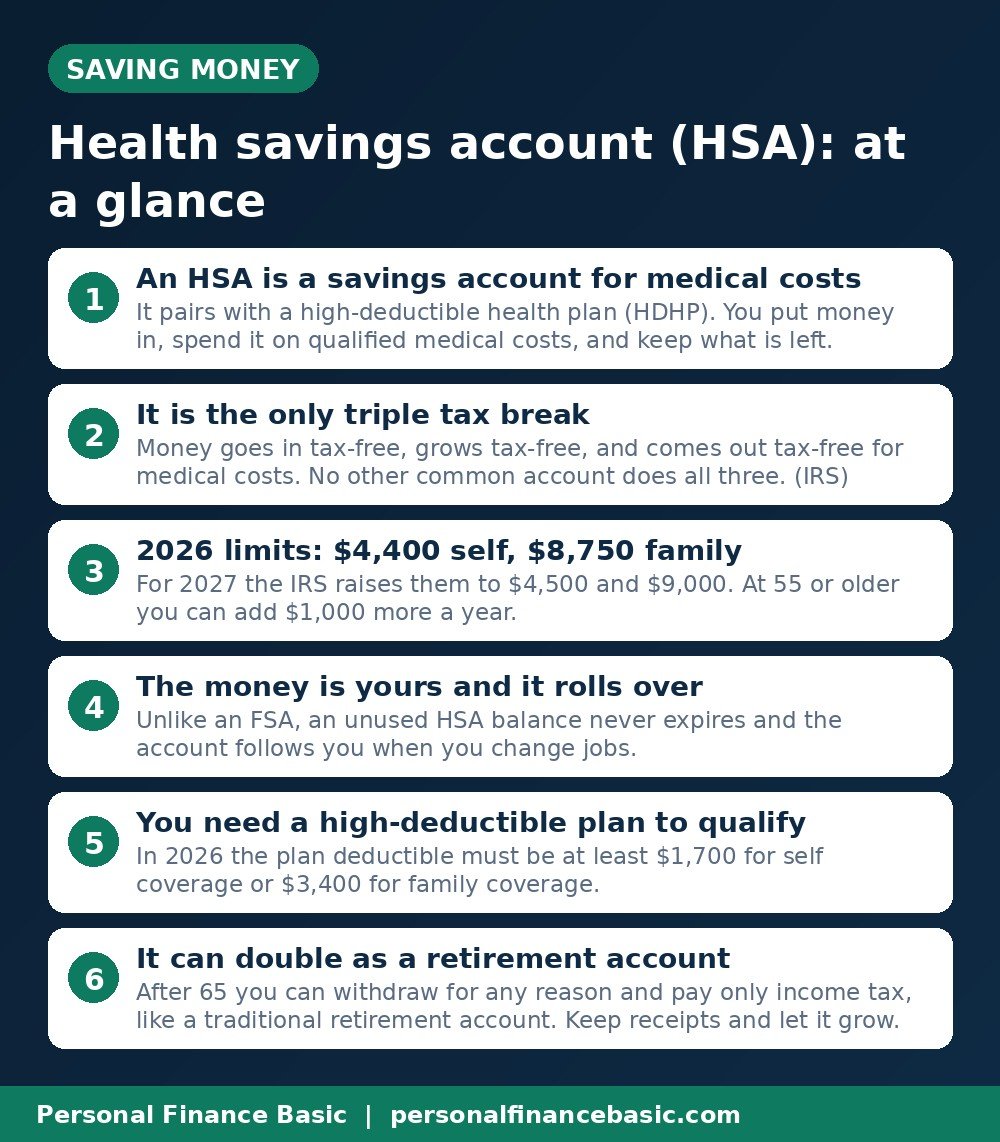
The main points from this guide, in one picture.
Frequently asked questions
Can I have an HSA and an FSA at the same time?
Usually no. A general-purpose FSA blocks HSA contributions. A limited-purpose FSA, covering only dental and vision, can sit next to one.
What happens to my HSA if I change jobs?
Nothing. The account is yours and the money stays with you. You can keep spending it, and keep contributing if your new plan is also a qualifying high-deductible plan.
Can I use my HSA for my family?
Yes. You can pay for qualified medical costs for yourself, your spouse, and your dependents.
What happens to my HSA when I die?
If your spouse inherits it, it stays an HSA in their name. If anyone else inherits it, the balance is taxed as income to them.
Is an HSA better than a 401(k)?
For medical costs, yes, because of the triple tax break. But a 401(k) usually comes with an employer match. Many people fund both, and take the match first.
The verdict
An HSA is the strongest tax break most workers can get, but only with a qualifying high-deductible plan. Check your plan, open the account, and cover at least the year’s medical costs.
If you are sorting out your retirement accounts too, read our guide to traditional IRA vs Roth IRA, and do not skip the free money in the 401(k) match explained.
This post is general education, not financial or tax advice. HSA rules and limits change; check the IRS rules and your plan documents before you decide.