By dinner time on Black Friday, Americans had already spent $9.7 billion online. Adobe Analytics counted the spending through 6:30 p.m. ET on 27 November 2026, up 12.8% on last year, and expects the final total to land between $13 billion and $13.4 billion.
That would make it the biggest Black Friday for online sales yet. But the headline hides the real story: shoppers are spending more dollars to buy roughly the same amount of stuff.
Here is what happened, what the season is expected to add up to, and what the numbers mean for your own holiday budget.
The short answer
Black Friday online sales are on track for a record $13 billion to $13.4 billion, after $9.7 billion by 6:30 p.m. on 27 November, according to Adobe Analytics. The holiday season is forecast to pass $1 trillion in retail sales for the first time, the National Retail Federation said.
But the growth is mostly prices. October PCE inflation, the Federal Reserve’s preferred gauge, was 3.8% year over year, so a 4.2% rise in holiday sales is only about 2% more goods in real terms.
Quick decision guide:
- Still shopping this weekend? Set your number before you browse. The national average for the five-day weekend is $624, according to Deloitte.
- Shopping on a tight budget? Compare your list to that $624 average, not to what your feed shows you.
- Tempted by buy now, pay later? Treat it as borrowing, not a discount. Four in ten Gen Z shoppers plan to use it this weekend.
- Already done? The numbers say you are in the minority, and that is a good place to be.
What happened on Black Friday
Adobe Analytics tracks US online spending in real time. Its count for Black Friday, 27 November, reached $9.7 billion by 6:30 p.m. ET, up 12.8% on last year. Adobe expects the final total to land between $13 billion and $13.4 billion, beating its September forecast of $12.9 billion.
The five-day stretch from Thanksgiving through Cyber Monday is projected to reach $47.5 billion online, up 7.4% on last year, according to Adobe. Cyber Monday, 30 November, is still forecast to be the biggest online shopping day of the year, at $15.1 billion.
Salesforce counted $5.9 billion of US online sales in the first half of Black Friday, on track for $18.7 billion for the full day, up 4% on last year.
The season is forecast to pass $1 trillion
The National Retail Federation forecast on 15 October that November-December retail sales will reach $1.013 trillion, up 4.2% on the $972 billion of 2025. It would be the first time the NRF’s measure passes $1 trillion.
Read that number carefully. The NRF figure is not adjusted for inflation, and it excludes car dealers, gas stations and restaurants. The Associated Press, reporting the forecast, said higher prices were expected to account for about half of the growth, leaving real growth at roughly 2%.
October PCE inflation was 3.8% year over year, with core PCE at 3.3%, according to the Bureau of Economic Analysis. A $1,000 holiday budget last year needs about $1,042 this year for the same basket. The record is real, but it is a record in dollars, not in gifts bought.
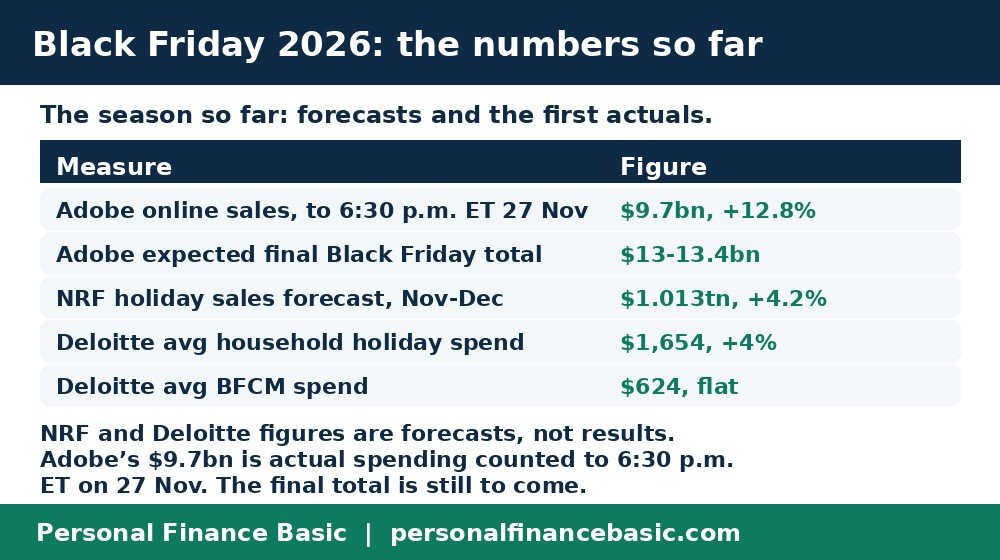
Black Friday 2026: the numbers so far. Forecasts are not results; Adobe’s final total is still to come.
What households plan to spend
Deloitte’s 2026 Holiday Retail Survey puts average household holiday spend at $1,654, up 4% from $1,595 in 2025. Retail goods take $988 of that, up 10% from $902, while holiday activities take $666, down 4%.
The five-day weekend tells the same flat story. Deloitte found 87% of people plan to shop it, up from 82% in 2025 and a 10-year high, but average planned spending stays flat at $624. More people are shopping. Nobody is spending more each.
The stress shows up in the groups stretching hardest. Households earning under $50,000 plan to spend $433 over the weekend, up 17% on last year. Gen Z shoppers plan to spend $752 on average, up from $609 last year, and 94% of them plan to shop. And 38% of shoppers are what Deloitte calls “holiday value seekers,” using five or more money-saving behaviors, yet they plan to spend 12% more than everyone else.
What it means for your money
First, set your number before you shop, and compare it to the national average. If your Black Friday weekend budget is $624, you are exactly average, according to Deloitte.
Second, a sale price is only a deal if the price actually fell. With prices up across the board, a “30% off” tag on a higher starting price can still cost more than last year’s regular price. Check the price against what the item cost a month ago, not the crossed-out number.
Third, treat buy now, pay later as borrowing. Deloitte found 40% of Gen Z shoppers plan to use it this weekend, and Adobe forecasts $807 million of Black Friday spending will go through it. Four payments of $100 is still $400, and a missed payment brings late fees.
The results are still coming. Adobe’s final Black Friday total and the Cyber Monday count will be published in the next few days. What will not change is the math underneath: a record in dollars, a flat record in what those dollars buy.
At a glance
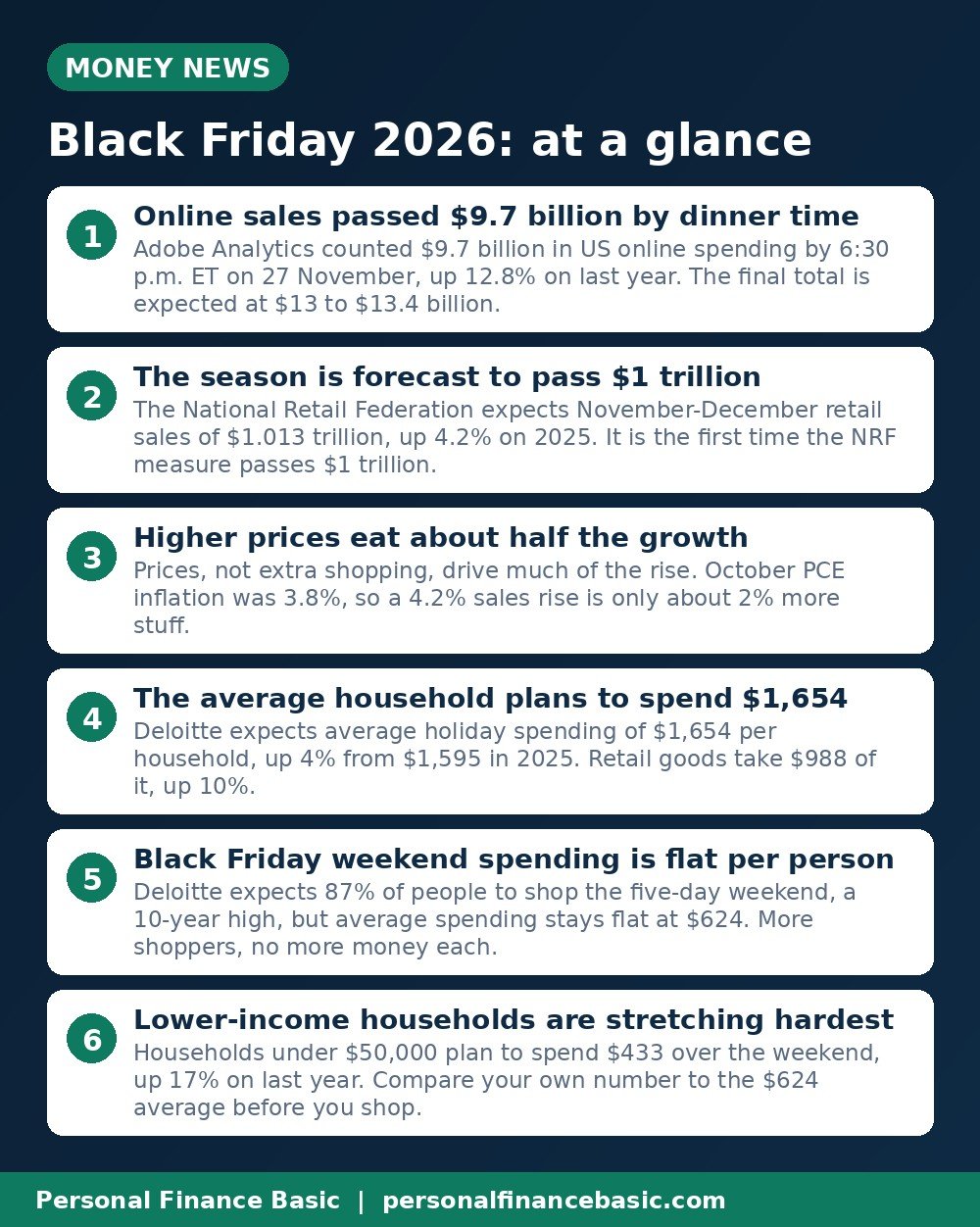
The main points from this guide, in one picture.
Frequently asked questions
How much did Americans spend online on Black Friday 2026?
Adobe Analytics counted $9.7 billion by 6:30 p.m. ET on 27 November, up 12.8% on last year, and expects the final total to land between $13 billion and $13.4 billion. The final figure had not been published when this post was written.
Is holiday spending really up 4.2% this year?
In dollars, yes: the National Retail Federation forecasts $1.013 trillion in November-December retail sales, up 4.2% on 2025. But prices account for about half of that growth, so the real increase is only about 2%.
What is the average household spending on the holidays?
Deloitte expects $1,654 per household this holiday season, up 4% from $1,595 in 2025. For the five-day weekend alone, the average planned spend is $624, flat on last year.
Is Cyber Monday bigger than Black Friday?
Online, yes. Adobe forecasts $15.1 billion for Cyber Monday, 30 November, against a Black Friday total expected at $13 billion to $13.4 billion.
The verdict
Black Friday 2026 will set an online sales record, and the season will pass $1 trillion for the first time. But the record is mostly higher prices, not more shopping, and the households stretching hardest are the ones with the least to spare.
Before you buy anything else this weekend, check your number against the $624 average and read our guide to shopping the sales without overspending. If a checkout offers buy now, pay later, read how it works first.
This post is general education, not financial advice. Figures come from Adobe Analytics, the National Retail Federation and Deloitte, as dated in the text; forecasts are not results, and the final Black Friday total had not been published when this post was written.