Prices rose again in October, and by more than economists expected. The Bureau of Labor Statistics released the October 2026 Consumer Price Index on Tuesday, November 10, 2026, at 8:30 a.m. Eastern Time. The all-items index rose 0.4 percent in October, after rising 0.6 percent in September. Economists polled by Reuters had forecast a rise of 0.3 percent.
Core prices, which leave out food and energy, rose 0.3 percent for the third month in a row, also above the 0.2 percent forecast. The report carried one unusual feature: the Bureau of Labor Statistics published no 12-month inflation rate this time, because it did not collect prices in October 2025. This post explains what the report said, why the yearly rate is missing, and what it means for your money.
What the report said
The headline number is the monthly change. Consumer prices rose 0.4 percent in October on a seasonally adjusted basis, down from 0.6 percent in September but above the 0.3 percent that economists expected. Core prices rose 0.3 percent, the same as in September and August.
Shelter did most of the work. The shelter index rose 0.3 percent in October and accounted for more than 30 percent of the monthly all-items increase, according to the Bureau of Labor Statistics. Rent of primary residence rose 0.2 percent. Food rose 0.5 percent, with food at home up 0.4 percent and food away from home up 0.5 percent. Energy rose 0.7 percent, much slower than the 5.2 percent jump in September. Used cars and trucks fell 1.2 percent.
The table below shows the main numbers from the October report.
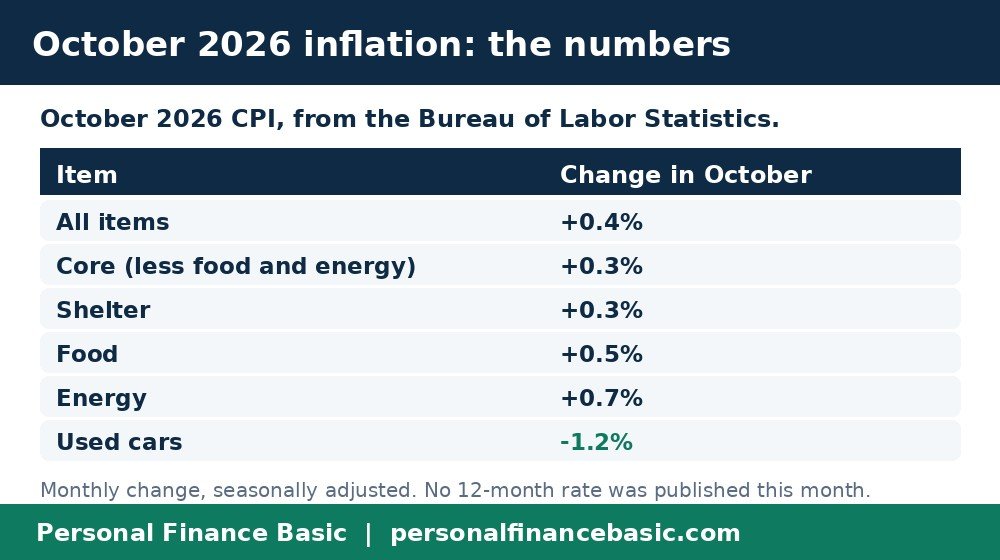
October 2026 CPI, from the Bureau of Labor Statistics. Monthly change, seasonally adjusted.
Why there is no yearly rate this time
Most months, the inflation report includes a 12-month rate, such as prices up 3.7 percent from a year earlier. This month it does not. The Bureau of Labor Statistics said it did not collect survey data for October 2025 because of a lapse in appropriations, the government shutdown last year. Without October 2025 prices, it cannot work out a 12-month change for October 2026.
The last published yearly rates are from September: consumer prices up 3.7 percent over 12 months, and core prices up 2.6 percent. Anyone quoting a yearly inflation rate for October 2026 is quoting a number the Bureau of Labor Statistics never published. Some private estimates put the yearly rate near 3.7 percent, but those are estimates, not the official figure.
The monthly numbers are still official and still useful. A 0.4 percent monthly rise, if it kept up for a full year, would add up to about 4.9 percent over 12 months. That is higher than the 3.7 percent yearly rate last published in September.
What it means for the Federal Reserve
The Federal Reserve watches this report closely, because it sets interest rates with inflation in mind. The timing matters. Federal Reserve Governor Christopher Waller said before the release that a 50 basis point rate rise should be considered at the December meeting if core inflation came in around 0.3 percent or higher. Core inflation came in at exactly 0.3 percent.
The Federal Reserve meets on December 8 and 9, 2026. The next inflation report, covering November, comes out on December 10, the day after the meeting ends. The Fed will make its December decision using this October report as its freshest inflation data.
For households, the point is simple: do not expect cheaper borrowing soon. Higher-for-longer rates keep credit card, car loan and mortgage rates high. If you carry a balance on a card, the interest cost stays high, and paying it down matters more than waiting for rates to fall.
What it means for your money
Start with the grocery bill and the rent, because those are the two categories that rose most clearly. Food rose 0.5 percent in one month, and shelter rose 0.3 percent. A household spending $800 a month on groceries would pay about $4 more for the same basket after one month at that pace. Rent rising 0.2 percent a month adds about $24 a year to a $1,000 monthly rent.
Second, check what your pay did. Real average hourly earnings were unchanged from September to October, the Bureau of Labor Statistics reported separately on November 10. That means the average worker’s pay did not keep up with prices in October. If your pay is flat while prices rise 0.4 percent a month, your money buys a little less each month. Look at the three biggest flexible costs, usually food, eating out and transport, and see where a small cut is possible.
Third, check what your savings account pays. When prices rise faster than the interest on your savings, the money in the account loses buying power. A high-yield savings account still pays more than a regular savings account, and moving idle cash there is one of the easiest responses to a hot inflation report. If your account pays far less than inflation, the money is shrinking in real terms.
Finally, do not make big money moves on one report. One month of data does not set a trend, and the missing yearly rate makes this report harder to read than usual. The useful response is small: check the grocery spend, check the savings rate, and keep paying down high-interest debt while rates stay high.
At a glance
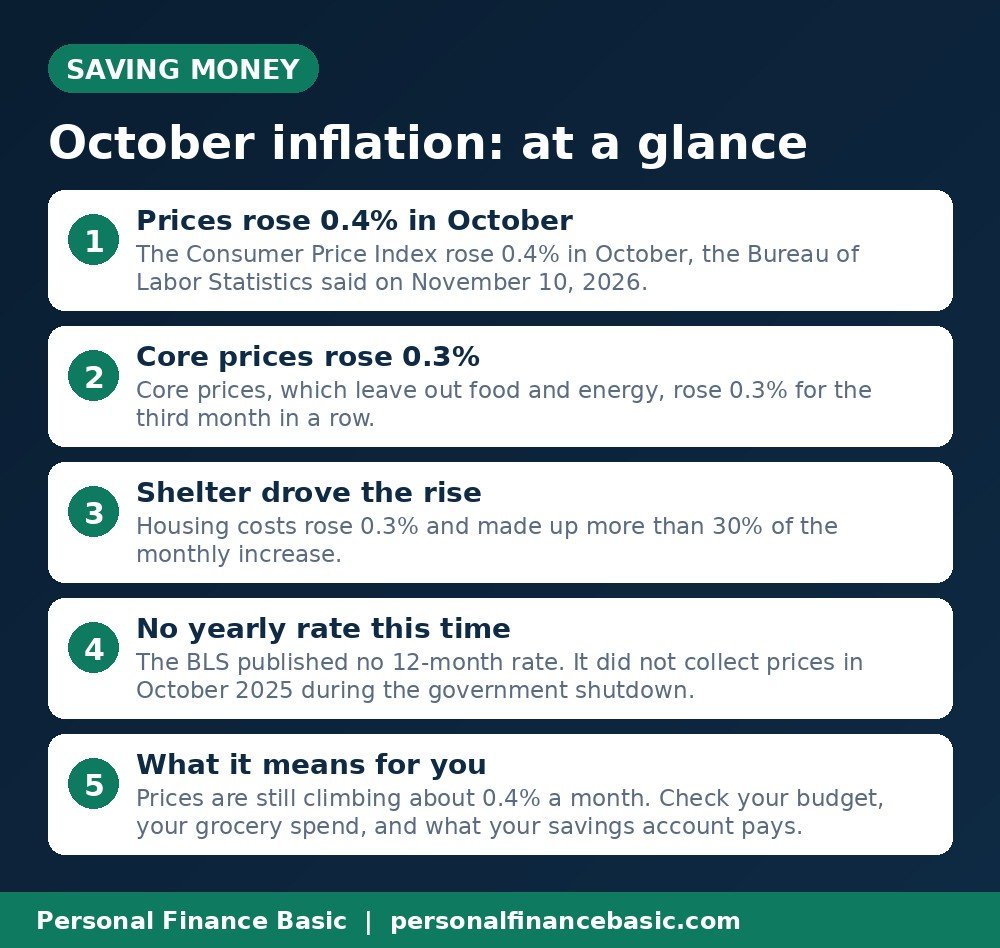
The main points from this guide, in one picture.
Frequently asked questions
How much did prices rise in October 2026?
The Consumer Price Index rose 0.4 percent in October, the Bureau of Labor Statistics said on November 10, 2026. That followed a 0.6 percent rise in September. Core prices, which leave out food and energy, rose 0.3 percent for the third month in a row.
Why is there no yearly inflation rate for October?
The Bureau of Labor Statistics did not collect prices in October 2025 because of a lapse in appropriations during the government shutdown. Without that base month, it cannot publish a 12-month change. The last official yearly rates are from September: 3.7 percent for all items and 2.6 percent for core.
What rose most in October?
Shelter rose 0.3 percent and made up more than 30 percent of the monthly increase. Food rose 0.5 percent, and energy rose 0.7 percent. Used cars and trucks fell 1.2 percent.
Will the Federal Reserve raise rates in December?
That is not decided. Governor Christopher Waller said a 50 basis point rise should be considered if core inflation came in around 0.3 percent or higher, and core came in at exactly 0.3 percent. The Fed meets December 8 and 9, and the next inflation report comes out December 10, after the meeting.
This guide is general education, not financial advice. Inflation figures come from the Bureau of Labor Statistics release of November 10, 2026. Consider speaking with a qualified financial adviser about your own situation.
Related reading: How Much Emergency Fund Do You Need? With $ Examples and High-Yield Savings Accounts: What to Look For