About 90% of US consumers have at least one credit card, according to Experian. The average American actively uses 3.7 cards, down from 4.1 a decade ago. The question is not whether to carry a card. It is how many make sense for your life.
No scoring model publishes an ideal number of cards. FICO does not tell you to hold two cards or five. What matters is how you use the cards you have, how many payments you can track without missing one, and what each new card does to your credit history. This guide walks through the numbers behind that choice, so you can pick a count that fits your habits.
What the average of 3.7 really means
Experian’s data from June 2025 puts the average at 3.7 cards in active use. A decade earlier it was 4.1. That average hides a wide spread. Some people carry one card for everything. Others carry five or six, each with a different job. Holding several cards is normal.
The average is a starting point, not a target. It tells you what other people do, not what your score needs. A person who pays every card in full and on time can hold five cards without trouble. A person who sometimes misses a payment may do better with one. The right number follows your habits, not the national average.
How the number of cards affects your credit score
A FICO score is built from five factors. Payment history is 35%, amounts owed is 30%, length of credit history is 15%, new credit is 10%, and credit mix is 10%. More cards can help one factor and hurt another at the same time.
Payment history is the biggest factor, and it is also the one where extra cards add the most risk. One payment that is 30 days late can hurt your score, no matter how many cards you hold. Each card you add is another due date to track and another chance to miss a payment. The people who benefit most from several cards are the ones who never miss a payment on any of them.
Length of history is 15% of the score, and a new card lowers your average account age. Open a new card and your average drops the day the account appears. Open several in a short time and the effect adds up. Old cards help: the longer an account stays open, the more it supports your average age.
The worked example: $1,500 a month
Utilization is your balance divided by your total credit limit, and keeping it under 30% lessens the negative effect on your score. Lower is better. Here is how the number of cards changes it, using the same spending each time.
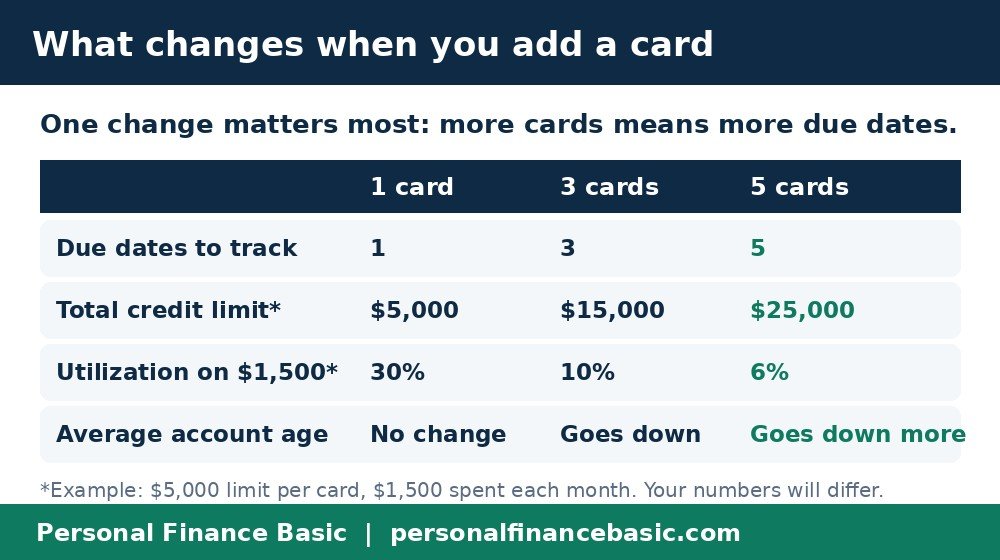
The same $1,500 of monthly spending at different card counts. Example: $5,000 limit per card.
With one card and a $5,000 limit, $1,500 of spending is 30% of the limit. That is the edge of the level where utilization starts to weigh on a score. Spread the same spending across three cards with $15,000 of total limit and utilization falls to 10%. With five cards and $25,000 of total limit, it is 6%. The spending did not change. The total limit did.
This example shows why more cards can look good on paper. It also shows the catch. The lower utilization only helps if every card is paid on time. One late payment on any of the five cards can cost more score points than the lower utilization saves. The example assumes the same $1,500 of spending and the same on-time payments in every case.
The downsides of holding too many
The main downside is simple: more cards mean more to manage. Five cards mean five due dates, five statements, and five balances to check. Automatic payments help, but you still need to check that each payment went through and that no charge looks wrong. A missed payment on a card you forgot about counts the same as a missed payment on your main card.
New cards also cost you in the short term. Each application can lower your average account age, and new credit is 10% of a FICO score. Open several cards in a few months and the combined effect is easy to see. A higher total limit also makes it easier to spend more than you planned, and a balance spread across several cards can be harder to see as one total. Credit mix is 10% of the score, but cards are one type of credit, so a second, third, or fifth card adds nothing there.
How to choose your number
Start with one card. Use it for regular spending, pay it in full each month, and do that for six months or more. That builds the habit that matters most: on-time payments, which are 35% of your score. One card you pay in full is worth more to your score than three cards you sometimes pay late.
Add a second card only when it has a clear job. It might separate one kind of spending from the rest, or give you a backup if your main card is lost or declined. Add a third the same way. If you cannot name the job a new card will do, you probably do not need it yet.
When you do add cards, keep your old ones open. Length of history is 15% of your score, and an old card keeps your average age higher. A small handful is where most people land. The average of 3.7 cards says most people hold a few, not a wallet full.
At a glance
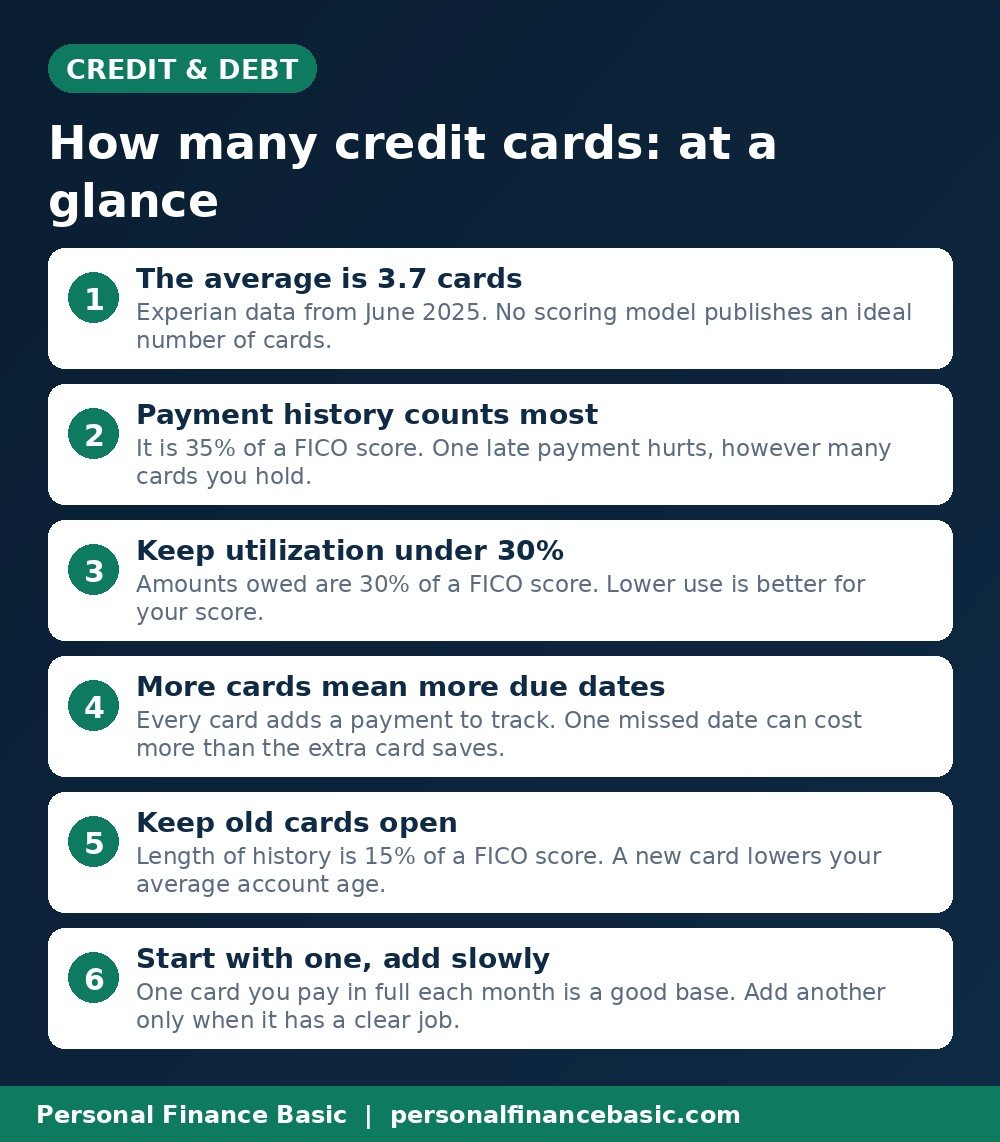
The main points from this guide, in one picture.
Frequently asked questions
Is there an ideal number of credit cards?
No. No scoring model publishes an ideal number. The average American actively uses 3.7 cards, according to Experian data from June 2025, but that is an average, not a recommendation. The right number depends on whether you can pay every card on time.
Does having more credit cards raise my credit score?
It can help in one way and hurt in another. More cards raise your total credit limit, which can lower your utilization. But each new card lowers your average account age, and each one adds a due date. Payment history is 35% of a FICO score, so on-time payments matter more than the card count.
Will closing a credit card hurt my score?
It can. Closing a card cuts your total available credit, which can push your utilization up. That is why keeping old cards open usually helps, especially cards with no annual fee. If a card charges a fee you do not want to pay, weigh the fee against the credit history you would lose.
How many cards should a beginner start with?
One. Use it for regular spending, pay it in full every month, and keep that up for at least six months. Once on-time payments are routine, you can add a second card if it has a clear job.
Does applying for a new card hurt my credit score?
A new card lowers your average account age, and new credit is 10% of a FICO score. One application has a small effect that fades, but opening several in a short time has a bigger effect, so space applications out.
This guide is general education, not financial advice. The right number of cards depends on your income, spending, and habits. Consider speaking with a qualified financial adviser about your own situation.
Related reading: How to Improve Your Credit Score in 6 Months and Secured vs Unsecured Credit Cards for Beginners