Your employer offers to add money to your retirement account, on top of what you put in yourself. All you have to do is contribute enough from your own pay to qualify. That extra money is called the employer match, and skipping it means turning down part of your pay.
A match is the closest thing to free money in retirement saving: your employer adds a set amount for each dollar you contribute, up to a limit. This guide explains how it works, what it is worth on a $60,000 salary, and how to get all of it.
What a 401(k) match is
A 401(k) is a retirement account you get through your employer. Money comes out of your paycheck before tax, or after tax if you use a Roth 401(k), and goes into the account. Many employers add their own money on top of yours. That is the match.
The match is based on how much you contribute. If you put in nothing, your employer adds nothing. If you put in enough to reach the full match, your employer adds the maximum. The match is not a bonus or a gift. It is part of your pay package, and it goes into the same retirement account as your own contributions.
Not every employer offers a match. Your plan’s Summary Plan Description, the document your employer must give you, states the exact formula.
The most common formulas
The most common formula is 50% of the first 6% of your pay. That means your employer adds 50 cents for each dollar you contribute, up to 6% of your salary. If you earn $60,000 and contribute 6%, that is $3,600 from you and $1,800 from your employer.
Another common formula is the safe-harbor match: 100% of the first 3% of your pay, plus 50% of the next 2%. On a $60,000 salary, contributing 5% means $3,000 from you and $2,400 from your employer: $1,800 on the first 3% and $600 on the next 2%.
Some plans match dollar for dollar up to a limit. Whatever your plan’s formula is, contribute at least enough to get the full match.
What the match is worth on $60,000
The table below shows what happens on a $60,000 salary with a 50% match on the first 6% of pay. The numbers are an example, using one formula, so you can see how the match changes as you contribute more.
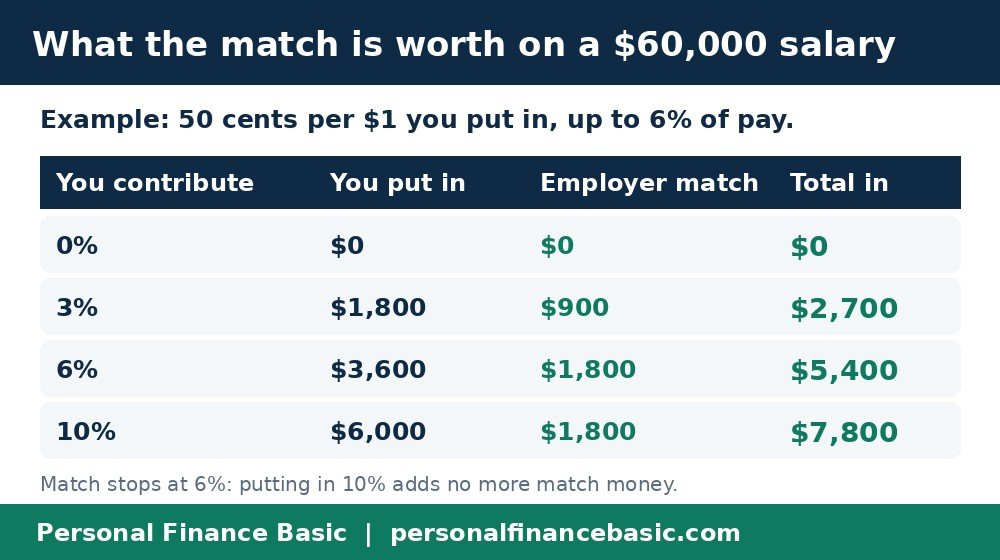
The match on a $60,000 salary, at 50% of the first 6% of pay. The match stops at 6%.
Contributing 3% leaves $900 a year on the table. That is $75 a month of pay you never see. Over 10 years, that is $9,000 of match money missed, before any growth on it.
Contributing 10% is good for your retirement, but it adds no more match. The match stops at 6%, so the extra 4% is your money only.
Think of the match as an instant return. Putting in $3,600 and getting $1,800 added means your account grows by $5,400 for $3,600 of your pay. That is a 50% return on the matched part, before any investment growth, and no investment can promise that.
The 2026 limits and where the match fits
For 2026, the IRS lets you put up to $24,500 of your own money into a 401(k), counting pre-tax and Roth contributions together. If you are 50 or older, you can add $8,000 more as a catch-up, for a total of $32,500.
The employer match does not count against your $24,500 limit. It counts toward a separate total limit of $72,000 for 2026, which covers your contributions, the match, and any other employer contributions.
The IRS has not announced the 2027 limits yet, as of early November 2026. The 2026 numbers above are the ones that apply now. Check the IRS site or your plan documents when the new limits are published.
Vesting: when the match is really yours
The money you contribute from your own pay is always 100% yours, from day one. If you leave your job after a month, you take all of it with you. The employer match is different: your plan can require you to stay for a set time before the match becomes fully yours. That is called vesting.
Federal rules set the maximum schedules. A plan can use cliff vesting, where you own none of the match until you reach a set date, then all of it: up to 3 years. Or it can use graded vesting, where you own a growing share each year: 20% after year 2, then 20% more each year, until you own 100% after 6 years.
Some plans, including safe-harbor plans, vest the match at once. If you are thinking of changing jobs, check how much of your match is vested first.
How to get the full match
Start by finding your plan’s formula. Log in to your 401(k) account or read the Summary Plan Description. Work out the percentage of pay you need to contribute to get the full match, then set your contribution to at least that level.
If money is tight, get the match before you save anywhere else. A 50% match is an instant return that no savings account can match. If you cannot reach the full match yet, raise your contribution by 1% each time your pay rises until you get there.
Check your contribution once a year. A pay rise changes the dollar amount behind the same percentage, and a new plan formula can change what the full match means. A five-minute check each January is enough.
If your employer does not offer a match, the 401(k) is still useful for its tax break, but the order changes. In that case, a Roth IRA is often the next step. The related guides below compare the two accounts.
At a glance
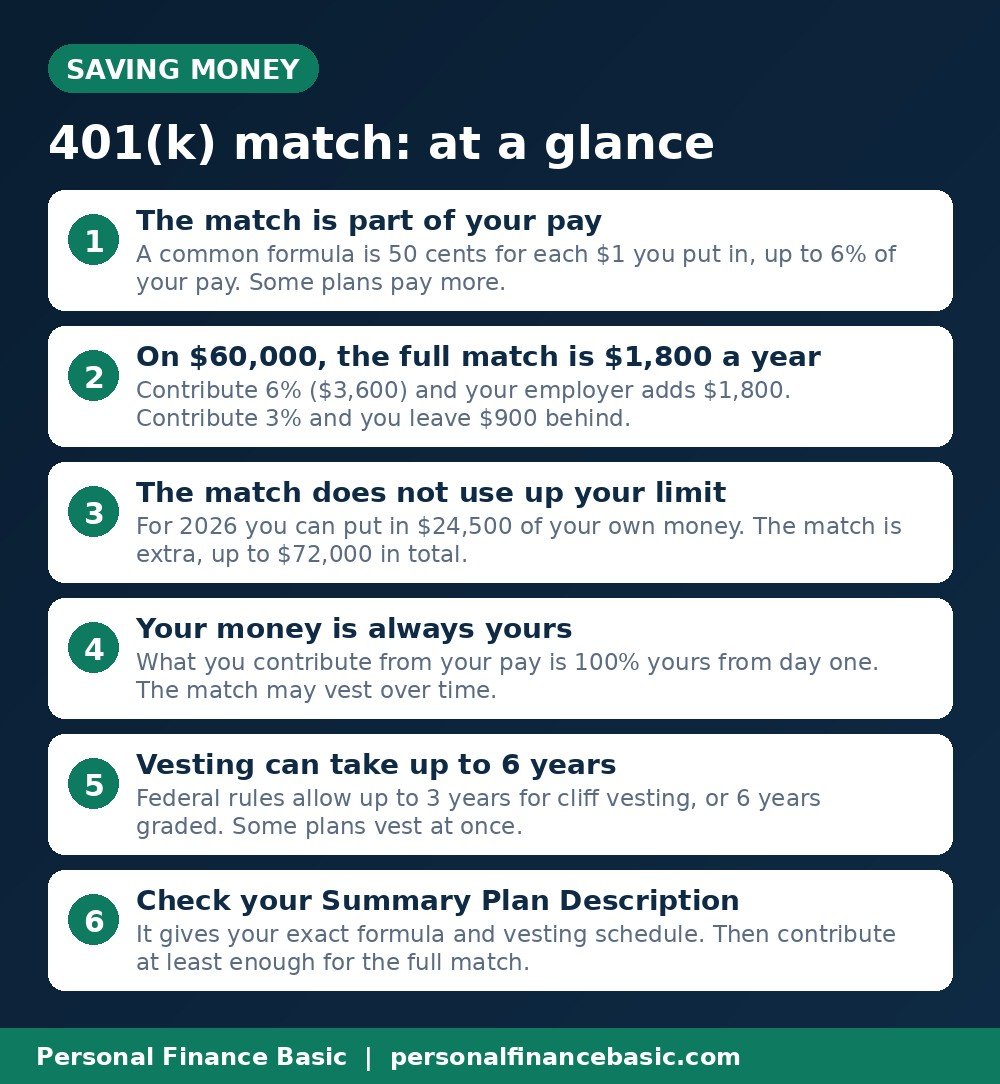
The main points from this guide, in one picture.
Frequently asked questions
What is a 401(k) match?
It is money your employer adds to your 401(k) based on how much you contribute from your pay. A common formula is 50 cents per dollar on the first 6% of your pay. If you put in nothing, your employer adds nothing.
How much match do I get if I earn $60,000 and contribute 3%?
With a 50% match on the first 6%, 3% of $60,000 is $1,800 from you and $900 from your employer. Raise your contribution to 6% and the match becomes $1,800 a year, which is $900 more.
Does the match count toward my $24,500 limit for 2026?
No. The $24,500 limit covers only your own contributions. The match counts toward the $72,000 total limit for all money going into the account. If you are 50 or older, your own limit is $32,500 with the catch-up.
What happens to the match if I leave my job?
Your own contributions are always yours. The match depends on vesting. With a 3-year cliff, leaving after 2 years means you keep none of the match. With graded vesting you keep the share you have earned, up to 100% after 6 years.
Should I contribute more than the full match amount?
It can help, but it adds no more match. Once you have the full match, extra contributions grow your retirement savings and get the tax break, but the match itself is already maxed. Many people put extra money in a Roth IRA next.
This guide is general education, not financial or tax advice. The right amounts depend on your income, costs, and goals. Consider speaking with a qualified financial adviser about your own situation.
Related reading: 401(k) vs Roth IRA: Which Should a Beginner Choose First? and Roth IRA for Beginners: How It Works and Who It Suits