
Most people never think about bank insurance until a bank makes the news. Then the question arrives all at once: is my money safe? In the United States, the answer for most bank deposits is yes, thanks to a federal program that has run since 1933. It is called FDIC insurance, and it protects deposits up to $250,000 if a bank fails.
This guide explains what FDIC insurance is, what it covers, what it does not cover, and how to check that your bank is insured.
What FDIC insurance is
The Federal Deposit Insurance Corporation, or FDIC, is an independent agency of the US government. It was created in 1933, after thousands of banks failed during the Great Depression and ordinary savers lost their deposits. Its job is to insure bank deposits and to keep the banking system steady.
When a bank is FDIC-insured, your deposits there are covered up to $250,000 per depositor, per bank, per ownership category. If the bank fails, the FDIC pays you back, up to that limit, from its insurance fund. The coverage is automatic and free. Banks pay premiums into the fund.
The record is strong. No depositor has ever lost a dollar of FDIC-insured money since the program began in 1933, through the savings and loan crisis of the 1980s, the financial crisis of 2008, and the bank failures of 2023.
The $250,000 limit, explained
The limit has three parts, and each one matters. Per depositor means the coverage belongs to you, the person who owns the money. Per bank means each separately chartered bank gives you a fresh $250,000 limit. Per ownership category means different kinds of accounts at the same bank get separate limits.
Here is how that works in practice. If you hold a checking account, a savings account, and a certificate of deposit at one bank, all in your name alone, those balances are added together. The combined total is insured up to $250,000 under the single ownership category. Opening three accounts in your own name at the same bank does not triple your coverage.
But other categories are separate. A joint account you share with your spouse falls in its own category, and each co-owner is insured up to $250,000, so a joint account can be covered up to $500,000. Certain retirement accounts, such as IRAs held as bank deposits, get their own $250,000 limit too. Trust accounts are insured at $250,000 per owner for each eligible beneficiary, so one household can hold well over $250,000 at a single bank and still be fully covered.
Different banks also mean separate limits: $250,000 at one insured bank and $250,000 at another are both fully covered. Different branches of the same bank do not count as separate banks.
What is covered, and what is not
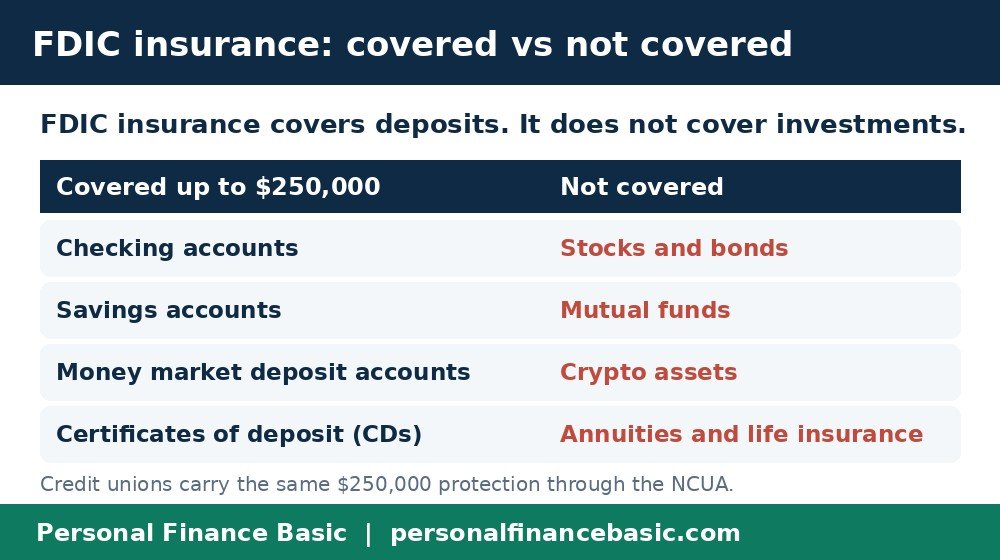
Deposits are covered. Investments are not, even if you bought them at a bank.
FDIC insurance covers deposit products: checking accounts, savings accounts, money market deposit accounts, and certificates of deposit. It also covers official items such as cashier’s checks and money orders issued by the bank. The limit counts your principal plus any interest earned up to the day the bank closes.
It does not cover investments. Stocks, bonds, mutual funds, annuities, life insurance policies, and crypto assets are not insured, even if you bought them through your bank or through a banker sitting in the branch. A brokerage account at a bank is a different kind of account, and its investments are not FDIC-insured.
This is the most common misunderstanding about FDIC insurance. People assume that anything held at a bank is insured. It is not. The rule is simple: if it is a deposit, it is covered up to the limit. If it is an investment, it is not.
How to check your bank is insured
Checking takes about a minute. The FDIC runs a free tool called BankFind Suite at fdic.gov. Type in the bank’s name, and it shows whether the bank is insured. You can also look for the words Member FDIC on the bank’s website, app, or branch door.
Be careful with fintech apps. Many apps that look like banks are not banks at all: they hold your money at a partner bank. In that case, check which bank actually holds the deposits and confirm that bank is insured.
Credit unions work the same way through a different agency. Deposits at federally insured credit unions are covered up to $250,000 by the National Credit Union Administration, or NCUA, under the same rules. Look for the words federally insured by NCUA.
What happens if your bank fails
Bank failures are rare. When an insured bank fails, the FDIC usually steps in over a weekend. In most cases another bank takes over the failed bank’s deposits, and customers can use their accounts as normal on the next business day. If no bank takes over, the FDIC pays insured depositors directly, usually within a few days.
That speed matters. The insurance is only useful if the money comes back fast, and the FDIC’s record is that insured depositors get access quickly, most often by the next business day. Amounts above the $250,000 limit in one ownership category are not guaranteed, and may be partly or fully lost.
What to do if you have more than $250,000
Many people cross the limit at some point: a house sale, an inheritance, or years of saving in one place. If your single-ownership deposits at one bank are above $250,000, the amount over the limit is uninsured. There are three plain ways to fix that.
First, spread the money across banks. Each separately chartered bank carries its own $250,000 limit. Second, use different ownership categories at the same bank: a joint account, a retirement account, or a trust account each carry separate limits. Third, use the FDIC’s free EDIE tool at edie.fdic.gov, which calculates your exact coverage across all your accounts at one bank in a few minutes.
Check your coverage once a year, and again after any big deposit. Interest counts toward the limit too, so an account sitting just under $250,000 can drift over it.
At a glance
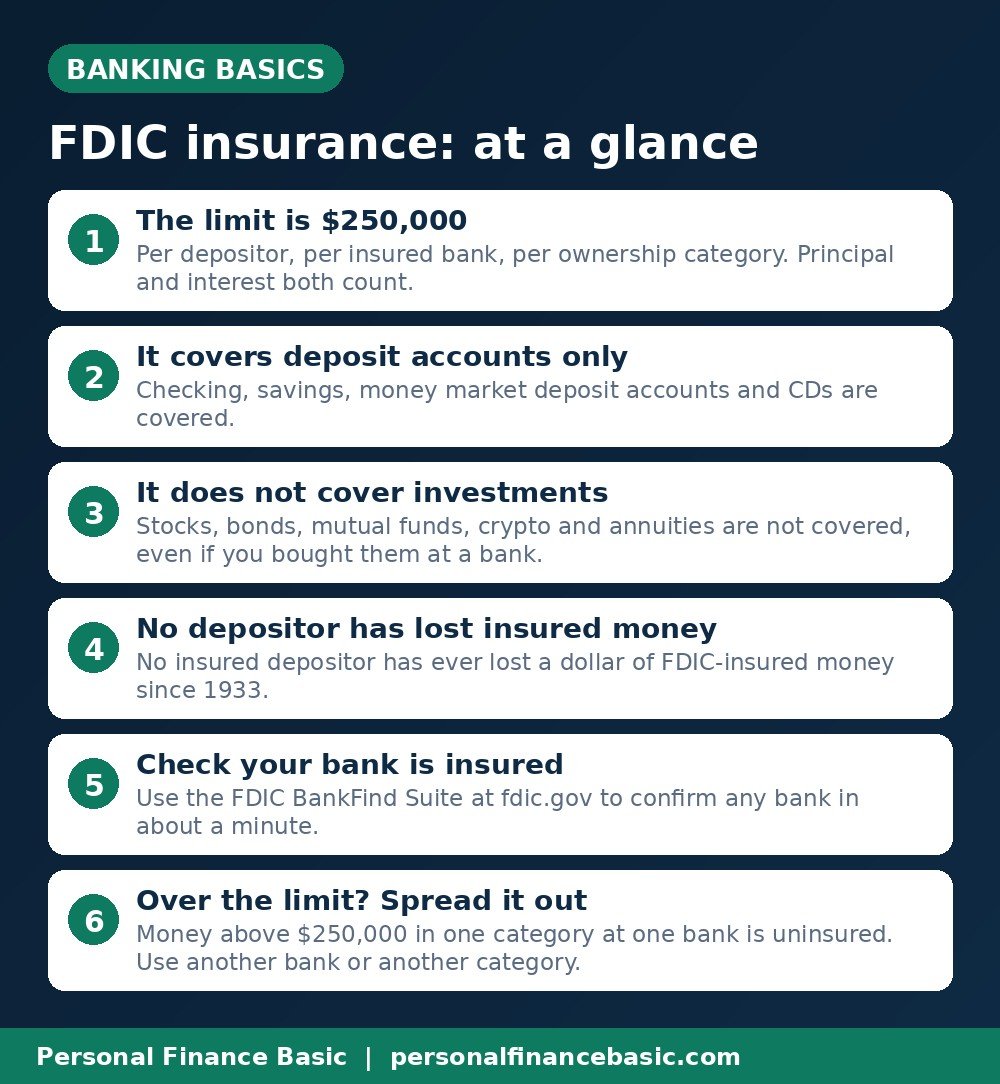
The main points from this guide, in one picture.
Frequently asked questions
Does FDIC insurance cover credit unions?
Not directly, but credit unions have the same protection through the NCUA. Federally insured credit unions cover deposits up to $250,000 per depositor, per institution. State-chartered credit unions may carry private insurance instead, so check before you join.
Is my money safe if my bank fails?
If the money is in an FDIC-insured deposit account and within the $250,000 limit, yes. No insured depositor has lost money since 1933, and access is usually restored by the next business day.
Does FDIC insurance cover my brokerage account at a bank?
No. Investments in a brokerage account, such as stocks, bonds, and mutual funds, are not FDIC-insured, even if the brokerage is owned by a bank. Brokerage accounts may carry separate SIPC protection for missing securities if the firm fails, not for market losses.
Are online banks FDIC-insured?
Most are, but check. An online bank with its own charter is insured like any other bank. An app that is not a bank may hold your money at a partner bank, so confirm which bank holds the deposits.
Does FDIC insurance cost me anything?
No. You pay nothing and you do not sign up. Banks pay premiums into the insurance fund, and coverage is automatic.
This guide is general education, not financial advice. Coverage rules can change, and the details of your own accounts matter. Check the FDIC’s own site at fdic.gov if you are unsure about your coverage.
Related reading: High-Yield Savings Accounts: What to Look For and Checking vs Savings Account: What Is the Difference?