Thanksgiving week is here, and your card is about to get a workout. Gifts, groceries, travel, a few online orders at midnight. Every swipe and every checkout is one more place your card number lives.
That is the risk. The Identity Theft Resource Center counted 3,322 data compromises in the US in 2025, and the holiday season is when stolen card numbers get used fastest. A credit freeze is the strongest free tool you have against that, and it costs nothing.
Here is how to tell whether you should freeze your credit before the holidays, and how to do it in about half an hour.
The short answer
Yes, for most people. A freeze blocks anyone, including you, from opening a new credit account in your name until you lift it. It is free to place and lift, does not affect your score, and lasts until you lift it, per the Federal Trade Commission (FTC).
The quick framework:
- Check the 5 signs below. One match is enough.
- Freeze at all three bureaus: Equifax, Experian and TransUnion.
- Keep your PIN or password from each bureau somewhere safe.
- Lift the freeze temporarily, for a day or a week, only when you apply for new credit.
Quick decision guide:
- Not applying for credit this month? Freeze now. It costs you nothing.
- Applying for a card or loan soon? Freeze after the application is approved.
- Already a fraud victim? Freeze and add an extended fraud alert.
- Only worried, not sure? A one-year fraud alert is the lighter option.
The 5 signs it is time to freeze
1. You got a data breach letter. If a store, a health plan or an employer told you your information may have been exposed, treat it as real. The FTC suggests checking your credit reports and considering a freeze when your Social Security number was involved.
2. You see an account or inquiry you do not recognize. One unknown inquiry can be a mistake. Two is a pattern. Freeze first, then dispute the items. Check all three reports free at AnnualCreditReport.com.
3. Your wallet, phone or mail was lost or stolen. A stolen wallet hands someone your name, address and card numbers in one package. A freeze stops them from turning that into a new account in your name.
4. You shop a lot online in November and December. Holiday shopping means more accounts, more saved cards and more chances for a number to leak. A freeze does not stop you using the cards you already have.
5. You will not apply for new credit for a while. If no card, loan or apartment application is coming in the next few months, a freeze costs you nothing in daily life. There is no reason to leave the door open.
Step 1: Freeze at all three bureaus
A freeze at one bureau does not carry over to the other two. You have to place it three times, once at each bureau. Online it takes about 10 minutes per bureau, so plan on about half an hour total.
Go to each bureau’s freeze page or call them: Equifax, Experian and TransUnion. You will confirm your identity with your name, address, date of birth and Social Security number, then set a PIN or password. Keep that login safe. You need it to lift the freeze later.
By law, a bureau must place a freeze within 1 business day of an online or phone request. It must lift one within 1 hour. Mail requests take up to 3 business days, so do it online or by phone.
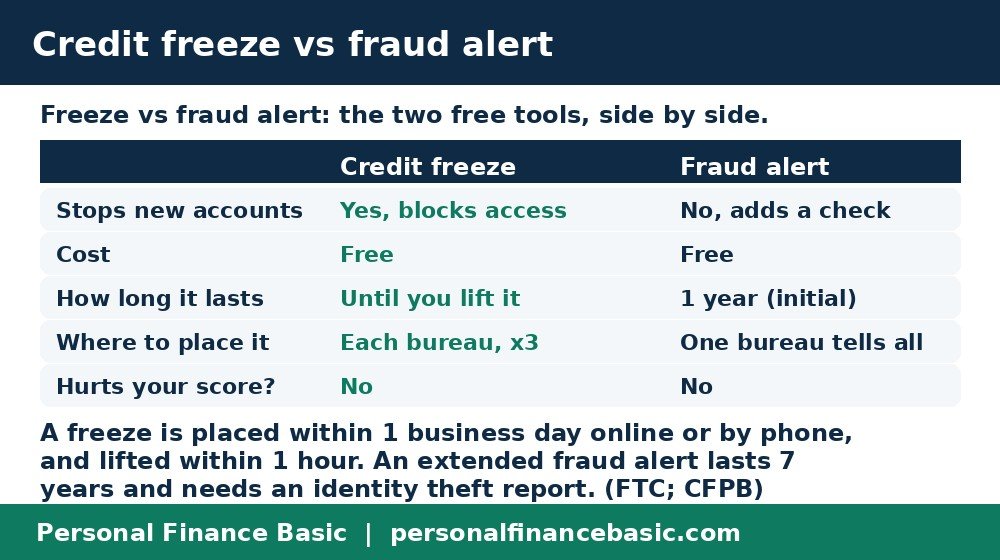
Credit freeze vs fraud alert: the two free tools, side by side.
Step 2: Know what a freeze does and does not do
A freeze stops a lender from pulling your credit report, and without that report most lenders will not open a new account. That is the whole point.
It does not stop everything. Your existing cards keep working exactly as before. Companies you already have accounts with can still see your report. Your credit score does not change, and a freeze does not stop someone using a card number they already stole. That is a different problem, and it is fixed by reporting the card stolen.
Step 3: Decide whether to add a fraud alert too
A fraud alert tells lenders to check your identity before opening a new account in your name. It does not block access to your report the way a freeze does, but it is easier: one call to one bureau places it at all three, and an initial alert lasts 1 year.
| Credit freeze | Fraud alert | |
|---|---|---|
| Stops new accounts | Yes, blocks access | No, adds an identity check |
| Cost | Free | Free |
| How long it lasts | Until you lift it | 1 year (initial alert) |
| Where to place it | Each bureau separately | One bureau tells the other two |
| Hurts your score? | No | No |
Source: FTC and CFPB guidance on freezes and fraud alerts.
An extended fraud alert lasts 7 years, but you need an identity theft report from IdentityTheft.gov or a police report. The FTC says you can have both a freeze and an alert, and for a past victim, both is the right call.
- Best for: anyone who is not about to apply for credit. The freeze is the stronger tool, and it is free.
- Not for: the week you apply for a mortgage, a car loan or a new card. Lift it first, apply, then freeze again.
Step 4: Lift it the right way when you need credit
When you apply for something, lift the freeze before the lender pulls your report, not after. Online or phone lifts must be done within 1 hour, but do it the day before to be safe.
You can lift for a set time, such as one day, or for one specific lender. A timed lift closes itself again. After the application, check that the freeze is back on.
If you lose your PIN, each bureau has a recovery process, usually by mail. That takes days, so store the PIN with your other important passwords now.
At a glance
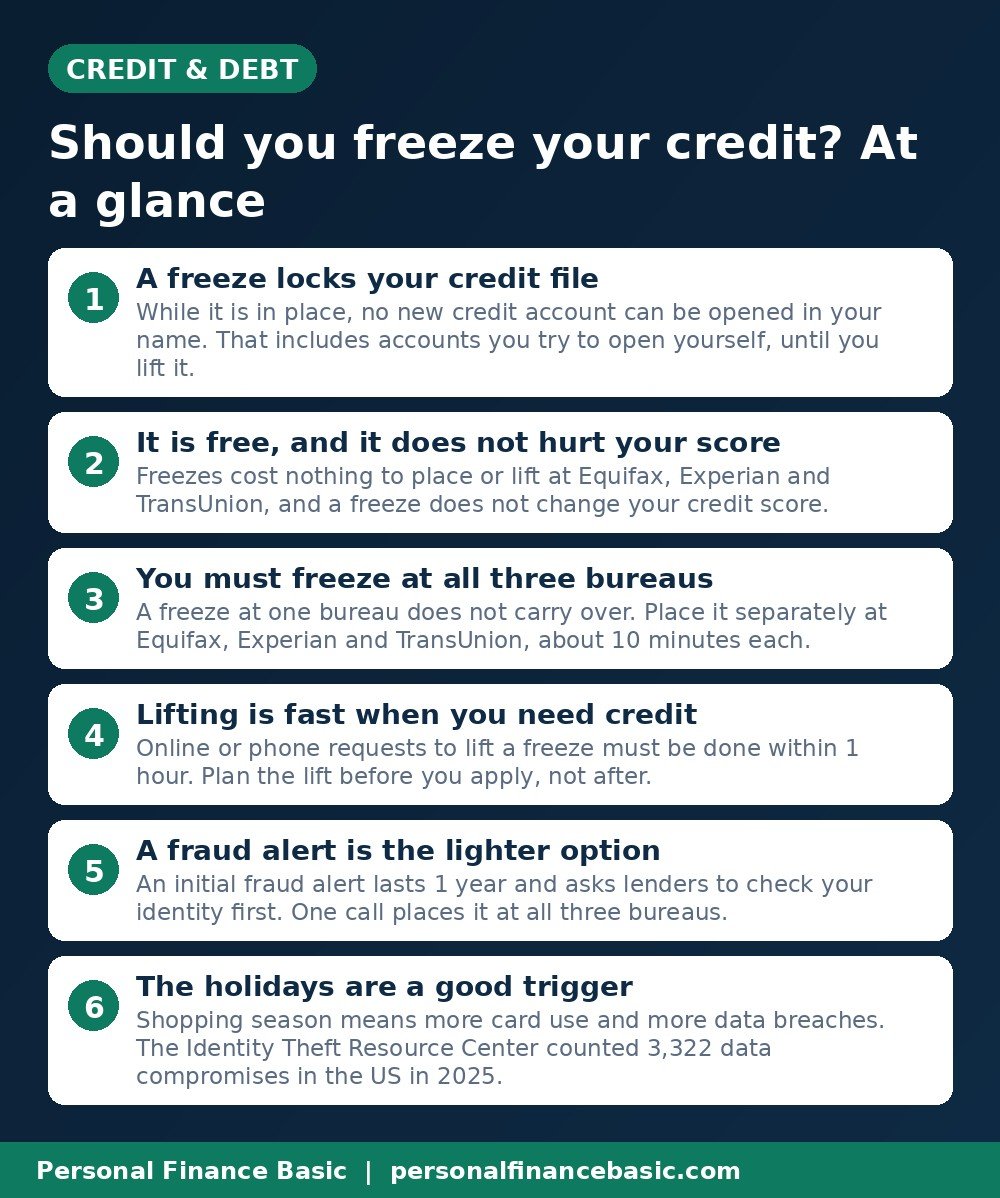
The main points from this guide, in one picture.
Frequently asked questions
Does freezing my credit hurt my credit score?
No. A freeze does not change your score, and it does not appear as a negative item on your report. It only blocks access to the report for new credit applications.
Is a credit freeze really free?
Yes. Federal law makes freezes free to place and free to lift at all three nationwide bureaus. No bureau may charge you for it.
Do I need to freeze at all three bureaus?
Yes. Equifax, Experian and TransUnion keep separate files. A freeze at one does not protect the other two, so place it three times.
Can I still use my credit cards with a freeze in place?
Yes. A freeze only blocks new accounts. Your existing cards, loans and bank accounts work exactly as before.
How fast can I lift a freeze when I need credit?
Online or phone requests to lift a freeze must be completed within 1 hour. You can also set a timed lift, for example for one day, and it closes itself again.
The bottom line: a freeze is free, takes about 30 minutes, and is the strongest lock you can put on your credit. If any of the 5 signs fit, do it before the holiday shopping starts.
This post is general education, not financial advice. Freeze and fraud alert rules are set by federal law; check the FTC’s guidance at consumer.ftc.gov for the latest steps.
Related reading: How to Dispute an Error on Your Credit Report and What Is Credit Utilization and Why Under 30% Matters