Holiday shopping season opens this week, and the last spending report before it is a shrug. On 17 November 2026, the Census Bureau reported that Americans spent $748.2 billion at stores and restaurants in October, up just 0.2% from September, only $1.6 billion more.
That small a gain is not clearly different from zero: the margin of error is plus or minus 0.4 points. And prices rose 0.4% in October, so what shoppers actually bought was flat, or slightly less.
Here is what the report really says, and what it means for your holiday budget.
The short answer
Americans are still spending, but the easy gains are gone. Sales rose 0.2% in October to $748.2 billion, after a 0.8% rise in September. Take out cars, and sales rose 0.6%, as did the control group that feeds into GDP.
The quick framework:
- Read the headline with the margin of error: 0.2% could be zero.
- Strip out prices: with consumer prices up 0.4%, real spending was flat.
- Look at what fell: cars and furniture dragged the total down.
- Look at what grew: online spending kept rising, up 11.8% on the year.
Quick decision guide:
- Shopping for gifts this week? Set the budget first. Flat spending means stores will compete hard for your money.
- Buying a car? Sales fell 1.6% in October. Dealers are feeling it, and that is leverage.
- Feeling squeezed by gas prices? Gas station sales are up 30.3% on the year, mostly higher prices, not more driving.
- Wondering if the economy is stalling? One flat month is not a stall. Spending is up 6.8% on the year.
What the October report actually showed
The Census Bureau’s advance estimate covers retail and food services sales, adjusted for seasons but not for prices. When prices rise, sales can grow even if nobody buys more. In October, prices did the growing.
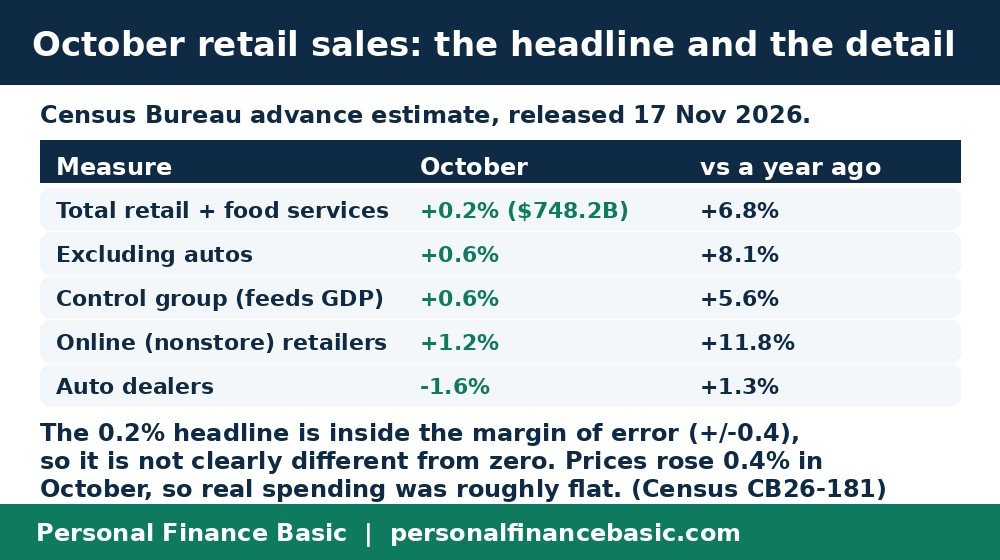
October retail sales: the headline and the detail.
The categories tell the story. Sales at motor vehicle and parts dealers fell 1.6% in October, after months of strong car buying. Furniture and home furnishings stores fell 2.3%. Clothing stores fell 0.7%, and grocery stores slipped 0.2%. On the other side, nonstore retailers, mostly online sellers, rose 1.2% in October to $128.2 billion, and are 11.8% above a year ago. Health and personal care stores rose 1.5%, and restaurants and bars rose 0.2%.
Gasoline stations rose 1.5% in the month and 30.3% on the year, mostly the surge in fuel prices, not more gallons sold. Sales over the three months to October were 6.4% higher than a year earlier, so the year still looks strong. The month does not.
- Best for: reading the trend, not the headline. The control group, up 0.6%, is the number economists watch, because it feeds into GDP.
- Not for: panic. A 0.2% month after a 0.8% month, inside the margin of error, is a pause, not a collapse.
Why the headline hides the real story
Three things make the 0.2% look better or worse than it is.
First, prices. The Bureau of Labor Statistics reported consumer prices up 0.4% in October, and 0.3% without food and energy. Retail sales are not adjusted for prices, so a 0.2% rise in spending with a 0.4% rise in prices means shoppers bought slightly less stuff for slightly more money.
Second, cars. Auto dealers are the biggest single drag on the month. Take them out, and sales rose 0.6% instead of 0.2%. Car sales fell because borrowing costs are high: the average 30-year mortgage rate was 7.28% in the week ending 19 November, and car loan rates track the same pressures.
Third, gas. Gasoline station sales are up 30.3% from a year ago, but that is the price at the pump, not the number of trips. The national average was $3.87 a gallon in mid-November, near a Thanksgiving record. Every dollar that goes to gas is a dollar that does not go to gifts.
Put together, the report says the same thing the jobs report said two weeks earlier: the economy is still growing, with 165,000 jobs added in October and unemployment at 4.1%, but households are feeling the cost of everything, and spending growth is slowing.
What it means for your holiday budget
Black Friday is 27 November. Four things to do with this report in mind.
Set the gift budget before you shop, not after. The site’s own reading this month found 41% of Americans will rely on credit to cover November expenses, and a third have no $1,000 cushion. Decide the total first, then the list.
Compare prices the way the report does. Online sellers are up 11.8% on the year for a reason: comparison is easy. Check the same item in two places before you buy, and remember that a sale price on a higher starting price is not a saving.
Count gas in the trip budget. A 500-mile round trip at $3.87 a gallon costs about $77.40 at 25 miles per gallon, against $61.60 at last year’s $3.08. That $15.80 is a gift’s worth of money, and it comes out of the same wallet.
Do not read a flat month as a reason to stop spending, or to spend more. If your income is steady and your debts are under control, a flat national number changes nothing about your week. If you are already relying on credit for November, it is one more reason to keep the list short.
- Best for: a written gift budget and a price check before every big purchase.
- Not for: changing your whole plan on one month of data. The next report, November sales, comes in mid-December, after the shopping is done.
At a glance
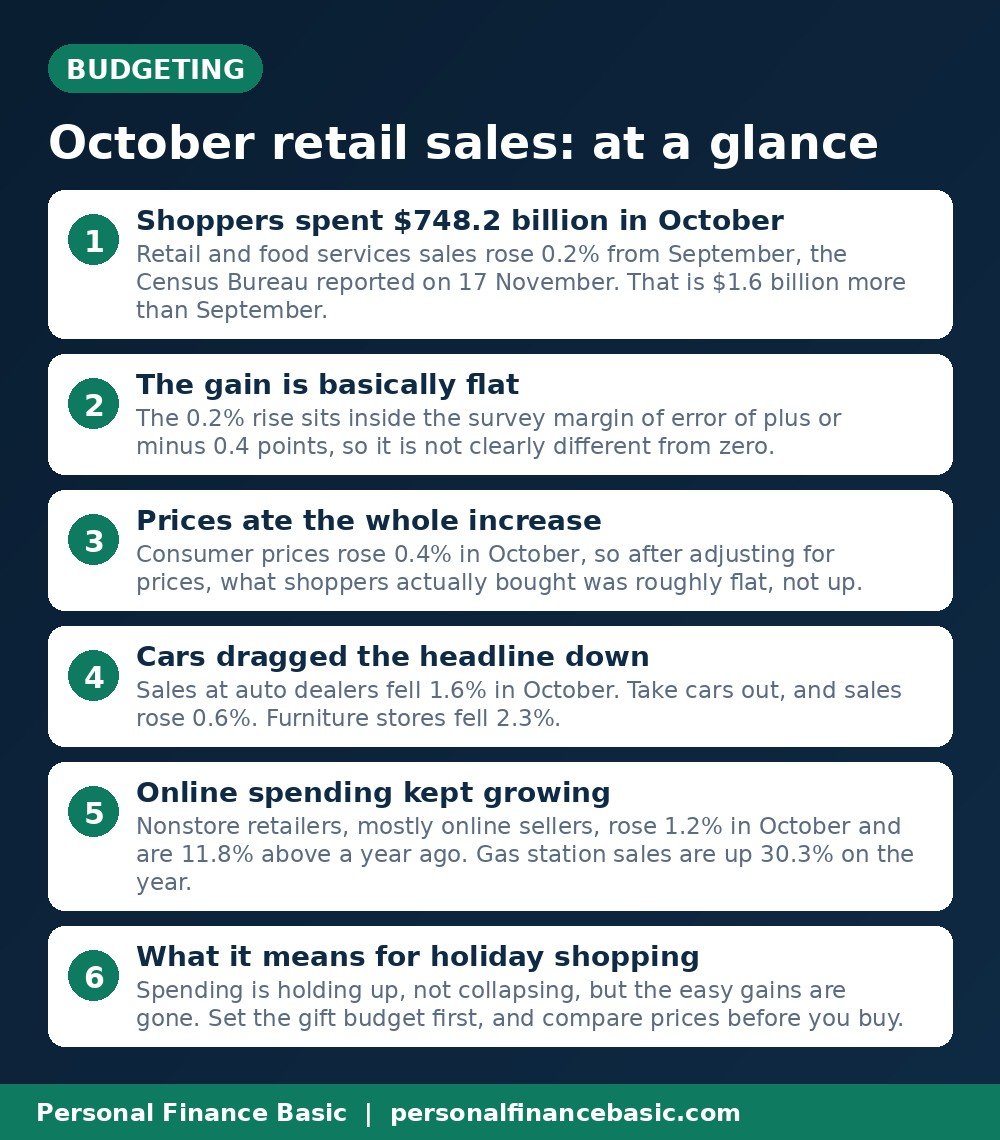
The main points from this guide, in one picture.
Frequently asked questions
What were retail sales in October 2026?
Retail and food services sales were $748.2 billion, up 0.2% from September and up 6.8% from October 2025, according to the Census Bureau’s advance estimate released on 17 November 2026. Sales excluding cars rose 0.6%.
Is a 0.2% rise good or bad?
Neither, on its own. The margin of error is plus or minus 0.4 points, so the rise is not clearly different from zero. Consumer prices rose 0.4% in the same month, so after prices, shoppers bought roughly the same amount.
Why did car sales fall?
Sales at motor vehicle and parts dealers fell 1.6% in October. Higher borrowing costs are the main reason: with mortgage rates near 7.3%, fewer buyers are taking on big monthly payments.
Does this mean a recession is coming?
One flat month does not say that. Jobs grew by 165,000 in October, unemployment is 4.1%, and spending is up 6.8% on the year.
The bottom line: Americans spent $748.2 billion in October, but after prices, they bought no more than in September. Cars and furniture slowed, online kept growing, and gas ate a bigger share. Decide the total first, then shop.
This post is general education, not financial advice. Retail sales are advance estimates and are revised.
Related reading: 41% of Americans Need Credit to Get Through November — and a Third Have No $1,000 Cushion and How to Cut Your Grocery Bill Without Feeling It