It is the same story every year. The car insurance bill lands in March, the car needs new brakes in June, and the holidays arrive in December with $600 of gifts to buy. Each bill is expected, yet each one breaks the month, because the money was never set aside.
Irregular bills are the bills that do not come every month: car insurance every six months, home repairs once or twice a year, holiday gifts, annual subscriptions, property tax. They are not surprises. The only surprise is the month they land in. Here is how to plan for them.
The short answer
List every bill that is not monthly, add up what it costs over a full year, divide by 12, and move that amount to a separate savings account on payday. One household in the example below has $5,440 of irregular bills a year, about $453 a month. Do that, and the bills stop being emergencies.
The quick framework:
- List every bill that is not monthly.
- Add up the full-year cost of each one.
- Divide the total by 12 to get your monthly amount.
- Move that amount to a separate account on payday.
- Review the list twice a year and fix the amount.
Quick decision guide:
- Want the simplest system? One shared pot for all irregular bills.
- One bill is much bigger than the rest? Give that one its own pot, like a $2,500 home repair fund.
- Just starting out? Begin with the three biggest bills and add the rest over a few months.
- Already use sinking funds? Irregular bills are exactly what sinking funds are for.
Step 1: List every bill that is not monthly
Go through a full year of bank statements and write down each bill that does not come every month. Most households find the same list: car insurance, home or renters insurance, car repairs, home repairs, holiday gifts, annual subscriptions, memberships and property tax.
Do not guess from memory: it misses the small ones, and they add up. An annual subscription, a yearly gym fee, a car registration fee: each is $50 to $200, and five of them are $250 to $1,000 a year.
Put a real number next to each one, using last year’s actual cost where you can. For repairs, use last year’s cost or a rule of thumb: many homeowners set aside 1% of the home’s value a year for upkeep, so a $250,000 home means about $2,500 a year. That is a planning guide, not a promise.
Step 2: Add them up and divide by 12
Here is one household’s list, as an illustrative example. Car insurance is $600 every six months, or $1,200 a year. Car repairs run about $900 a year. Home repairs, using the 1% rule on a $250,000 home, are $2,500. Holiday gifts are $600. Annual subscriptions are $240. The total is $5,440 a year.
Divide by 12 and the monthly number is $453.33, or about $453 a month. That is what this household needs to set aside so that no irregular bill breaks the budget. On a $3,000 monthly take-home pay, $453 is about 15% of income, a real chunk, but money that would have been spent anyway, just in lumps.
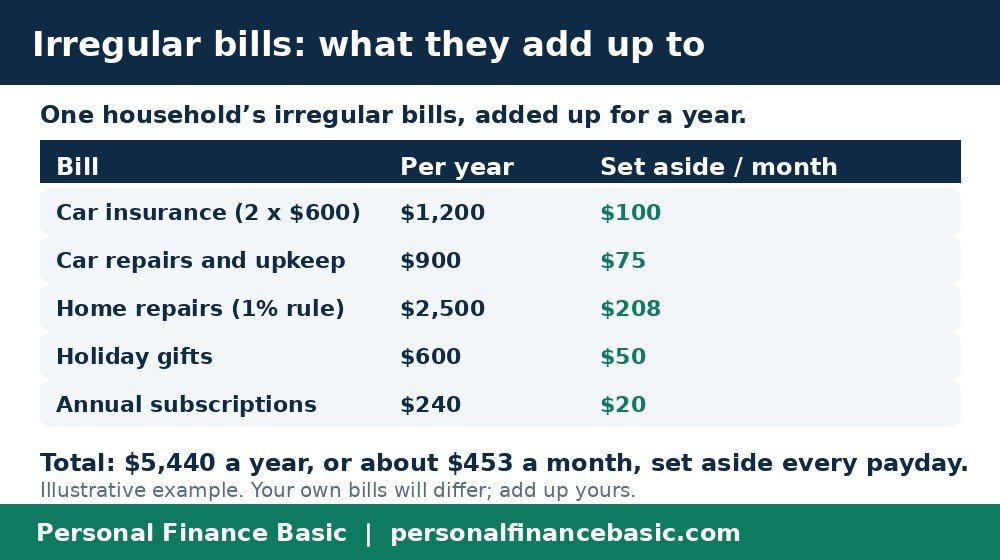
One household’s irregular bills, added up for a year. Your own bills will differ.
Step 3: Move the money on payday
The plan only works if the money leaves your spending account before you can spend it. Set up an automatic transfer for payday: the day your pay lands, your irregular-bills amount moves to a separate savings account. Treat it like a bill.
A separate account matters: money in your everyday account gets spent, while money in a separate savings account stays put until the bill arrives. Most banks let you open a second savings account for free and name it “irregular bills”.
If the full amount is too much to start, begin with half and raise it by $25 a month.
- Best for: anyone whose budget breaks two or three times a year on bills they knew were coming.
- Not for: true emergencies like a job loss; those need a separate emergency fund.
Step 4: One pot or one pot per bill?
Two ways to run the system, and both work. One shared pot is simpler: all $453 goes into one account, and every irregular bill comes out of it. The risk is that a big bill early in the year empties the pot, so start building it a few months before you rely on it.
Separate pots are tidier: one for car insurance, one for home repairs, one for gifts. You always know what each pot holds. The cost is more accounts to watch and more transfers, which is why most people only split out the biggest bill or two.
| Method | Effort | Risk | Best for |
|---|---|---|---|
| One shared pot | Low: one transfer | A big early bill can empty it | Most households |
| Separate pots | Medium: several transfers | Low: each bill has its own money | One bill much bigger than the rest |
| Pay when due, no plan | None until the bill lands | High: the bill breaks the month | Nobody, in the long run |
Illustrative comparison. The right choice is the one you will actually keep doing.
Step 5: Review the list twice a year
Bills change, and the plan has to change with them. A new car changes the insurance, a new home changes the repair budget, a cancelled subscription frees $15 a month. Re-add the list in January and July, and fix the monthly amount to match.
When a bill comes in lower than planned, leave the extra in the pot; it covers the bill that comes in higher. When a bill comes in much higher, top the pot back up over the next two or three months rather than pulling from your emergency fund.
At a glance
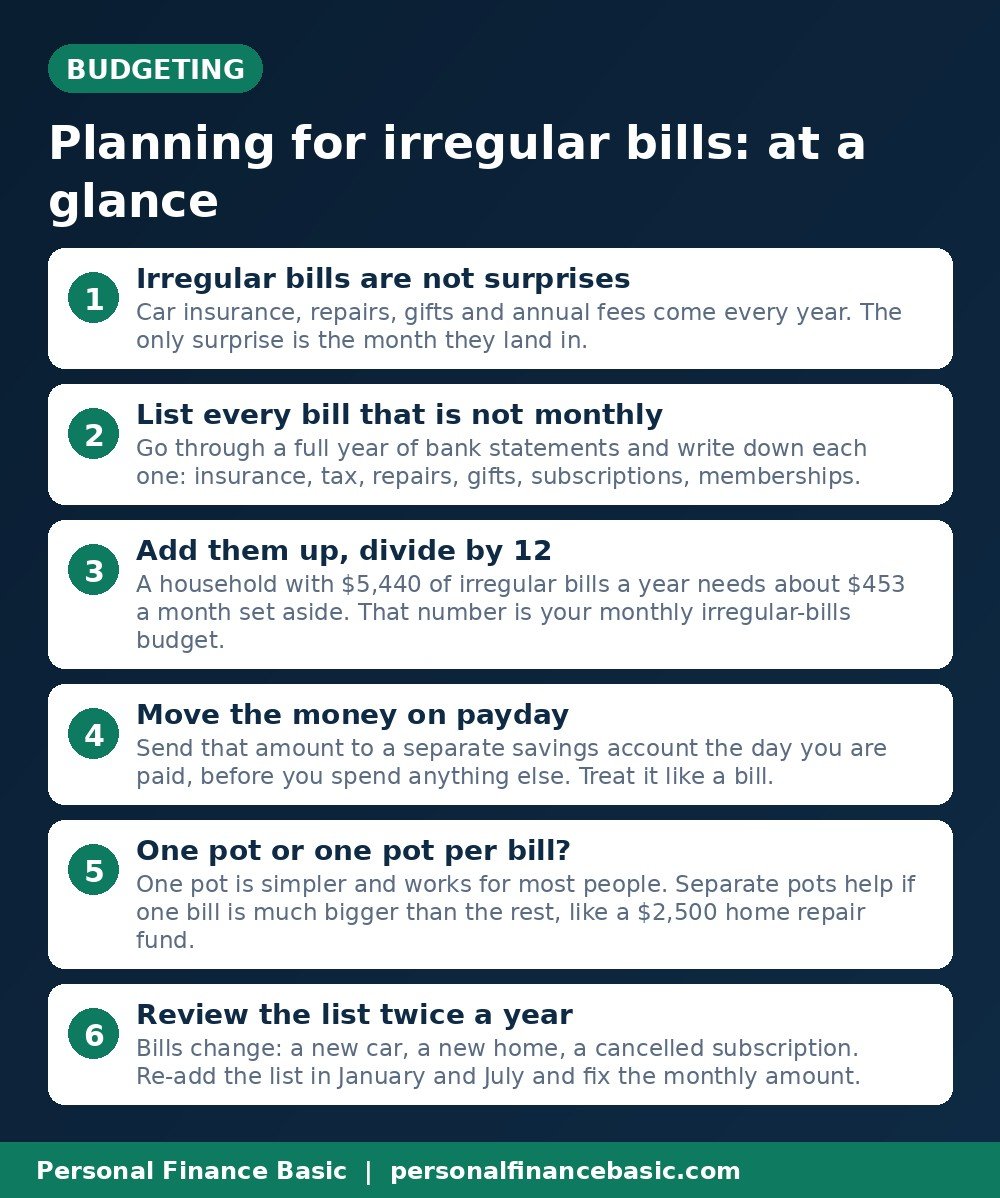
The main points from this guide, in one picture.
Frequently asked questions
What counts as an irregular bill?
Any bill that does not come every month but does come every year: car insurance, home repairs, holiday gifts, annual subscriptions, property tax, car registration and memberships. If it shows up on your bank statement once or twice a year, it belongs on the list.
How much should I set aside for home repairs?
A common rule of thumb is 1% of the home’s value a year, so a $250,000 home means about $2,500. Older homes often need more. Last year’s actual repair costs are a better guide if you have them.
Should irregular bills come from my emergency fund?
No. Irregular bills are expected, so they get their own pot. The emergency fund is for true surprises like a job loss or a major medical bill. Paying a known bill from it leaves you with less protection when a real emergency comes.
What if I cannot afford the full monthly amount yet?
Start with what you can, even half, and raise it by $25 a month. Cover the three biggest bills first, then add the rest.
How often should I update the list?
Twice a year, in January and July, or whenever a big bill changes. Re-add the list, divide by 12 again, and fix the automatic transfer to match.
The bottom line: irregular bills are not surprises, just bills with a longer gap between them. List them, add them up, divide by 12, and move that amount aside on payday. The household in the example needs about $453 a month; your number will differ, but the method is the same.
This post is general education, not financial advice. The $5,440 example is illustrative; add up your own list before setting your monthly amount.
Related reading: Sinking Funds: What They Are and How to Start One and Zero-Based Budgeting: How It Works, Step by Step