You need to send $5,000 to someone. Your bank offers two ways to do it: an ACH transfer, which is free and takes a day or two, or a wire transfer, which costs about $30 and arrives today.
Both move money from one bank account to another. The difference is speed, cost, and what happens if something goes wrong. The ACH network moved 33.6 billion payments worth $86.2 trillion in 2024, according to Nacha. Wires moved far fewer payments, but far larger ones.
Here is how to pick the right method for each payment, and the one mistake that can lose your money for good.
The short answer
Use ACH for routine payments: rent, bills, payroll and money between your own accounts. It is free or nearly free, and 1 to 3 business days is fast enough. Use a wire only when the money must arrive today, or the amount is too large for ACH limits.
The quick framework:
- Decide how fast the money must arrive.
- Check the fee before you send anything.
- Verify the account details twice for a wire.
- Keep the confirmation for every transfer.
- Match the method to the job, not the habit.
Quick decision guide:
- Paying rent, a bill or a friend? Use ACH. It is free and fast enough.
- Need it there today, no excuses? Use Same-Day ACH first, or a wire if the amount is large.
- Sending a house deposit or a car payment? Use a wire, and verify the details by phone.
- Sending money abroad? A wire is usually the only option, and it costs more.
Step 1: Decide how fast it must arrive
Standard ACH takes 1 to 3 business days. Your bank sends the payment in a batch with thousands of others, and it settles on the next business day or the one after. That is fine for a bill due next week, not for a payment due today.
Same-Day ACH is the middle option. It settles the same day if you send it before the cutoff, and it is capped at $1 million per payment. It handled 1.24 billion payments in 2024, up 45% on the year before.
A domestic wire arrives the same business day if you send it before the cutoff, usually mid-afternoon. International wires take 1 to 2 business days. The Federal Reserve’s Fedwire system moved about $1,133 trillion in 2024 in only about 199 million transfers: wires are for large, urgent payments.
- Best for: ACH for anything due in 2 or more days, Same-Day ACH for same-day needs under $1 million.
- Not for: assuming a Friday payment arrives on Saturday. It will not.
Step 2: Check the fee before you send
The cost gap is the biggest difference between the two methods. A standard ACH transfer is often free for consumers. Some banks charge a few dollars for an outgoing ACH, and some charge nothing at all.
A domestic wire typically costs $15 to $35 to send, and the receiver often pays about $15 too. International wires cost about $35 to $65, plus a receiving fee and sometimes a currency conversion charge.
That fee adds up. Pay a vendor $1,500 a month by wire at $30 a time, and you spend $360 a year on fees. Send the same $1,500 by ACH and the cost is usually zero.
Take the $5,000 example from the start. By ACH, the full $5,000 arrives and the cost is $0. By wire, you pay about $30 to send it and the receiver may pay about $15, so $45 disappears on a payment that did not need to be instant.
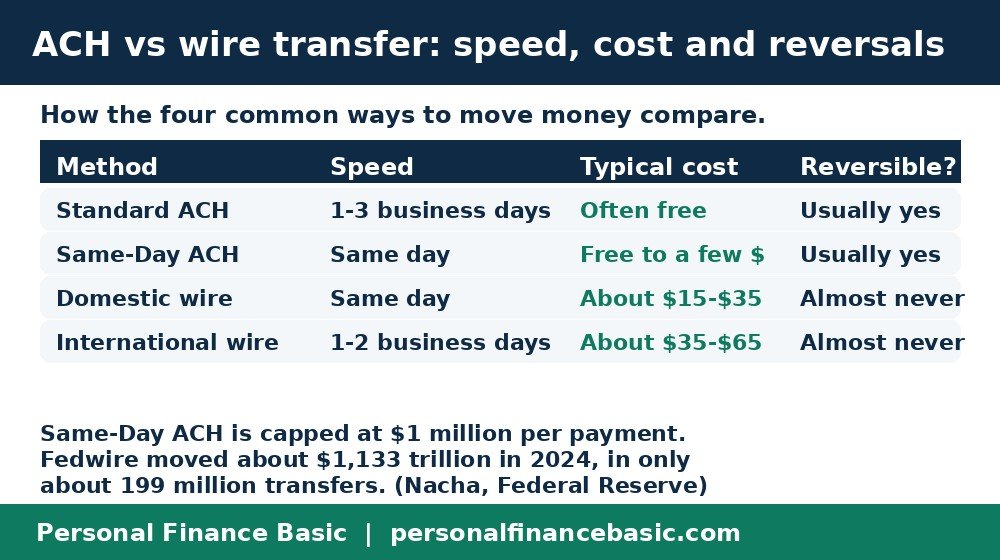
ACH vs wire transfer: speed, cost and reversals.
- Best for: ACH for anything recurring. The fee saving is the whole point.
- Not for: paying a $30 wire fee on a payment that could wait two days.
Step 3: Verify the details twice, especially for a wire
A wire is almost impossible to reverse. Once it settles, the money belongs to the receiving account, and your bank cannot pull it back. Type one digit wrong and the money can go to a stranger, and getting it back can take weeks or may never happen.
ACH is safer here. A payment sent by mistake can usually be reversed or returned if you catch it quickly.
For any wire, check the details twice. Then call the receiver on a number you already have, not a number in the same email that gave you the account details, and read the numbers back to them.
For a first payment to a new person or business, send a small test amount first if the situation allows it. A $10 test that arrives safely is cheap insurance on a $10,000 payment.
- Best for: a wire only after you have verified the details by phone.
- Not for: sending a wire from instructions in an email you were not expecting.
Step 4: Keep proof of every transfer
Every transfer leaves a trail, and you should keep it. Save the confirmation number, the date, the amount and the receiving account’s name. For rent and bills, that record is your proof of payment.
For ACH, your bank statement shows the payment and the date it settled. For wires, keep the wire confirmation too, because it shows the exact time the money left your account.
If a payment does not arrive when it should, call your bank with the confirmation number in hand. For ACH, the bank can trace the payment through the network.
- Best for: keeping a confirmation for every payment over $500.
- Not for: trusting your memory about whether a payment went out.
At a glance
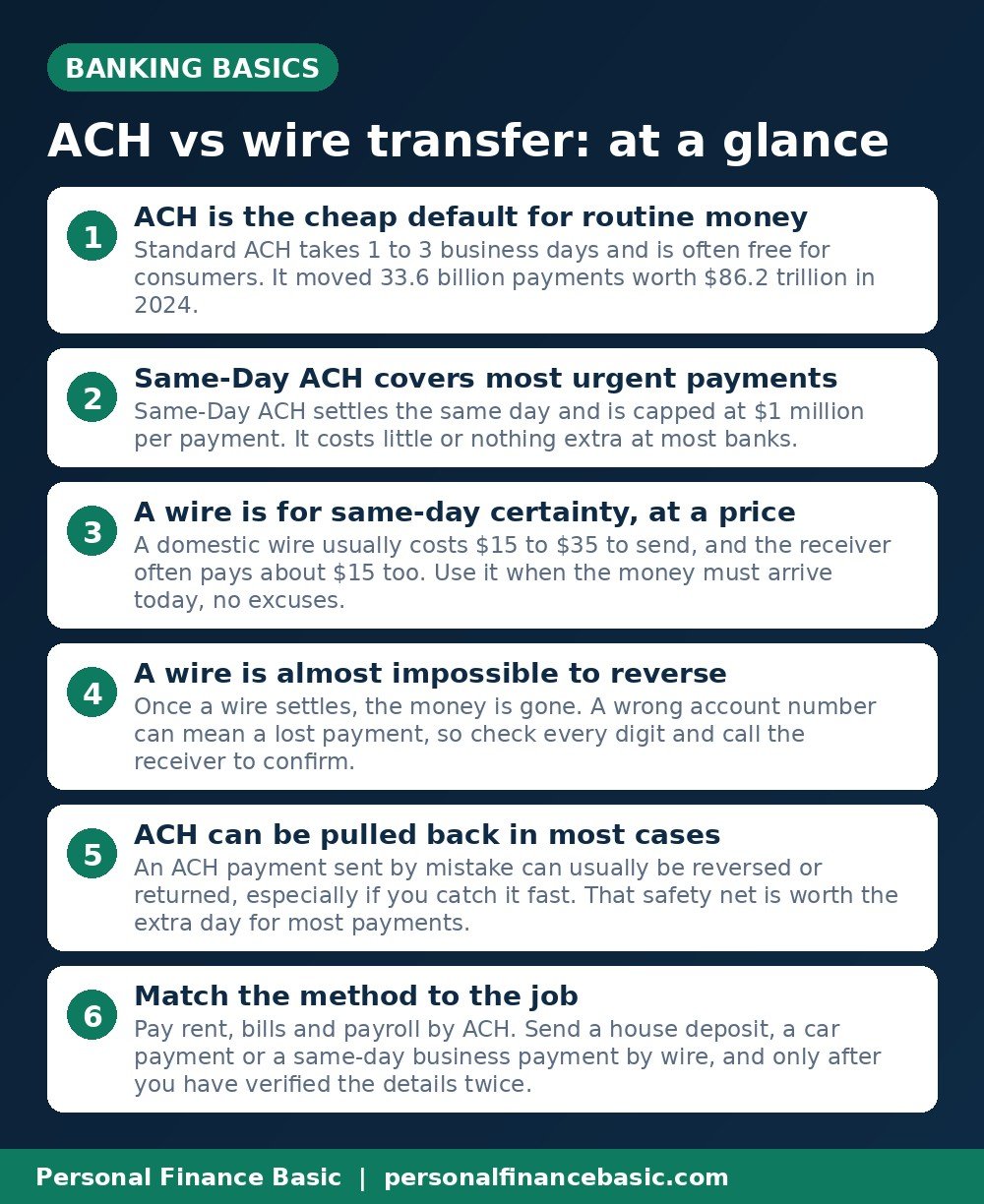
The main points from this guide, in one picture.
Frequently asked questions
How long does an ACH transfer take?
A standard ACH transfer takes 1 to 3 business days. Same-Day ACH settles the same day if you send it before the cutoff. Weekends and holidays do not count, so a payment sent on Friday evening may not settle until Tuesday.
How much does a wire transfer cost?
A domestic wire typically costs $15 to $35 to send, and the receiver often pays about $15 to receive it. International wires cost about $35 to $65 to send, plus a receiving fee and sometimes a currency conversion charge.
Can I reverse a wire transfer?
Almost never. Once a wire settles, the money belongs to the receiving account and your bank cannot pull it back. An ACH payment sent by mistake can usually be reversed or returned if you catch it quickly, which is one reason to prefer ACH.
What is the Same-Day ACH limit?
Same-Day ACH is capped at $1 million per payment. It settles the same day and costs little or nothing extra at most banks.
Is ACH or wire better for paying rent?
ACH is better for rent. It is free, it arrives in 1 to 3 business days, and it can be reversed if something goes wrong. A wire costs about $30 each month for no benefit, unless your landlord demands same-day payment.
The verdict
ACH is the right choice for almost every payment you make: it is free, it is fast enough, and it can be fixed if something goes wrong. Save wires for the payments that truly must arrive today or are too large for ACH limits, and verify the details twice before you send one.
If you want to set up regular payments from your paycheck, read our guide to direct deposit, and if you are choosing where to keep the money, see checking vs savings accounts.
This post is general education, not financial advice. Fees and cutoffs vary by bank; check your own bank’s schedule and fee list before you send a transfer.